
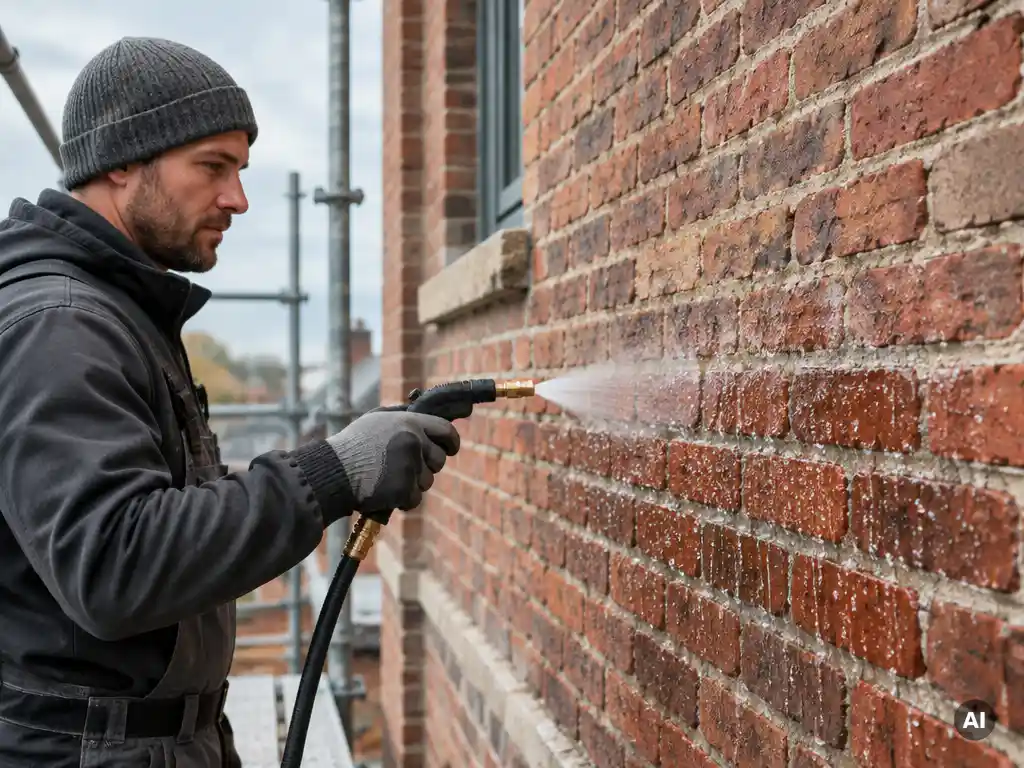
For the professional water-repellent treatment of brick facades, you use a vapor-permeable impregnating agent based on a combination of alkylsilanes and (poly)siloxanes. This agent penetrates the pores of the brick and makes the facade water-repellent, while moisture from the wall can still evaporate. The right choice depends on the absorbency, the moisture content and the condition of the facade.
Below, we walk through the questions you need to answer as a specialist before choosing and applying a facade impregnating agent.
Which active ingredient suits brick: silane or siloxane?
For brick, a combination of alkylsilanes and (poly)siloxanes works best. Silanes are small molecules that penetrate deep into the stone. Siloxanes are larger components that form a water-repellent layer in the pores. Together they provide depth and a stable effect at the surface.
Why that combination? A silane on its own penetrates deeply, but on an open, highly absorbent substrate it can partly disappear. A siloxane on its own stays closer to the surface. An impregnating agent with both components combines those properties and therefore suits the variation you encounter in brickwork. Also make sure the agent remains vapor-permeable. A facade must be able to release moisture from the structure; otherwise you trap moisture in the wall.
Different manufacturers use different ratios and carriers. Always check the product data sheet for the exact composition, its suitability for brick and the recommended consumption figures.
Which properties of the brick and facade should the choice be based on?
Base your choice on four points: the absorbency of the brick, the moisture content of the facade, the condition of the joints and brickwork, and exposure to the weather. Each point determines which impregnating agent is suitable and how much you need.
- Absorbency and porosity: Highly absorbent brick takes up more product than a dense, hard-fired brick. This affects consumption and the choice of active ingredient.
- Moisture content: Impregnating a facade that is still damp traps moisture inside. Measure the moisture content before you start and allow the facade to dry sufficiently.
- Condition of the joints and brickwork: Repair cracks, open joints and loose bricks first. An impregnating agent does not bridge structural defects.
- Weather exposure: A facade on the weather side of a building with a lot of driving rain requires more attention than a sheltered facade.
Also check whether the substrate contains calcareous components or has been treated before. Earlier coatings or impregnations affect the absorption of a new agent. If in doubt, first carry out a test patch in an inconspicuous spot.
What needs to be done to the facade before applying the water-repellent treatment?
Before the water-repellent treatment, the facade must be clean, dry and repaired. Remove dirt, algae and deposits, repair damaged pointing and allow the brickwork to dry completely. An impregnating agent only adheres and works well on an open, clean substrate.
Begin with an inspection: look for cracks, loose joints, leaks and damp patches. Repair those defects first, otherwise you lock a problem in behind a water-repellent layer. Then clean the facade with an agent suited to the type of soiling. You can find more information about professional facade cleaning on our website.
For heavily soiled mineral substrates, we use Facadeclean, for example, an acidic facade cleaner based on ammonium bifluoride. Facadeclean can attack calcareous types of stone, so check the substrate first. For vertical surfaces there is Facadeclean Gel, which, thanks to its gel form, does not drip easily and stays in contact with the surface longer. After cleaning, rinse the facade thoroughly and let it dry completely before you impregnate. Always follow the product data sheet for contact time and rinsing pressure.
How is an impregnating agent applied professionally?
Specialists apply an impregnating agent to a clean, dry facade with a low-pressure sprayer, roller or brush, in saturated passes from bottom to top. The substrate must absorb the product well. Follow the instructions on the product data sheet for consumption, number of coats and weather conditions.
In practice, the procedure runs as follows:
- Protect the surroundings: Cover glass, window frames, metal and plants where the product should not end up.
- Check the conditions: Apply the agent only in the weather conditions permitted by the product data sheet, and not on a damp or frost-prone facade.
- Apply the product to saturation: Work in passes and make sure the brick absorbs enough. Avoid puddling and drip marks.
- Work wet-on-wet where the product data sheet recommends it: This way the agent penetrates deep into the substrate.
- Allow the facade to dry and cure: Do not rinse or load the surface until the recommended time has elapsed.
You can read more about facade impregnation and water-repellent treatment on our application page. Besides water repellency, do you also want to protect the facade against graffiti? An anti-graffiti coating can take over the function of facade impregnation, so do not combine the two as standard. Take a look at our graffiti removers for removing existing graffiti.
How long does facade impregnation last and how do you check that it is working?
Facade impregnation generally lasts up to ten years, unless the product data sheet states a different service life. The actual service life depends on the substrate, the weather exposure and the workmanship. You check its effectiveness by looking at whether water still beads off the surface.
You can do a simple check with water: spray or sprinkle water on the facade and see whether it beads off or soaks into the stone. If the water clearly soaks into the brick, the water-repellent effect is diminishing. Also watch for damp patches, algae growth and discoloration, especially on the weather side. Inspect the facade periodically and after severe weather.
If the effect is diminishing, have a specialist assess whether re-impregnation is worthwhile. Clean the facade again before a new treatment and follow the product data sheet for the pretreatment.
How we help with the water-repellent treatment of brick facades
We support specialists at every step of the facade process, from cleaning to protection. Our range and our technical knowledge help you apply the right agent to the right substrate.
- Facade cleaners: Facadeclean and Facadeclean Gel for heavily soiled mineral substrates, including brick.
- Technical advice: Our technical advisors and R&D department think along with you about your project and the choice of system.
- Product information: For each product we supply a technical data sheet with instructions for use and safety instructions.
- Free sample: You can first test Facadeclean Gel on your own project.
- Quality: We are ISO 9001 certified for products and advice.
Do you have a question about impregnating or cleaning a brick facade? Get in touch with us or call +31 (0) 418 680 680. We would be happy to help.