
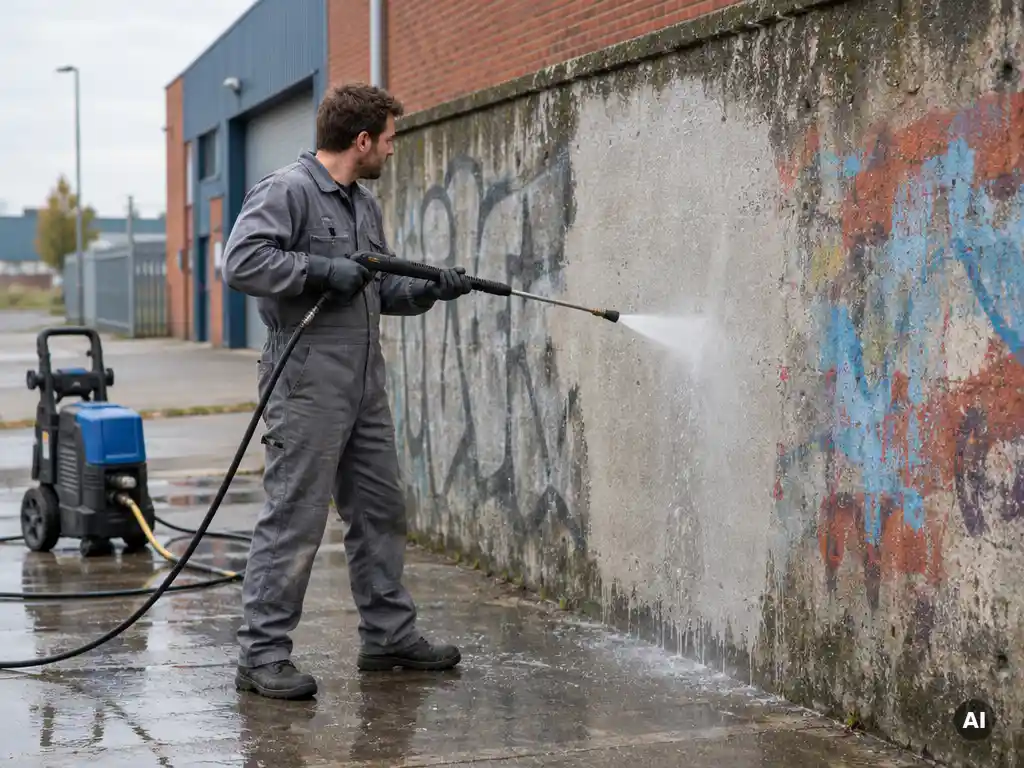
The right graffiti remover for a business site depends on the surface, the type of graffiti and the desired finish. For porous surfaces such as concrete and brick, choose a gel-type remover; for sensitive surfaces such as traffic signs, choose a milder variant. Specialists match the product to the situation on site.
A business site rarely consists of a single material. Fencing, facades, containers and signage each call for their own approach. Below you can read which questions to answer before you choose a product.
Which surface determines the choice of graffiti remover?
The surface has the greatest influence on the choice, because porous materials such as concrete and masonry absorb graffiti more deeply than non-porous surfaces such as metal or glass. So first look at the porosity, the sensitivity and the location of the surface before you select a graffiti remover.
On a business site you will usually encounter these surfaces:
- Concrete and brick: porous, so paint soaks in and often leaves ghost marks behind. For vertical surfaces such as facades and masonry, a gel-type remover is suitable, because the gel stays on the surface.
- Metal: non-porous, but not every product is suitable. Shadow Remover Strong can damage metal surfaces, so always check the product data sheet.
- Sensitive surfaces: think of traffic signs and acrylic glass. Graffiti Remover Extra Lite was developed for these.
- Natural stone: not every natural stone reacts the same way to acidic or alkaline agents. Granite is a natural stone, but that says nothing about how other types of stone react.
If in doubt, always do a test patch. That way you can see before the full treatment whether the surface tolerates the product. For an overview of available graffiti removers by surface, you can consult our product range.
Which types of graffiti require a different approach?
Graffiti differs in paint type and ink, and the stubbornness of ghost marks also differs per surface. A standard graffiti remover dissolves the paint layer itself, whereas residual discoloration in porous surfaces requires a separate product. So you adapt your approach to what remains after the first cleaning.
On a business site you will roughly see three situations:
- Fresh paint and markers on smooth surfaces: a gel-type graffiti remover dissolves the paint. For quick touch-ups during inspection rounds, Graffiti Remover Wipes are intended, for doors, waste bins and electrical cabinets, among other things.
- Paint on vertical, porous surfaces: Graffiti Remover Gel Strong is intended for vertical surfaces such as brick, facades and concrete.
- Ghost marks after removal: on concrete and masonry, discoloration often remains. Shadow Remover Strong was developed for the most stubborn ghost marks and contains sodium hypochlorite, among other things, which gives it a strong bleaching effect.
Are you dealing with residual discoloration? Then read more about removing graffiti ghost marks. If you also have vehicles or rolling stock on your site in addition to buildings, take a look at the approach for removing graffiti in public transport.
How do you choose a safe and environmentally friendly graffiti remover?
You choose a graffiti remover based on the product documentation: the product data sheet and the safety data sheet tell you which surfaces the product is suitable for, which protective equipment you need and what the properties of the product are. A product claim alone is not sufficient substantiation, so always check the technical data.
When comparing, pay attention to these points:
- Composition: Shadow Remover Strong, for example, contains sodium hypochlorite and has a strong bleaching effect. That calls for different precautions than a milder remover.
- Personal protection: products can cause severe burns and permanent eye damage. So wear suitable gloves, protective clothing and safety goggles.
- Product-specific data: some products have demonstrable properties, such as Graffiti Remover RS, which is biodegradable according to OECD Test 302B. Such a property says something about biodegradability, not automatically anything about safety or mildness.
- Storage and shelf life: Shadow Remover Strong contains bleach and therefore has a shelf life of approximately 6 to 12 months. Graffiti Remover RS has a shelf life of at least 24 months in unopened packaging.
If in doubt, always consult the safety data sheet or our R&D department.
How do you remove graffiti step by step without causing damage?
You remove graffiti without causing damage by first treating a test patch, applying the product undiluted, letting it work and then rinsing it off. Always follow the product data sheet for each product, because contact time, rinsing pressure and temperature differ per remover.
As an example, here is the procedure for Shadow Remover Strong, as stated in the product data sheet:
- Do a test patch and check whether the surface tolerates the product.
- Apply the product undiluted with a brush or chemically resistant scrubbing brush in a thick layer.
- Let the product work for a few minutes.
- Spray away the ghost marks using suitable pressure and hot water (40 to 90 °C).
- If the result is insufficient, let the product work for 4 hours up to several days and cover with plastic film to prevent it from drying out.
Also keep the practical points in mind: do not mix products with other agents, be careful with acidic products and do not apply anything on hot surfaces or in full sun. Low temperatures can slow down the effect, so adjust the contact time accordingly. When using indoors, ensure sufficient ventilation. For facades and buildings on your site, our page on removing graffiti from buildings provides additional context. Preferably have the work carried out by specialists.
When is an anti-graffiti coating smarter than removing graffiti again and again?
An anti-graffiti coating is smarter when the same spots are repeatedly vandalized. A coating makes graffiti easier to remove and reduces the chance of ghost marks, so on recurring hotspots you spend less time and cleaning agent than with repeated removal alone.
With graffiti protection you distinguish between two types:
- Semi-permanent coating: this disappears when graffiti is removed and must then be reapplied.
- Permanent coating: this withstands multiple cleaning rounds. The number differs per system.
Graffitiguard Permanent is an impregnating agent with anti-graffiti properties. Anti-graffiti coatings can also take over the function of facade impregnation, so we do not recommend the combination as standard. If facade impregnation is desired after all, it involves a combination of alkylsilanes and (poly)siloxanes. The lifespan of a coating is generally a maximum of ten years, unless product-specific information indicates otherwise.
For graffiti prevention, you therefore look at the frequency of attacks, the surface and the maintenance budget. A porous concrete wall that is vandalized every quarter calls for a different choice than a fence that was damaged once.
When is professional support or training needed?
Professional support is needed when you are unsure about the surface, when strong products containing bleach or a high pH are used, or when you have a recurring graffiti problem. Specialists assess the situation on site and train your team in safe, correct application.
These situations in particular call for advice:
- You are not sure whether a product is suitable for a sensitive or unknown surface.
- A remover contains components that can cause severe burns and permanent eye damage.
- You want to set up a fixed maintenance plan for a large business site.
- You are hesitating between removal, impregnation or an anti-graffiti coating.
Keep in mind that the user always remains responsible for product choice, application and result. Good preparation and expert advice reduce the risk of damage.
How Mavro helps with graffiti removal on your business site
We develop, produce and test graffiti removers in-house and are ISO 9001 certified. That way you will find a suitable product with us for different surfaces and situations, with advice included.
- A wide range of graffiti removers, from gel to wipes, for concrete, brick, facades and sensitive surfaces, among other things
- Products for ghost mark removal, such as Shadow Remover Strong, for stubborn discoloration on porous surfaces
- Anti-graffiti coatings for recurring hotspots
- Technical advice from our R&D department and training in product application
Would you like to know which graffiti remover suits your business site? Contact us or call +31 (0) 418 680 680. We are happy to help.