
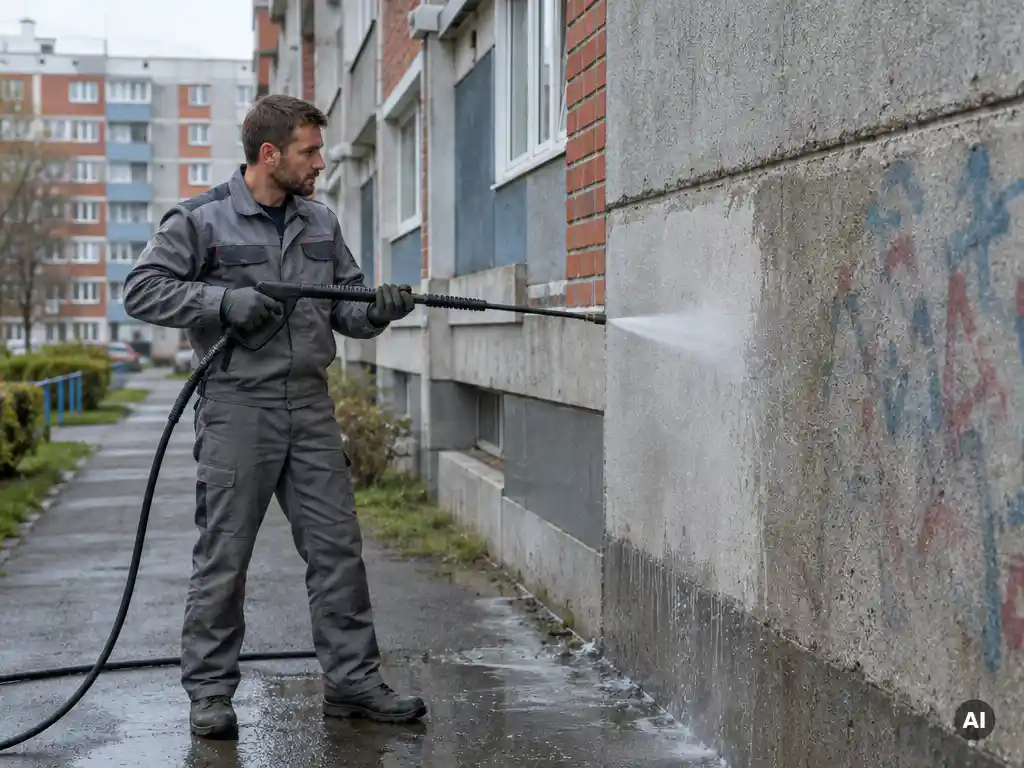
For large-scale property maintenance, you choose a graffiti remover based on the surface, the type of graffiti, and the working method. Gel-type removers work well on vertical surfaces such as facades, brickwork, and concrete. For ghosting that remains, use a separate shadow remover. Always check the product data sheet before using a product on a specific surface.
Below, you will read which questions you, as a property manager or specialist, need to answer before choosing a graffiti remover, and how to organize the approach on a large scale.
Which surface determines the choice of graffiti remover?
The surface determines which product you can use, because porous and sensitive materials react differently to solvents and alkaline agents. In property maintenance, this often involves brick, concrete, natural stone, metal, glass, and plastic. For each surface, choose a product that is intended for it.
Porous surfaces such as brickwork and concrete absorb paint and ink. That is why a gel-type remover works well here: the gel stays put on vertical surfaces and has time to work. Our Graffiti Remover Gel Strong is intended for vertical surfaces such as brick, facades, and concrete and is applied undiluted.
Sensitive surfaces call for a milder formulation. We developed the Graffiti Remover Extra Lite for traffic signs and plexiglass. For doors, waste bins, and electrical cabinets, you use the Graffiti Remover Wipes, handy to take along on a maintenance round.
Be careful with general assumptions about natural stone. Not every natural stone reacts the same way to acids or alkaline agents, even though they fall under the same label. Therefore, always test first in an inconspicuous spot and consult the product data sheet.
Which type of graffiti requires which remover?
The type of graffiti determines the remover: you remove paint and ink with a graffiti remover, while remaining discoloration requires a shadow remover. Much graffiti leaves a shadow behind after the first cleaning, because pigments have been drawn into the surface.
For shadows, we offer several products, each with its own application:
- Shadow Remover Strong: a strongly alkaline product with a bleaching effect on pigments, suitable for many surfaces and in particular for natural stone. You apply it undiluted and rinse it off with hot water after a few minutes. The product contains sodium hypochlorite and sodium hydroxide.
- Shadow Remover Gel: a gel for graffiti shadows, which you rinse off with high-pressure water (70 to 150 bar) and hot water.
You can read more about this approach on our page about removing graffiti shadows. Never mix these products with other agents and watch out for acidic products. On rolling stock, you use a different solution, such as the Graffiti Remover RS. This is a gel-type remover for trains, buses, and metros. See the public transport application for details.
How do you approach graffiti removal on a large scale?
On a large scale, a fixed approach works best: take stock of the locations, determine the right product for each surface, have specialists carry out the work, and record what you use. This keeps results, safety, and costs manageable across multiple properties.
- Take inventory: map the surface, type of graffiti, and area per location.
- Choose per surface: use a gel-type remover for facades and concrete, and a milder variant for sensitive surfaces.
- Test first: try it in an inconspicuous spot before treating the entire surface.
- Remove the graffiti: follow the product data sheet for application, dwell time, and rinsing.
- Treat shadows: tackle remaining discoloration separately with a shadow remover.
- Protect the result: where possible, apply an anti-graffiti coating.
Use professional specialists for this work. They know the working method, wear the right protective clothing, and take into account conditions such as temperature and direct sunlight, which are noted on product data sheets. For facades, you can find more information about removing graffiti from buildings.
What are the requirements for environmentally friendly and safe graffiti removers?
A graffiti remover must meet the requirements of your project and the safety instructions on the product data sheet. A stated property, such as biodegradability, says something about the product, but does not automatically make it milder or safer.
When choosing, pay attention to these points:
- Product-specific data: check what the product data sheet demonstrates. For example, Graffiti Remover RS is biodegradable according to OECD test 302B.
- Safety instructions: some products, such as Shadow Remover Strong, can cause severe burns and permanent eye damage. Always wear suitable gloves, protective clothing, and safety goggles.
- Safety data sheet: consult it if in doubt, or contact our R&D department.
- Storage and shelf life: store products in a cool, frost-free place and pay attention to the shelf life.
Our starting point is simple: we make no claims that we cannot substantiate. For application and safety, we always refer to the product data sheet and the label.
How do you prevent graffiti from returning again and again?
You limit recurring graffiti with an anti-graffiti coating. It makes graffiti easier to remove, so you spend less time and resources per cleaning. No coating can prevent graffiti entirely, but you make the result less appealing to vandals.
There are two main types. A semi-permanent anti-graffiti coating disappears when graffiti is removed and you then have to reapply it. A permanent anti-graffiti coating withstands multiple cleanings, although the number differs per system. Graffitiguard Permanent is an impregnating agent with anti-graffiti properties.
Anti-graffiti coatings can take over the function of a facade impregnation, so a combination of both is not normally necessary. If you still want to apply a facade impregnation, it is usually a combination of alkylsilanes and (poly)siloxanes. The service life of a coating is generally a maximum of ten years, unless the product data sheet states otherwise. One of our clients had a facade cleaned first on a facade project and then applied a colorless coating, so that the facade was protected against new graffiti.
When do you choose a supplier that offers advice?
You choose a supplier that offers advice as soon as you are working with multiple surfaces, sensitive materials, or large areas. A wrong product choice can cause damage to the surface. An advisor helps you determine the right product and the right working method before you start.
Advice is especially useful in these situations:
- your properties consist of different materials, such as natural stone, concrete, and metal
- you are not sure how a surface reacts to an alkaline or acidic product
- you want to combine a cleaning approach with an anti-graffiti coating
- you are looking for a solution for a situation for which no standard product exists yet
How Mavro helps with graffiti removal in large-scale property maintenance
We develop and produce our graffiti removers in-house and support you in the selection and application. This is how we help you arrive at a working method that suits your properties:
- a broad range of graffiti removers for facades, sensitive surfaces, and rolling stock
- separate products for graffiti shadows
- anti-graffiti coatings to remove new graffiti more quickly
- advice from our technical advisors and R&D department, even when no standard solution exists yet
- training and support in the application of our products
Would you like to know which graffiti remover suits your project? Contact us or call us on +31 (0) 418 680 680. We would be happy to think along with you.