
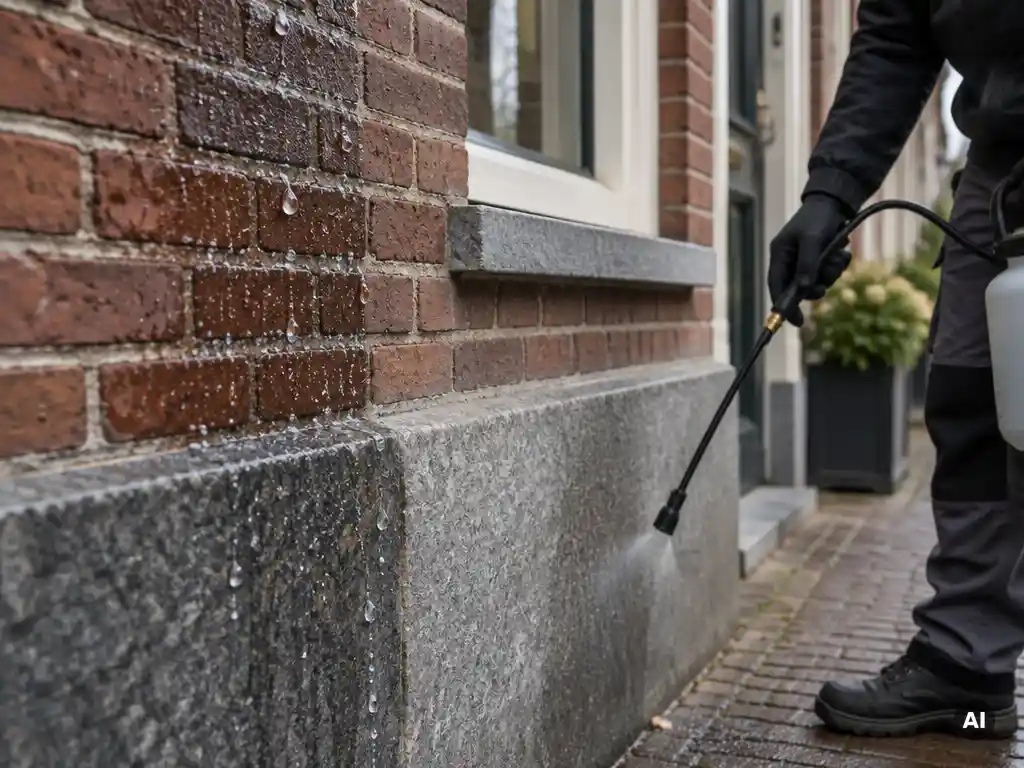
Brick, natural stone, concrete and calcium silicate brick are the facade materials that benefit most from facade impregnation. The prerequisite is that the material is porous enough to absorb the active components. Non-porous materials such as glazed ceramics or metal are not suitable. In this article, we answer the most frequently asked questions about which facade materials are and are not suitable for impregnation.
Which facade materials benefit most from impregnation?
Porous mineral facade materials benefit most from facade impregnation. Think of brick, concrete, natural stone, calcium silicate brick and untreated plasterwork. These materials absorb the active components, usually a combination of alkylsilanes and (poly)siloxanes, deep into the substrate and form a water-repellent barrier inside it without sealing the surface.
The extent to which a material benefits depends on the porosity, the structure and the condition of the facade. The more open the structure, the deeper the impregnation can penetrate and the more effective the water repellency. On well-impregnated facades, the surface repels moisture, which counteracts mould growth, frost damage and soiling. For professional specialists, it is therefore useful to assess for each project which material they are dealing with.
You can find more information about the possibilities on the page about facade impregnation and hydrophobing.
How does facade impregnation work on porous substrates?
Facade impregnation works by letting the active components, alkylsilanes and (poly)siloxanes, soak deep into the pores of the material. There they react with the substrate and form a hydrophobic layer that repels moisture but remains vapour-permeable. The surface hardly changes in appearance, but its behaviour towards water changes fundamentally.
Alkylsilanes are smaller molecules that penetrate deep into the pores and react chemically with the substrate. Siloxanes are larger molecules that work more at the surface and form a physical water-repellent film. Together they provide broad and durable protection. The service life of an impregnation system is generally up to ten years, depending on the environmental conditions and the system used.
The moisture content of the substrate is important for the application. Too high a moisture content impedes the penetration and adhesion of the impregnation. Specialists check this before treatment. Always consult the product data sheet for the specific application requirements.
We’ll find the answer for you!
Want to talk through your challenge?
Our advisers will gladly help you with a practical solution.
Is brick suitable for impregnation?
Yes, brick is well suited to facade impregnation in most cases. Brick has an open, porous structure that allows alkylsilanes and siloxanes to penetrate. The impregnation protects the brickwork against moisture penetration, soiling and frost damage without blocking vapour permeability.
There are, however, points to watch. Heavily weathered or damaged bricks can be impregnated less effectively because the structure has become too open or too uneven. The joints also deserve attention: porous jointing mortar absorbs the impregnation, but damaged or missing joints must be repaired first. A thorough facade cleaning before impregnation is always useful, so that the pores are free of dirt, algae and other growth that impede penetration.
What makes natural stone particularly suitable for facade impregnation?
Natural stone is particularly suitable for facade impregnation because the material is naturally porous and at the same time susceptible to moisture damage, soiling and biological growth. The impregnation penetrates deep into the stone structure and protects the material from the inside, without sealing the surface or changing its appearance.
Not every natural stone reacts in the same way, however. Sandstone and limestone are generally highly porous and absorb impregnating agents well. Denser types of stone such as granite have a lower porosity, which limits penetration. Specialists assess for each type of stone and each project whether impregnation is the right choice and which system best matches the properties of the stone. Never make absolute statements about the suitability of a type of stone without having assessed the specific substrate.
Which facade materials are not suitable for impregnation?
Non-porous facade materials are not suitable for facade impregnation. The active components cannot penetrate the material, so the impregnation gets no grip and does not work. This category includes glazed ceramic tiles, metal facade cladding, glass and dense plastic panels.
Facades that have already been treated with a film-forming coating, such as a layer of paint or lacquer, are also in most cases not immediately suitable for impregnation. The existing layer blocks penetration. In that case, a different approach is needed, depending on the material and the desired protection. For non-porous facade cladding and window frames, semi-permanent or permanent coatings offer a better solution than impregnation.
How do you know if a facade is ready for impregnation?
A facade is ready for impregnation when the surface is clean, dry and structurally intact. That means: no algae, moss, dirt or loose parts, a moisture content that falls within the requirements of the product to be used, and no damage that must be repaired first.
Specialists generally carry out a number of practical checks:
- Measuring the moisture content of the substrate with a moisture meter
- Visual assessment for cracks, loose joints or damage
- Checking whether the facade has previously been treated with a coating or impregnation
- A water droplet test to assess the current water repellency of the surface
If the surface is still water-repellent from a previous treatment, a new impregnation will not penetrate well. If the facade is soiled, professional cleaning is the first step. For the exact requirements, always consult the product data sheet of the impregnating agent to be applied.
How Mavro helps with facade impregnation and protection
We offer professional solutions for the protection and renovation of facades, tailored to the specific substrate and the desired result. Whether it concerns impregnation of brick or natural stone, or protection of non-porous facade cladding: our range includes products for a wide variety of situations.
- Facade impregnation based on alkylsilanes and (poly)siloxanes for porous mineral substrates
- Semi-permanent coatings such as Nitowax and Nitoshield for non-porous facade cladding and window frames
- Permanent colour restorers such as Nitocolour for weathered facades, with a service life of generally up to ten years
- Professional advice and support with product selection and application
- Guidance by specialists, from product assessment to completion
Want to know which product best suits your project? Get in touch via our contact form or call +31 (0) 418 680 680 directly. Our specialists will be happy to think along with you.