
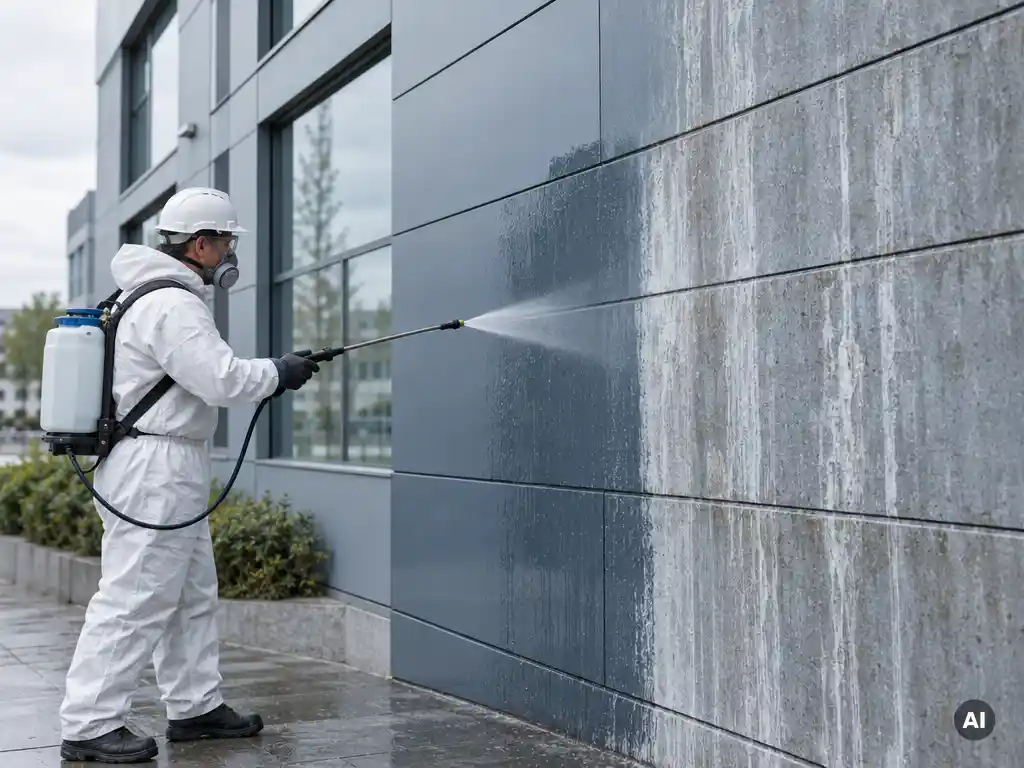
For limescale deposits on commercial buildings, choose an acidic facade cleaner that dissolves lime, such as Facadeclean Extra Strong for extremely soiled, acid-resistant mineral substrates. The right choice depends on the facade material and the degree of soiling. Calcareous stone types such as marble and travertine require a different approach. In this article you will read how acidic cleaners work, which substrates are sensitive, how specialists go about the work and how to limit recurrence.
How does an acidic facade cleaner work on limescale?
An acidic facade cleaner dissolves limescale chemically by letting the minerals in the deposit react with the acid. This breaks down the deposit without mechanical abrasion. The stronger the acid, the faster and more thorough the effect, but the greater the load on the substrate as well.
Limescale forms when water with dissolved minerals evaporates and leaves a hard layer behind. On commercial buildings you often see this under roof edges, from splashing water at the plinth and around facade elements where moisture runs down. A neutral or alkaline cleaner has little effect on that layer. An acidic cleaner does.
Facadeclean Extra Strong is a powerful acidic facade cleaner based on hydrofluoric acid (HF) and phosphoric acid, with a pH below 1. We developed this product for situations in which standard facade cleaners fall short. It removes common facade soiling and forms of deposits on mineral substrates.
Which facade materials are sensitive to acidic cleaners?
Calcareous substrates are the most sensitive to acidic cleaners, because the acid attacks the material itself. Think of marble and travertine. Glass, metal, paintwork and paving also need protection. Not every natural stone reacts the same way, so a test patch is always necessary.
You can use Facadeclean Extra Strong on most mineral substrates, including concrete, brickwork and clinker bricks. Do not apply the product to glass or calcareous stone types such as marble and travertine. During preparation, cover all substrates you are not treating, such as paintwork, paving, metals, glass and plants.
For facades made of calcareous or acid-sensitive stone, we look at an alternative. Facadeclean HC is an alkaline facade cleaner based on sodium hypochlorite and sodium hydroxide (pH 12 to 13). You can apply it to, among others, concrete, slate, brick, unpolished marble, stucco, sandstone, basalt-like stone and granite. This product mainly removes general facade soiling and is less effective against efflorescence. For efflorescence we recommend Cement Residue Remover. Always make a test patch before use, because natural stone does not react the same everywhere.
How do you tackle limescale on a commercial building?
You tackle limescale using a fixed sequence: assess the substrate, make a test patch, cover adjacent areas, apply the cleaner, let it take effect and rinse afterwards. Have this work carried out by specialists, especially with acidic cleaners containing hydrofluoric acid. This limits damage and safety risks.
For Facadeclean Extra Strong, work in these steps:
- Cover substrates that are not to be treated with plastic, such as paintwork, paving, metals, glass and plants.
- Dilute the product at most 1:4 with water.
- Wet the substrate beforehand with water.
- Apply the product with a soft brush and work from bottom to top. This prevents streaks and staining.
- Let the product take effect for approximately 1 to 15 minutes. Keep the substrate damp and do not let the product dry out.
- Rinse and clean the substrate with high pressure and warm or cold water. Depending on the substrate, the pressure is between 50 and 200 bar, with a water temperature of at most 50 °C.
- Repeat the treatment if necessary.
The theoretical consumption is 5 to 15 m² per liter, depending on the nature and degree of soiling and the porosity of the substrate. Low temperatures slow down the effect, so adjust the contact time accordingly. Do not work on hot substrates or in full sun. You can read more about the approach to different types of soiling in our facade cleaning section.
Which safety and environmental rules apply to facade cleaning?
Strict safety measures apply when cleaning facades with acidic products. Always consult the product data sheet, the label and the safety data sheet for the current requirements. Wear protective clothing and avoid contact with skin, eyes and airways. For legislation and regulations on the discharge and disposal of rinse water, we refer to the applicable local requirements.
Facadeclean Extra Strong causes severe burns and eye damage and contains hydrofluoric acid. Therefore take these measures:
- Wear liquid-tight clothing, chemical-resistant gloves, face protection and safety goggles.
- Do not breathe in vapor, mist or spray.
- Keep calcium gluconate ointment or calcium gluconate gel within reach.
- Do not mix the product with other products and pay particular attention to alkaline products.
If the product gets on the skin, rinse immediately with plenty of lukewarm running water, for a maximum of 5 minutes. Then apply a thick layer of calcium gluconate ointment, rinse it off after 2 minutes and apply a new layer. Repeat this every 2 minutes until the pain subsides or medical help is present. In case of contact, consult a doctor.
If you use Facadeclean HC, be aware of the corrosive effect on metals. Protect exposed metal surfaces and use application equipment made of chemically resistant plastic. Do not mix this product with acidic products or ammonia, because of toxic fumes.
How do you prevent limescale from coming back?
You limit recurring limescale by addressing the cause and protecting the facade after cleaning. Make sure the substrate is fully rinsed and dried before you apply an impregnating agent or coating. A protective layer reduces moisture absorption, the transport of minerals and thus the formation of new deposits.
With facade impregnation and hydrophobing you make the facade water-repellent, usually with a combination of alkylsilanes and (poly)siloxanes. This inhibits moisture, algae and atmospheric pollution and makes later cleaning easier. The service life is generally up to ten years.
For non-porous facade cladding or window frames, our renovation and protective coatings offer a solution. Semi-permanent coatings such as Nitowax, Nitoshield and Nitocryl® and the permanent, color-restoring coating Nitocolour (service life of up to 10 years) repel moisture, oils, solvents and graffiti. If you also want to tackle graffiti, take a look at our range of graffiti removers. Also keep an eye on the cause: leaking gutters, splashing water and moisture flowing along the facade keep supplying lime-rich water.
How Mavro helps with removing limescale on commercial buildings
We help you choose the right facade cleaner for your building and apply it safely. Our technical advisors and R&D department look at your facade, the substrate and the soiling with you. Mavro is ISO 9001 certified, which safeguards our approach to products and advice.
- Product advice per substrate, from Facadeclean Extra Strong for extremely soiled, acid-resistant mineral substrates to Facadeclean HC for general facade soiling.
- Training and support with application for your specialists.
- Custom solutions from our lab if no suitable solution exists yet.
- Protective follow-up steps such as facade impregnation or renovation coatings.
Present your challenge to us via our contact form or call us on +31 (0) 418 680 680. Together we will discuss which approach suits your commercial building.