
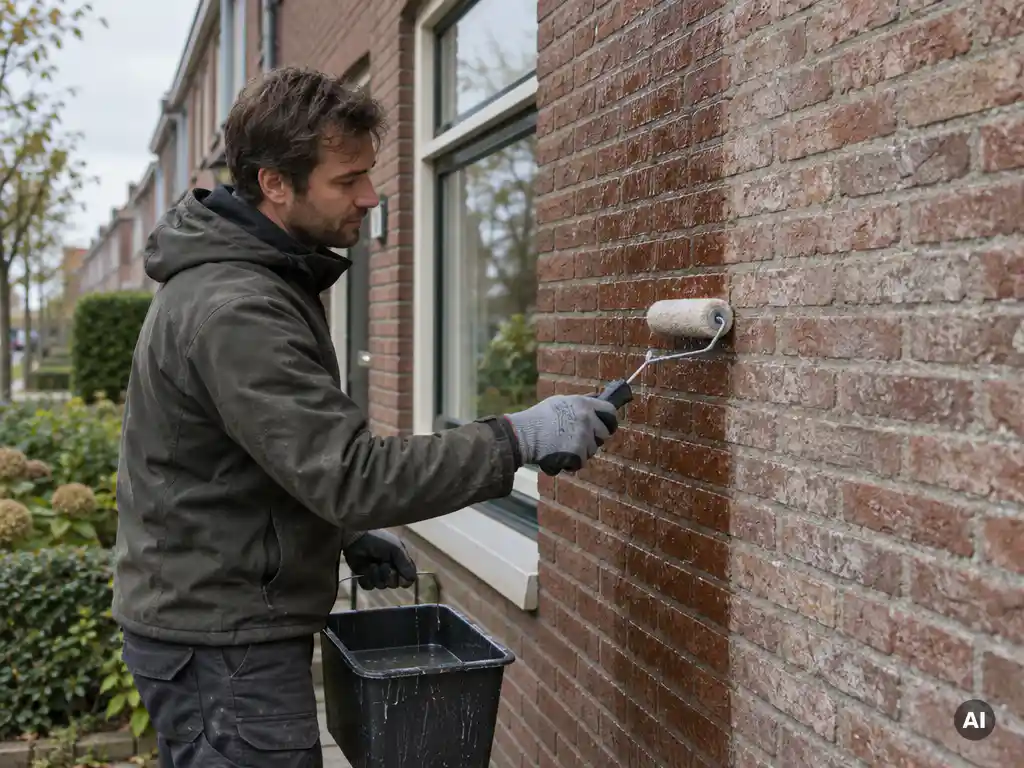
Choose a water-based facade impregnating agent when you are dealing with a low moisture content in the substrate, low VOC emissions and user-friendly application. Choose a solvent-based product when the substrate is very dense or smeared shut and deep penetration matters more than limiting emissions. When in doubt, always seek advice from specialists.
Both types contain active ingredients based on a combination of alkylsilanes and (poly)siloxanes. The difference lies in the carrier medium: water or solvent. The questions below show how that plays out in practice.
How does the performance of the two impregnating agents differ?
Both types make the facade water-repellent by lining the pore walls with a hydrophobic layer, while the facade remains vapor-permeable. The difference lies in the carrier medium of the components: in a water-based product it is water, in a solvent-based product it is an organic solvent.
With facade impregnation, the active components penetrate the pores of the stone and react there with the substrate. The carrier medium determines how the active ingredient spreads, how quickly the product dries and how it behaves at different moisture contents. A solvent-based product is usually applied to a dry substrate. A water-based product requires a different view of the moisture content, because water and substrate influence each other differently.
For the exact application method, consumption and drying times, always consult the product data sheet and the label of the chosen product. These values differ per system and therefore should not be derived from a general comparison.
Which type works best on which substrates?
The substrate determines the choice more than anything else. Impregnating a facade made of brick, concrete or natural stone always requires an assessment of porosity, moisture content and contamination. Therefore, never make absolute statements: not every natural stone reacts the same way.
When impregnating brick, you look at the absorbency of the brick and the joints, the presence of efflorescence and the condition of the pointing. On a highly absorbent substrate, a product that penetrates the substrate well is preferred. On a less absorbent or mixed substrate, other factors weigh more heavily, such as the finish and ease of repair.
Therefore, always apply a test patch to check the suitability of the product on your substrate. Our technical advisors do this daily in the field: they inspect the substrate, apply test patches and assist customers at the start of large projects. Clean the facade thoroughly beforehand and let it dry completely. You can read more about preparation on our page about facade cleaning.
Which weather conditions determine the choice when applying?
Dry weather conditions and a dry, frost-free substrate are decisive. Rain shortly before, during or shortly after application disrupts the performance, regardless of the type. Hot substrates and full sun also risk an uneven result.
The carrier medium plays a part here. Water and solvent do not evaporate in the same way and behave differently at low temperatures or high humidity. For concrete limit values for temperature, moisture content and waiting time after rain, we refer to the data sheet of the product you choose, as these values differ per product.
Therefore, plan the work with a weather forecast covering several days. Specialists allow for a buffer around application, so that the product has enough time to react with the substrate.
What are the consequences for the environment, VOC and safety?
A solvent-based facade impregnating agent contains organic solvents and therefore has a higher VOC content than a water-based product. This has consequences for ventilation, fire safety, personal protection and the surroundings of the work site. A low-VOC facade impregnating agent is therefore often attractive for work near residents, schools or care facilities.
Do not draw automatic conclusions about safety from this. A water-based product is not automatically harmless, and a solvent-based product is not automatically unacceptable. Every product has its own hazards and protective measures.
Therefore, read the data sheet, the label and the safety data sheet for each product. Leave the execution to specialists who know which protective clothing, ventilation and screening are required. When project requirements specify VOC values, always request the current product data.
How do durability and maintenance interval differ in practice?
A facade impregnation generally lasts up to ten years, unless product-specific information indicates otherwise. This lifespan depends on the substrate, exposure to weather and wind, the quality of the preparation and the application. The type of carrier medium is only one of the factors.
Check the facade periodically for signs of decreasing water repellency. If water no longer beads off and the facade absorbs moisture again, new impregnation is worth considering. In that case, clean the facade first and let it dry well.
An anti-graffiti coating can take over the function of facade impregnation. Therefore, do not routinely recommend a combination of both. For an impregnating agent with anti-graffiti properties, take a look at our range of graffiti removers and the accompanying protection, or ask our specialists for advice.
When is a water-based product the wisest choice?
A water-based product is wise when low VOC emissions are desired or required, when the work takes place close to people, or when the substrate and conditions are suitable according to the data sheet. A solvent-based product is a better fit when the substrate or the desired result calls for it.
Use these questions as a decision guide:
- What substrate do you have and how absorbent is it?
- What is the moisture content of the facade at the time of application?
- What requirements apply for VOC, odor and safety in the surroundings?
- What weather conditions do you expect during and after the work?
- What lifespan and maintenance interval does the client expect?
A test patch often gives the clearest answer. You can find more background on the application on our page about facade impregnation and hydrophobing.
How Mavro helps you choose the right facade impregnating agent
We think along with you, from challenge to application. Our technical advisors and the R&D department look at your substrate, situation and requirements, and help you choose the right product. Good advice is free with us.
- We inspect the substrate and the contamination on site.
- Together with you, we apply a test patch to check suitability.
- We provide support at the start of large projects and offer training for the application.
- For the exact application method, we refer to the data sheet and the label.
Would you like to know which facade impregnating agent suits your project? Contact us or call +31 (0) 418 680 680.