
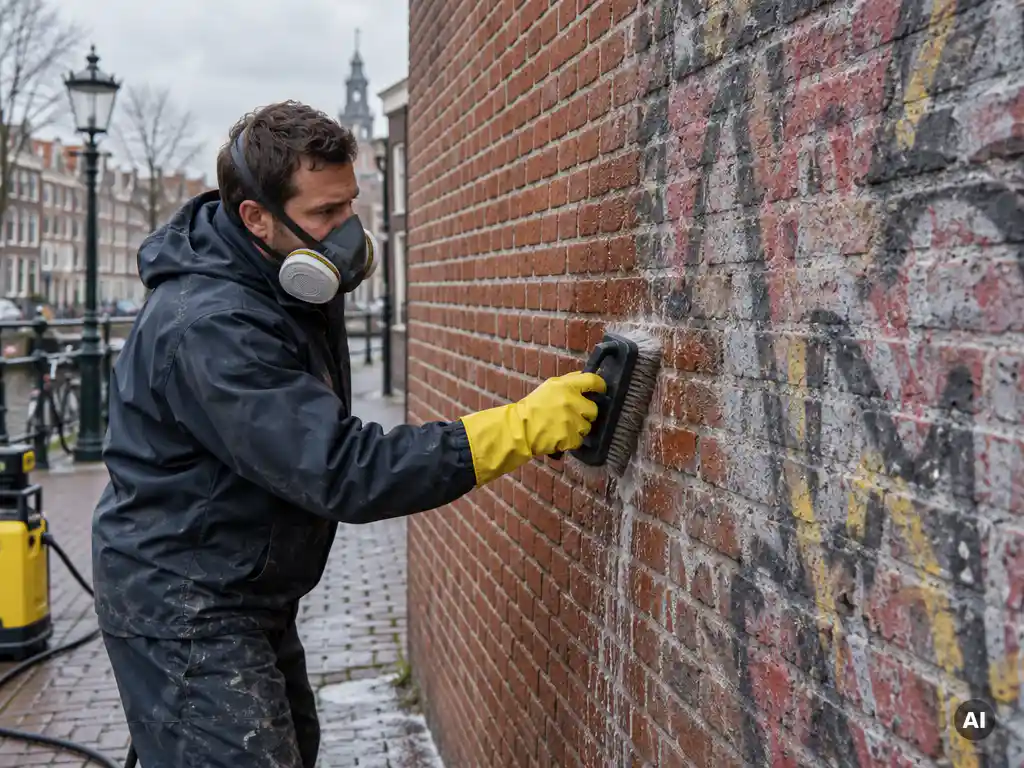
Removing graffiti from brick requires the right approach: use a professional gel-based graffiti remover, apply it undiluted to the surface, let it work, and then rinse thoroughly with water. Brick is a porous substrate that absorbs paint pigments deeply, so a standard cleaner is rarely enough. In this article we answer the most frequently asked questions about removing graffiti from brick, from the right method to preventing future damage.
Why is brick so difficult to clean of graffiti?
Brick is naturally porous. The open structure of the material draws paint pigments, ink, and lacquer deep into the surface as soon as graffiti is applied. The longer the graffiti stays in place, the deeper the penetration and the harder the removal. Ordinary cleaning products do not reach the pigments in the pores, which leaves residue behind.
In addition, the surface texture of brick is irregular. Rougher bricks trap paint particles in small cavities and grooves that are difficult to reach mechanically or chemically. This makes a superficial treatment insufficient. Graffiti on brick calls for a product that penetrates the pores, dissolves the paint particles, and can then be rinsed away completely without damaging the brick surface.
What methods are there for removing graffiti from brick?
For removing graffiti from buildings there are three common methods: chemical cleaning, mechanical cleaning, and pressure washing. The choice depends on the type of graffiti, the age of the contamination, and the condition of the brick.
- Chemical cleaning: A professional graffiti remover dissolves the paint particles so they can be rinsed off the surface. This is the most commonly used method for brick because the product penetrates the pores without putting mechanical stress on the material.
- Pressure washing: Water pressure can remove loose layers of paint, but it rarely works deeply enough on porous brick and can damage the mortar joints if the pressure is too high. Pressure washing is often combined with a chemical product.
- Mechanical cleaning: Sanding or blasting is invasive and quickly damages the brick surface. This method is rarely advisable for brick and is only used by specialists in specific situations.
For professional applications on brick, chemical cleaning with a suitable graffiti remover is the standard approach.
Which graffiti remover works best on brick?
On brick, a gel-based graffiti remover works best. The gel form keeps the product on the vertical surface and gives it enough time to work, instead of running off immediately. The product must be suitable for porous substrates and capable of dissolving multiple types of graffiti, including spray paint, marker, and lacquer.
Choose a product that is applied undiluted. Dilution reduces effectiveness on porous materials such as brick, where the contamination has penetrated deep into the material. Always consult the product data sheet and label for the correct application and safety information. Take a look at the range of professional graffiti removers for an overview of the options available for different substrates.
How do you remove graffiti from brick step by step?
You remove graffiti from brick by applying the graffiti remover undiluted, respecting the contact time, and then rinsing the surface thoroughly. Always follow the instructions on the product data sheet. The steps below describe a general workflow for professional execution.
- Preparation: Protect adjacent surfaces and make sure the work area is properly cordoned off. Wear the personal protective equipment listed on the label.
- Applying the product: Apply the graffiti remover undiluted to the affected brick. With a gel product, use a brush or spatula so the product adheres well to the surface and reaches the pores.
- Contact time: Let the product work in accordance with the specifications on the product data sheet. Prevent the product from drying out; cover the surface if necessary.
- Removing and rinsing: Remove the product, including the dissolved graffiti, with a brush or cloth and rinse the surface thoroughly with clean water. Check that all residue has been removed.
- Repeat if necessary: For deep-seated or old graffiti, a second treatment may be needed. Assess the result after the surface has dried.
If you are unsure about the substrate or the type of graffiti, leave the work to specialists to avoid damage to the brick surface.
Can removing graffiti damage brick?
Yes, removing graffiti can damage brick if you use the wrong method or the wrong product. Mechanical sanding immediately damages the surface. Excessive water pressure can damage the mortar joints. Aggressive chemical products that are not suitable for brick can attack the structure of the material or cause discoloration.
To prevent damage, always use a product that has been specifically developed and tested for porous substrates such as brick. For unknown or sensitive substrates, first carry out a test treatment on a small, inconspicuous area. Consult the product data sheet for the correct application. If in doubt, professional advice from specialists is the safest choice. Also pay attention to the condition of the mortar joints: damaged or weathered joints are especially vulnerable during chemical cleaning and pressure washing.
How do you prevent new graffiti on brick?
The most effective way to prevent new graffiti on brick is to apply an anti-graffiti coating immediately after cleaning. A coating forms a protective layer on the surface, so graffiti adheres less well and is easier to remove the next time it is attacked.
Two types of anti-graffiti coatings are relevant for brick:
- Semi-permanent coating: This coating is removed along with the graffiti and must be reapplied after every cleaning. Suitable for locations with occasional graffiti.
- Permanent coating: This coating withstands multiple cleaning cycles; the exact number varies per system. Suitable for locations that are targeted regularly.
In addition to coatings, practical measures also contribute to prevention: good lighting, vegetation against walls, and prompt removal of graffiti as soon as it appears. Graffiti that is removed quickly discourages repeat offenses. Also look into the options for removing graffiti ghosting, which remains when graffiti has not been removed completely and attracts new graffiti.
How we help with removing graffiti from brick
We develop and produce professional graffiti removers that are suitable for porous substrates such as brick. Our range includes gel-based products that are applied undiluted and dissolve virtually all types of graffiti and ink without damaging the underlying material. What we offer:
- Professional gel-based graffiti removers for brick and other porous substrates
- Anti-graffiti coatings, both semi-permanent and permanent, for protection after cleaning
- Technical advice on the right product choice for your specific situation and substrate
- Support for contractors, municipalities, housing associations, and facility managers
Want to know which product best suits your situation? Contact us or call directly on +31 (0) 418 680 680. Our specialists are happy to think along with you.