
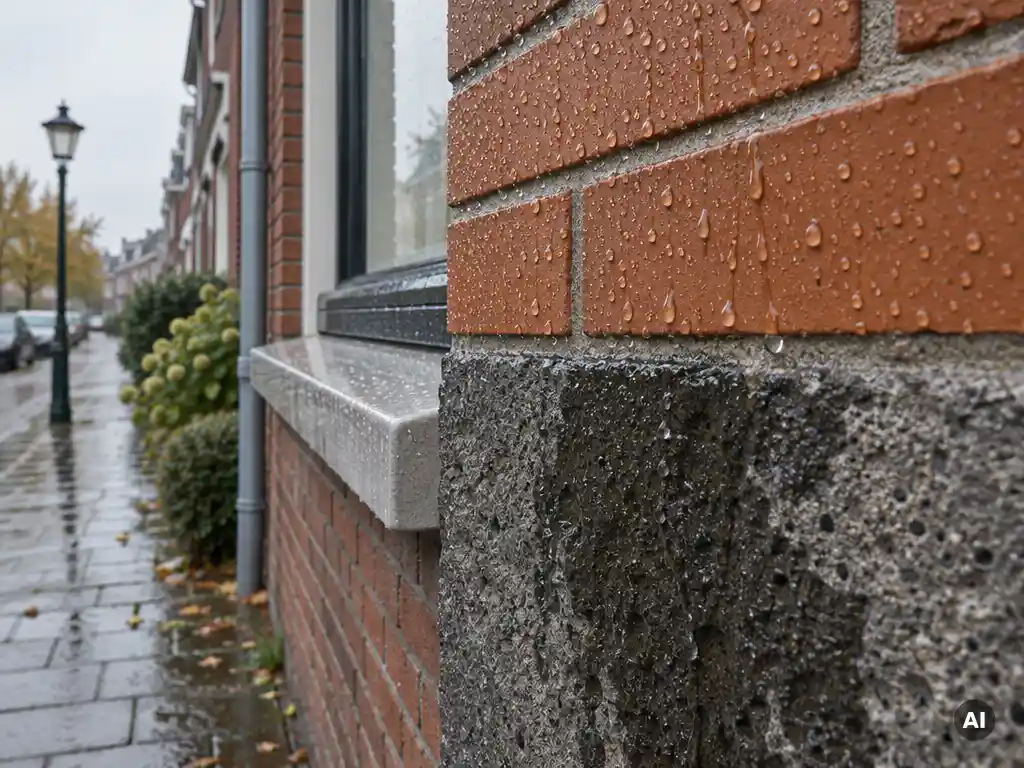
Porous facade cladding absorbs water and requires a different treatment than non-porous materials, which repel moisture or absorb hardly any. This distinction determines which cleaning method you use, which protective coating is suitable, and how you keep a facade in good condition in the long term. The questions below give you a clear picture of what this difference means in practice.
Which materials are porous and which are non-porous?
Porous facade materials are materials with an open structure that can absorb moisture, air, and dirt. Non-porous materials have a closed surface that lets little or no moisture through. The distinction lies in the material structure itself, not in the finish or color.
Porous materials include:
- Brick and masonry
- Concrete and aerated concrete
- Sandstone and other sedimentary natural stone types
- Calcium silicate brick
- Cement-based plasterwork
Non-porous materials include:
- Glazed ceramics and tiles
- Glass
- Polished granite and certain other igneous rocks
- Metal and aluminum facade panels
- Plastic and fiber cement panels
Note that even within a single material category there is variation. Granite is a type of natural stone, but not every granite behaves identically. Porosity depends on the density, the processing, and the finish of the surface.
How does water behave on porous versus non-porous facades?
On a porous facade, water is drawn into the material through the open pore structure. On a non-porous facade, water stays on the surface and runs off. This difference in water behavior has direct consequences for the durability of the facade and the choice of protective treatments.
With porous facades, water absorption leads to a series of problems. Moisture that penetrates deep into the material can expand during frost and cause cracks. A prolonged moisture content also promotes the growth of algae, moss, and mold. Salts present in groundwater or rainwater crystallize at the surface and cause efflorescence. All these processes attack the structure of the material.
On non-porous facades, rainwater runs off quickly. Dirt adheres less readily to the surface, but it can cake on if neglected. Frost damage due to water absorption plays hardly any role here, because the material itself does not absorb moisture.
We’ll find it out for you!
Want to talk through your challenge?
Our advisors are happy to help you find a practical solution.
Why does cleaning differ between porous and non-porous facades?
Cleaning porous and non-porous facades differs because the material reacts differently to cleaning agents, water, and mechanical force. The wrong approach on a porous facade can damage the material or drive the dirt deeper into the surface.
With professional facade cleaning of porous materials, specific points of attention apply:
- High water pressure can damage porous materials such as sandstone or calcium silicate brick. Low pressure with a targeted cleaning agent is often more effective.
- Acidic cleaning agents are not suitable for all types of natural stone. Some types of stone react strongly to acids and can discolor or be damaged.
- Cleaning agents penetrate deeper into porous materials, which affects the dwell time and the rinsing procedure.
Non-porous facades generally tolerate a wider range of cleaning methods, but here too the right choice of agent depends on the type of dirt and the surface. Aggressive agents on coated or lacquered facade panels can damage the finish.
Which protective coating works on porous facades and which does not?
On porous facades, facade impregnation works best: a treatment based on alkylsilanes and (poly)siloxanes that penetrates deep into the material and makes it water-repellent from the inside out. On non-porous facades, an impregnation cannot bond, because there is no open pore structure to penetrate. Surface coatings are the appropriate solution there.
With facade impregnation of porous materials, the product penetrates the pores and forms a hydrophobic barrier without disrupting the vapor-permeable nature of the material. The surface therefore continues to breathe, while moisture from outside is repelled. The service life of a facade impregnation is generally up to ten years, depending on the product and the conditions.
For non-porous facades and facade elements such as plastic window frames, semi-permanent and permanent surface coatings are available. These coatings bond to the existing surface, restore its appearance, and provide protection against moisture, dirt, and graffiti. The choice between a semi-permanent and a permanent coating depends on the desired protection period and the maintenance profile of the object.
How do you recognize whether a facade is porous before treatment?
You can recognize a porous facade with a simple water droplet test: apply a small amount of water to the surface and see what happens. Does the water quickly soak into the material? Then the facade is porous. Does the water remain as a droplet on the surface? Then the material is non-porous or has already been treated.
In addition to the water droplet test, there are other signs that indicate porosity:
- Visible efflorescence or white deposits on the surface, which indicate salt crystallization from within the material
- Algae and moss growth in the joints or on the surface
- Dark stains after rain that dry slowly
- A rough or grainy surface structure
The moisture content of the facade is also a relevant factor before treatment. Too high a moisture content in the substrate can negatively affect the adhesion and performance of impregnating agents and coatings. Specialists measure this with a moisture meter before carrying out a treatment.
When is professional advice needed for facade treatment?
Professional advice is needed as soon as you are dealing with unknown materials, visible damage, a combination of types of dirt, or when a previous treatment has changed the surface. In those situations, a wrong choice is costly and sometimes difficult to reverse.
Specific situations in which you should call in specialists:
- Facades with historic or architecturally valuable materials, where the wrong approach causes irreparable damage
- Visible structural damage such as cracks, frost damage, or detachment of the material
- Facades to which a previous coating or impregnation has been applied whose composition is unknown
- Graffiti on porous substrates, where the remover has been drawn deep into the material
- Large objects where a wrong product choice leads to high repair costs
Even when you are unsure about the porosity of a material or the correct order of treatments, advice from a specialist is valuable. Always consult the product data sheet and label for specific application instructions.
How we help with facade cleaning and protection
We develop and produce professional products for both porous and non-porous facades, tailored to the specific requirements of each material and each application. Our range includes:
- Facade impregnation agents based on alkylsilanes and (poly)siloxanes for porous substrates such as brick, concrete, and natural stone
- Semi-permanent and permanent surface coatings for non-porous facades and facade elements, including Nitowax, Nitoshield, Nitocryl® and Nitocolour
- Graffiti removers that are applied undiluted on both porous and non-porous substrates
- Targeted cleaning agents for facade cleaning, matched to the type of dirt and the substrate
We are happy to advise you on the right approach for your specific situation. Get in touch via our contact form or call us directly on +31 (0) 418 680 680.