
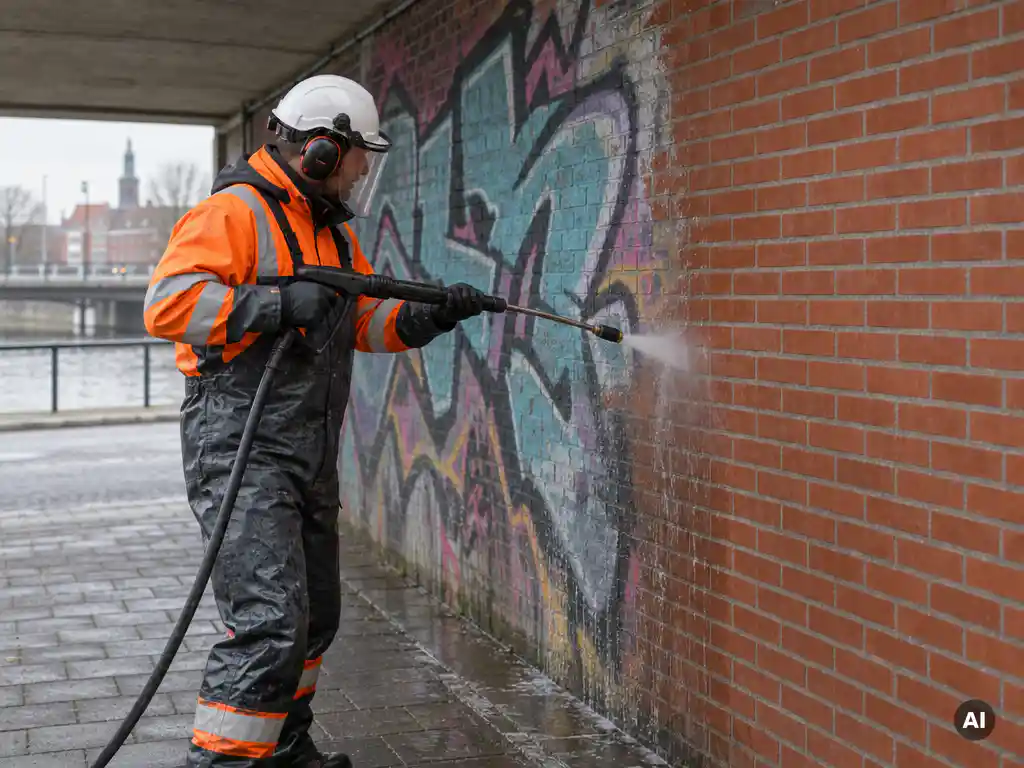
A graffiti remover is a chemical product that dissolves paint, ink, or spray paint from a surface and removes it without damaging the material itself. It works by breaking down the binders in the graffiti, so the paint loosens from the surface and can be removed mechanically or with water. In this article, we answer the most frequently asked questions about graffiti removers: from choosing the right product to using it safely and effectively.
How does a graffiti remover remove graffiti from surfaces?
A graffiti remover works by breaking down the chemical compounds in the graffiti. The active substances in the product penetrate the paint layer and break down the binders that hold the paint to the surface. The loosened graffiti can then be rinsed off or removed mechanically, without damaging the substrate.
Effectiveness depends on the type of graffiti, the substrate, and how long the graffiti has been on the surface. Freshly applied graffiti is generally easier to remove than dried or deeply absorbed paint. Gel products have the advantage that they stay on the surface longer, which gives them more contact time. This allows the product to penetrate deeper into porous materials such as concrete or brickwork.
What types of graffiti removers are there?
Graffiti removers come in various formulations, each suited to specific applications and substrates. The main categories are liquids and gels. Liquids are suitable for smooth, non-porous surfaces. Gels cling better to vertical or porous surfaces and are therefore more versatile.
Products also differ in their chemical composition. Some removers are formulated for use on sensitive materials such as natural stone, where the pH value and chemical aggressiveness are carefully matched to the surface. Other products can be used more broadly on metal, glass, ceramics, and concrete. View the complete range of graffiti removers to determine which product suits your application.
Which surface determines which graffiti remover you choose?
The choice of graffiti remover is determined first and foremost by the nature of the substrate. Porous materials such as concrete, brickwork, and some types of stone require a product that can penetrate deeply. Non-porous surfaces such as glass, metal, and ceramics, on the other hand, require a product that breaks down the paint layer on the surface without penetrating.
Extra caution is required with natural stone. Granite is a natural stone, but not every natural stone reacts the same way to acids or alkaline agents. It is therefore important to choose the right product based on the specific type of stone and always test a sample area first. If you are unsure whether a product is suitable for a particular substrate, it is wise to consult the product documentation or call in a specialist.
For graffiti on buildings, the substrate often varies from project to project. You can find more information about the approach for each situation on the page about removing graffiti from buildings.
What is the difference between a graffiti remover and an anti-graffiti coating?
A graffiti remover removes graffiti that is already on a surface. An anti-graffiti coating protects a surface preventively, so that graffiti adheres less well and is easier to remove. The two products complement each other, but they serve a fundamentally different purpose and come into play at different moments in the process.
Anti-graffiti coatings come in two variants: semi-permanent and permanent. A semi-permanent coating is removed along with the graffiti and must be reapplied afterwards. A permanent coating withstands multiple cleanings; the exact number varies per system. There are also impregnating agents with anti-graffiti properties, such as Graffitiguard Permanent, which protect the substrate from within.
It is a misconception that an anti-graffiti coating eliminates the need for a graffiti remover entirely. With a semi-permanent coating, recoating is necessary after each removal. The choice between the two systems depends on the location, the use, and the desired maintenance strategy.
When is a professional graffiti remover necessary?
A professional graffiti remover is necessary when consumer products give insufficient results, when the substrate is susceptible to damage, or when large surfaces are involved. Professional products are formulated for specific substrates and types of graffiti, and therefore deliver more reliable results in demanding situations.
In practice, this involves situations such as:
- Graffiti on porous substrates such as concrete, brick, or natural stone
- Dried or multi-layered graffiti that has penetrated deep into the material
- Graffiti on public infrastructure, such as stations, tunnels, or vehicles
- Projects where the substrate must be preserved, such as historic buildings
- Situations where graffiti ghosting remains after a first removal attempt
Public transport often has additional requirements for the removal process. You can read more about this specific context on the page about removing graffiti in public transport. For stubborn residual traces after removal, the page on removing graffiti ghosting offers additional information.
How do you use a graffiti remover safely and effectively?
You use a graffiti remover effectively by applying the product undiluted to the affected surface, observing the contact time as indicated on the product data sheet, and then removing the loosened graffiti with water or mechanically. Always consult the product data sheet and label for the specific instructions for each product.
A few general points of attention for professional use:
- Always test a sample area in an inconspicuous spot to assess how the substrate reacts.
- Apply the product undiluted to the surface, unless the product data sheet states otherwise.
- Observe the contact time as stated in the product documentation. Do not remove the product too early.
- Wear the right personal protective equipment, such as gloves and eye protection. Consult the label for the specific requirements.
- Remove residues thoroughly to prevent graffiti ghosting.
Have complex or large-scale removal projects carried out by specialists. They have the knowledge and equipment to apply the right product in the right way, without risking damage to the substrate.
How we help with graffiti removal
We develop and produce professional graffiti removers suitable for a wide range of substrates and types of graffiti. Our range includes gel products that dissolve graffiti on both porous and non-porous surfaces, including concrete, brickwork, metal, glass, and ceramics. What sets our products apart:
- Formulated for professional use by specialists
- Applied undiluted for optimal results
- Tailored to specific substrates and types of graffiti
- Backed by technical product documentation and expert advice
Would you like to know which product best suits your situation, or do you have a specific project where you could use advice? Then get in touch with us via our contact form or call us directly on +31 (0) 418 680 680.