
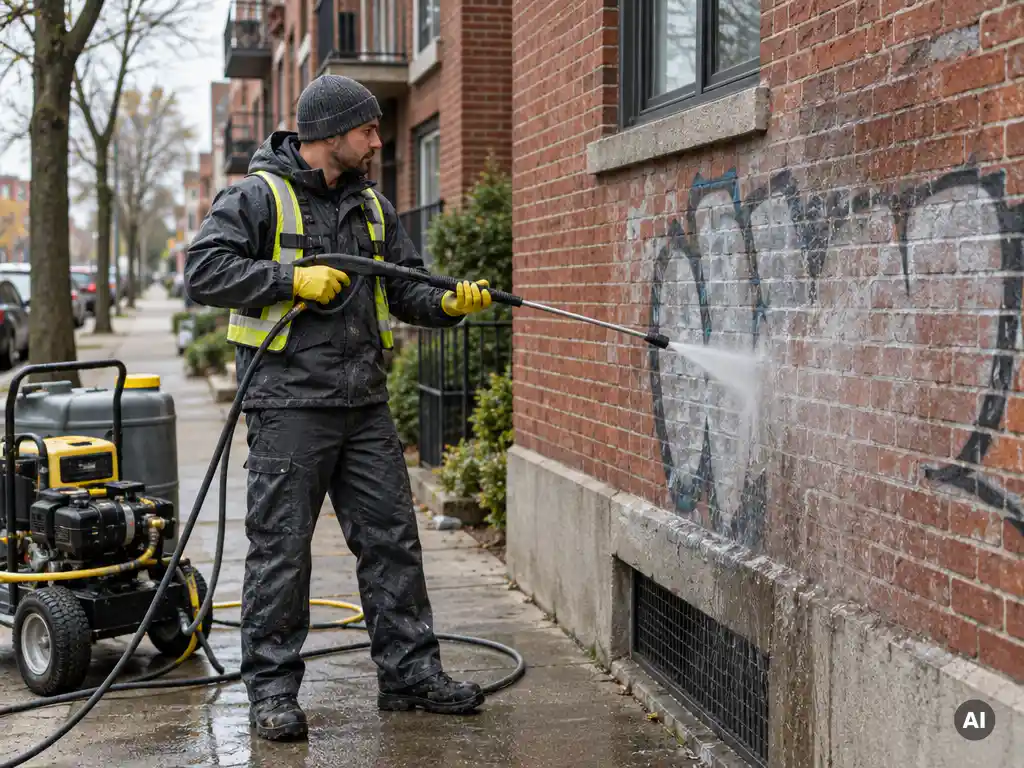
To remove graffiti across multiple property locations, you need three things: a gel-type graffiti remover suited to the substrate, a remover for ghosting residue, and a hot-water pressure washer. Anti-graffiti coating prevents repeated damage. A fixed procedure per location keeps results predictable.
The right combination depends on the moisture content and porosity of the substrate, the type of graffiti, and the protection you want afterwards. Below you will find, question by question, what your specialists need.
Which graffiti removers work best for each substrate?
The best graffiti remover depends on the substrate. Porous materials such as concrete, brickwork and natural stone call for a gel-type remover plus a ghosting remover. Smooth or sensitive surfaces call for a milder gel and a test patch beforehand. Take a look at our range of graffiti removers for the complete selection.
Our graffiti removers are used undiluted. This method suits gel-type products such as GraffitiRemover Gel, which has been developed for porous and non-porous substrates such as natural stone, concrete, brickwork, metal, glass and ceramics. The product dissolves almost all types of graffiti and ink without damaging the underlying material.
Keep the following points in mind when making your choice:
- Porous substrates such as concrete, brickwork and limestone: graffiti penetrates deep into the material and often leaves ghosting behind.
- Smooth substrates such as glass, ceramics and metal: the paint sits on the surface, so a gel-type remover is usually sufficient.
- Rolling stock: a separate remover is available for this. Read more about removing graffiti in public transport.
Natural stone is a broad category. Not every type of stone reacts the same way to alkaline or acidic components. Always do a test patch to make sure the substrate is not damaged.
What equipment and tools are needed on site?
On site, you need a brush or chemically resistant scrubbing brush, a hot-water pressure washer, personal protective equipment and masking material. You apply the remover undiluted with the brush. The pressure washer rinses away the dissolved graffiti. This applies to both steps of the standard procedure.
For removing ghosting, our product documentation specifies a particular method for each product. You apply Shadow Remover with a brush or chemically resistant scrubbing brush and, after the dwell time, rinse it off with high-pressure hot water. On hard, slightly porous substrates such as plastic, Shadow Remover works effectively in combination with a power sponge. You apply Shadow Remover Strong in a thick layer and rinse it off after a few minutes. If the result is insufficient, let this product dwell longer and cover it with plastic film to prevent it from drying out.
Also bring along:
- Chemical-resistant gloves, protective clothing and safety goggles.
- Clean water to clean tools and remove product residue.
- Material to shield surrounding surfaces.
For pressure values, temperatures and dwell times, always consult the product data sheet and the label of the product you are using.
How do you ensure a uniform approach across multiple locations?
You achieve a uniform approach with a fixed product choice per substrate type, a shared work protocol, and the same specialists or the same instructions for every location. Record for each location which substrates are present and which products belong with them. This prevents differences in results and unnecessary test patches.
Work with these steps:
- Inventory the substrates per building: concrete, brickwork, natural stone, metal, glass or coating.
- Link a fixed product to each substrate type and record this in a work instruction.
- Do a test patch first on new substrates and record the result.
- Plan ghosting removal as a separate step when the graffiti is on porous substrates. Read more about removing graffiti ghosting.
- Have specialists work according to the product data sheet, so that application and safety are the same everywhere.
For the basics of your approach, you can also visit our page on removing graffiti from buildings.
Which anti-graffiti coating prevents repeated damage?
A permanent anti-graffiti coating is the best way to prevent repeated damage, because it withstands multiple cleaning cycles. The number of cycles differs per system. A semi-permanent coating, on the other hand, disappears when graffiti is removed and has to be reapplied afterwards.
For a property portfolio with a lot of recurring graffiti, you will therefore often choose a permanent system. Graffitiguard Permanent is an impregnating agent with anti-graffiti properties. Anti-graffiti coatings can also take over the function of facade impregnation. For that reason, do not routinely recommend combining them with a separate impregnation. Where facade impregnation is relevant, it involves a combination of alkylsilanes and (poly)siloxanes.
For protective systems, count on a service life of up to ten years as a rule, unless the product data sheet states otherwise. Have specialists determine the choice per facade and substrate.
What environmental and safety requirements must products meet?
Graffiti removal products must meet the requirements on the product data sheet, the label and the safety data sheet. Specialists always work with suitable gloves, protective clothing and safety goggles. Avoid skin and eye contact, and consult the safety data sheet if in doubt.
Pay attention to the differences between products. Shadow Remover has a pH of approximately 14 and contains, among other things, potassium hydroxide and 2-butoxyethanol. Shadow Remover Strong contains sodium hypochlorite and sodium hydroxide. That product can damage metal substrates and can cause severe burns and permanent eye damage. Do not mix products with other agents and take care with acidic products.
Do not use products on hot substrates or in full sun. When using them indoors, ensure sufficient ventilation. A product that is biodegradable is not automatically milder or safer to use, so always follow the product-specific instructions.
What does graffiti management cost across a property portfolio?
The cost of graffiti management depends on the number of locations, the type of substrate, how often graffiti occurs, and the choice between removal and protection. A fixed amount cannot be given without an inventory. These factors do determine your total cost per location, however.
- Substrate and surface area: porous substrates often require extra steps for ghosting removal. The theoretical consumption differs per product and substrate: for Shadow Remover Strong it is 1 m² per litre, for other products more.
- Recurrence: locations that are hit often deserve a trade-off between repeated removal and a permanent coating.
- Type of coating: a semi-permanent coating has to be reapplied after every removal, whereas a permanent system withstands multiple cleaning cycles.
- Execution: professional execution by specialists reduces the risk of damage and repair work.
First map out the substrates and the graffiti frequency for each building. On that basis, compare the cost of removal with that of protection.
How we help with removing graffiti at multiple locations
We develop and produce professional graffiti removers and anti-graffiti solutions ourselves. Our technical advisers and R&D department will review the substrates in your portfolio with you and put together a product selection per substrate.
- Advice on the right graffiti remover, ghosting remover and anti-graffiti coating per substrate.
- Product data sheets with application, dwell time and safety instructions for each product.
- Training and support with application, so that your specialists work the same way everywhere.
- Quality and advice under ISO 9001 certification.
Would you like to know which combination suits your property locations? Get in touch with us or call us on +31 (0) 418 680 680. We would be happy to think along with you.