
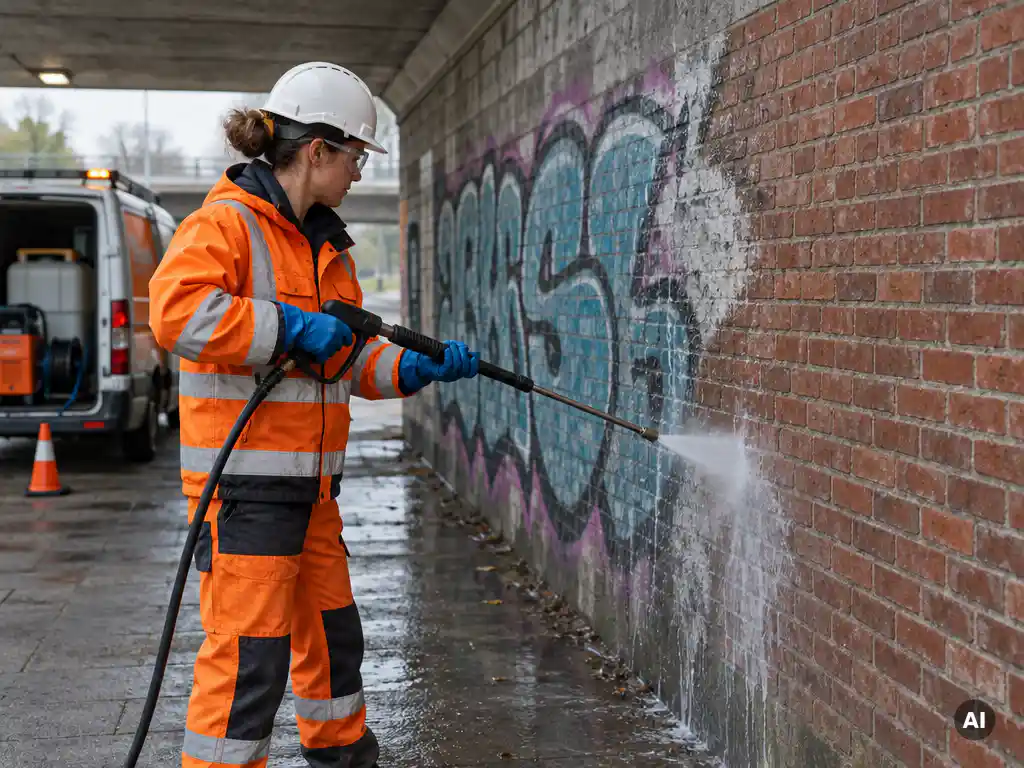
You carry out graffiti removal more efficiently on recurring maintenance jobs by choosing the right product in advance for each surface and type of paint, bundling routes and locations, and preventing damage with an anti-graffiti coating. This reduces the number of operations per location and prevents the same spot from coming back as a job again and again. Below you can read how to go about it.
Why does recurring graffiti removal cost so much time and money?
Recurring graffiti removal costs a lot of time and money because the same locations are hit again and again, the approach often differs from job to job, and remaining shadows require a second round. This leads to extra travel time, extra material and extra hours per location.
A few causes come up often:
- The wrong product choice: an agent that doesn’t suit the surface or type of paint produces an incomplete result and forces you to repeat the work.
- Remaining shadows: especially on porous surfaces such as brickwork and concrete, shadows often remain visible after the paint has been removed.
- Unprotected surfaces: without anti-graffiti protection, paint penetrates deep into the surface, so every new tag costs more work.
- Ad hoc planning: you drive to the same neighborhood several times instead of bundling locations.
Anyone who tackles these four points eliminates most of the waste in the process.
How do you plan graffiti removal for recurring jobs more smartly?
You plan more smartly by registering locations, bundling routes and recording for each location which surface and which product you use. That way you don’t have to reassess when the next report comes in, and the team can set off straight away with the right preparation.
Practical steps for more efficient planning:
- Record every location: note the surface, type of graffiti, product used and the result. With a recurring report you know immediately what worked.
- Bundle reports per area: schedule several locations in one round, so you lose less travel time.
- Bring the right products as standard: a graffiti remover, a shadow remover and the associated tools. This prevents a second visit.
- Do a test patch: test the product beforehand in an inconspicuous spot, so you don’t cause damage to the surface.
- Align your working method with the product data sheet: always follow the product data sheet and the label for application and safety.
A fixed working method also helps you get new colleagues up to speed faster. Take a look at our range of graffiti removers to put together a standard product set for your team.
Which removal method suits which surface and type of paint?
The right removal method depends on the surface, the type of paint and the situation. Porous surfaces such as brickwork and concrete call for a different approach than smooth or delicate surfaces. Therefore always check the product data sheet and do a test patch before treating the entire surface.
Facades, brickwork and concrete
On porous and hard surfaces such as brickwork, facades and concrete, specialists often use a graffiti remover in gel form. A gel stays in place better on vertical surfaces, so the product runs off less. Graffiti Remover Gel Strong is intended for stubborn paint, graffiti, markers and shadows, and is suitable for use at low temperatures. You apply Mavro’s graffiti removers undiluted. Read more about removing graffiti from buildings.
Rolling stock and public transport
For trains, buses and metros there is a separate solution. Graffiti Remover RS is a gel-form remover for rolling stock, developed to treat the original finishing material with respect. You can find more about removing graffiti in public transport on our website.
Shadows after the first treatment
After graffiti has been removed, shadows regularly remain on porous surfaces. Shadow Remover has been developed for this situation and penetrates deep into the pores of the surface. The product is suitable for natural stone, concrete, brickwork and tiles, among others. Do not use it on soft metals such as aluminum and copper. Shadow Remover Gel suits vertical surfaces, because the gel form dries more slowly and therefore works for longer. For the most stubborn shadows there is Shadow Remover Strong, a strong product with a bleaching effect that you only use on surfaces that are resistant to bleaching. You can read more background at removing graffiti shadows.
Not every natural stone reacts the same way to alkaline agents. Therefore always do a test patch and consult our R&D team if in doubt.
How do you prevent graffiti from sticking stubbornly again and again?
You prevent stubborn graffiti with an anti-graffiti coating, because paint then penetrates less deeply into the surface and you can remove graffiti more easily. You choose between a semi-permanent and a permanent coating, depending on how often the location is hit.
The difference between the two systems is important for your maintenance planning:
- Semi-permanent anti-graffiti coating: this disappears during graffiti removal. You then apply the coating again.
- Permanent anti-graffiti coating: this withstands several cleaning cycles. The number varies per system.
- Graffitiguard Permanent: this is an impregnating agent with anti-graffiti properties.
An anti-graffiti coating can take over the function of facade impregnation. So don’t combine the two as standard, but determine per facade what is needed. If you do apply a facade impregnation, you generally choose a combination of alkylsilanes and (poly)siloxanes. For protective treatments, generally count on a service life of up to ten years, unless the product data sheet states otherwise.
Also pay attention to the moisture content of the surface and the components of the chosen system, because this affects adhesion and performance.
When is it worth investing in training and advice?
Training and advice pay off as soon as several specialists perform the same tasks, when you work with different surfaces or when the same locations keep coming back. A shared working method prevents mistakes, limits repeat visits and makes the result predictable, even when staff change.
It pays off especially in these situations:
- You are hiring new specialists who need to work independently quickly.
- You work on delicate or unusual surfaces and want to rule out damage.
- You are looking for a standard product set for a maintenance contract with many locations.
- You want to know whether a semi-permanent or permanent coating suits a location.
Professional execution helps you follow safety instructions, such as avoiding skin and eye contact and wearing suitable gloves, protective clothing and safety glasses. For application and safety, always consult the product data sheet, the label and the safety data sheet.
How Mavro helps with more efficient graffiti removal
We develop and produce graffiti removers, shadow removers and anti-graffiti solutions ourselves, so that for a recurring maintenance job you build a complete system with a single partner. This helps you to:
- choose the right product for each surface and type of paint, from facade to rolling stock;
- tackle remaining shadows in a single pass with a suitable shadow remover;
- choose between semi-permanent and permanent anti-graffiti protection;
- have your team supported by our technical advisers and R&D department.
We are ISO 9001 certified and are happy to think along with you about your challenge. Request a free sample or discuss your situation with an adviser. Contact us or call +31 (0) 418 680 680.