
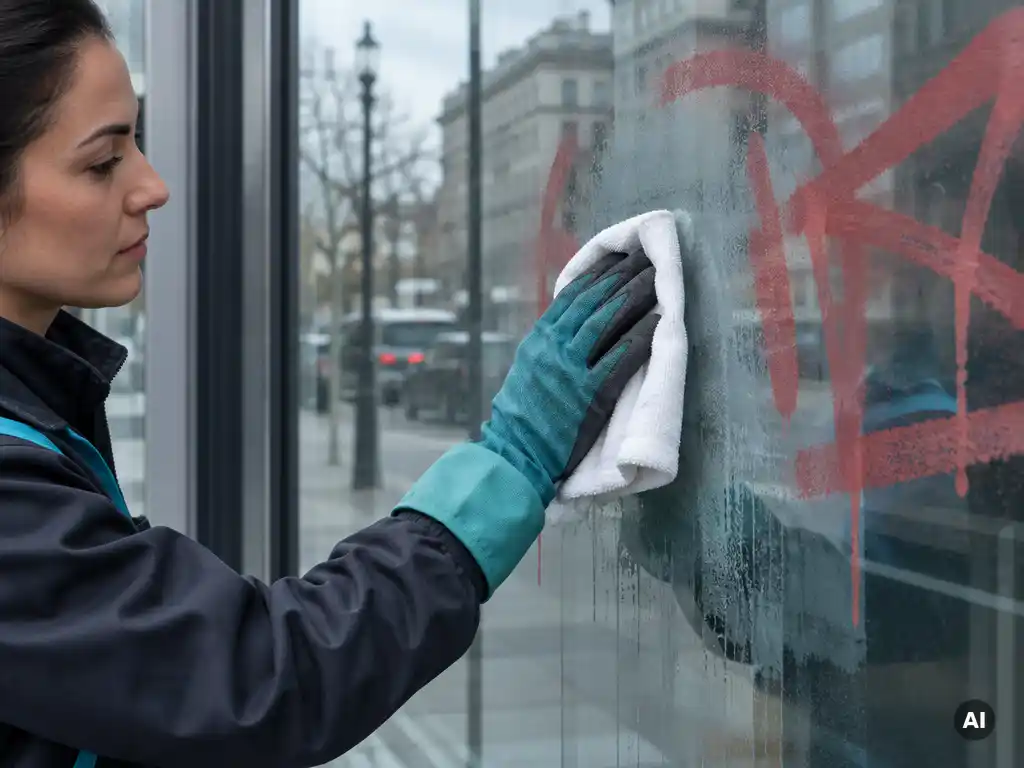
To remove graffiti from glass without scratching it, use a professional gel-based graffiti remover designed specifically for non-porous surfaces such as glass. Never use abrasives or aggressive scraping techniques: glass is hard but scratches easily. The right approach depends on the type of graffiti and whether the glass has already been damaged by etching agents.
Below, we answer the most frequently asked questions about graffiti on glass, from spray paint to etching damage, and from product selection to prevention.
Why is glass so sensitive when removing graffiti?
Glass is a non-porous, smooth surface that does not absorb paint. That sounds like an advantage, but it also makes glass vulnerable: any mechanical intervention, such as sanding or scraping with a hard scraper, immediately leaves visible scratches. In addition, glass reacts chemically differently from concrete or stone, which means not every cleaning agent is suitable.
Improper use of solvents or overly aggressive products can make the glass surface dull or cloudy. This applies especially to coated, laminated, or tempered glass, where the top layer is extra sensitive. Professional specialists therefore always take the glass type into account before choosing a cleaning product.
Which types of graffiti are most common on glass?
Two types of graffiti are most common on glass surfaces: spray paint (including felt-tip pens and markers) and etched graffiti. Spray paint adheres to the glass surface without soaking in. Etched graffiti is fundamentally different: the glass surface is damaged chemically or mechanically, making the damage irreparable.
- Spray paint and markers: Adhere to the surface and can be removed without lasting damage using the right graffiti remover.
- Etched graffiti (chemical): Caused by acid-containing agents that permanently damage the glass. The damage cannot be cleaned away and can only be repaired or replaced.
- Etched graffiti (mechanical): Scratched in with a sharp object. This too is permanent damage to the glass surface.
The distinction matters: with spray paint, removal is possible, while with etched graffiti it is a matter of damage repair or replacement. You can find more information about the approach for each type of surface on the page about removing graffiti from buildings.
How do you remove spray paint from glass without damaging it?
You remove spray paint from glass by applying a professional graffiti remover undiluted to the affected surface, letting the product take effect, and then removing it with a soft cloth or a stream of liquid. Do not use metal scrapers or abrasives: they scratch the glass irreparably.
The step-by-step approach:
- Apply the graffiti remover undiluted to the surface. For glass, a gel form is preferable: the gel stays on the vertical surface and does not run off.
- Let the product take effect according to the instructions on the product data sheet. Always consult the label for the correct dwell time.
- Remove the product and the dissolved paint with a soft cloth, sponge, or low-pressure water jet. Work carefully so as not to damage the glass.
- Rinse the surface with clean water.
After treatment, check that the glass is completely clean and contains no residue of the cleaning product. If you are unsure about the glass type or the coating, always consult the product data sheet and have the treatment carried out by specialists.
What can you do about etched graffiti on glass?
Etched graffiti on glass cannot be removed with a graffiti remover. The damage is in the glass itself: the surface has been damaged chemically or mechanically. Cleaning does not solve the problem. The only solutions are professional glass polishing (for light etching damage) or replacing the pane.
For light, superficial etching damage, a specialized glass company can sometimes polish the surface to reduce the damage. For deeper or more extensive etching damage, replacing the glass is the only realistic option. In this case, a graffiti remover has no effect and does not resolve the visible damage.
Prevention is therefore the most effective approach for etched graffiti. See the section on anti-graffiti coatings later in this article.
Which products are both safe and effective for glass?
For glass, professional gel-based graffiti removers are the most suitable. The gel form provides sufficient contact time on the smooth, vertical surface and prevents the product from running off before it has done its job. Products such as GraffitiRemover Gel are developed for use on non-porous surfaces, including glass, and dissolve spray paint and inks without attacking the underlying material.
When choosing a product, pay attention to the following:
- Check that the product is suitable for non-porous surfaces and specifically for glass.
- Always consult the product data sheet and label for the correct application and safety measures.
- Use the product undiluted, unless the product data sheet states otherwise.
- If in doubt, test first on a small, inconspicuous area.
View the full range on the graffiti removers page for an overview of available products per surface.
How do you prevent future graffiti on glass surfaces?
You protect glass surfaces against future graffiti by applying an anti-graffiti coating. For glass, a semi-permanent or permanent coating that shields the surface is usually chosen. With a semi-permanent coating, the protective layer disappears during graffiti removal and must be reapplied. A permanent coating withstands multiple cleaning cycles, although the exact number differs per system.
An anti-graffiti coating on glass offers two benefits: spray paint adheres less well to the protected surface, and if graffiti is applied anyway, it is considerably easier to remove. With etched graffiti, a coating also offers protection: the coating absorbs the damage instead of the glass itself, so you replace the coating rather than the pane.
Always have specialists assess the choice of the right coating system for glass. Not every coating is suitable for every type of glass or every environment.
How we help with graffiti on glass
We develop and produce professional graffiti removers for specialists who work on buildings, infrastructure, and public transport. Whether it concerns spray paint on a shop window or stubborn graffiti on train windows, we offer the right products and the accompanying advice:
- GraffitiRemover Gel for non-porous surfaces such as glass, ceramics, and metal, to be applied undiluted
- Product-specific information via detailed product data sheets and labels
- Tailored advice for your specific surface and situation
- Support for both one-off removal and structural graffiti prevention
Want to know which product best suits your situation? Contact us or call directly on +31 (0) 418 680 680. Our specialists are happy to help you find the right solution.