
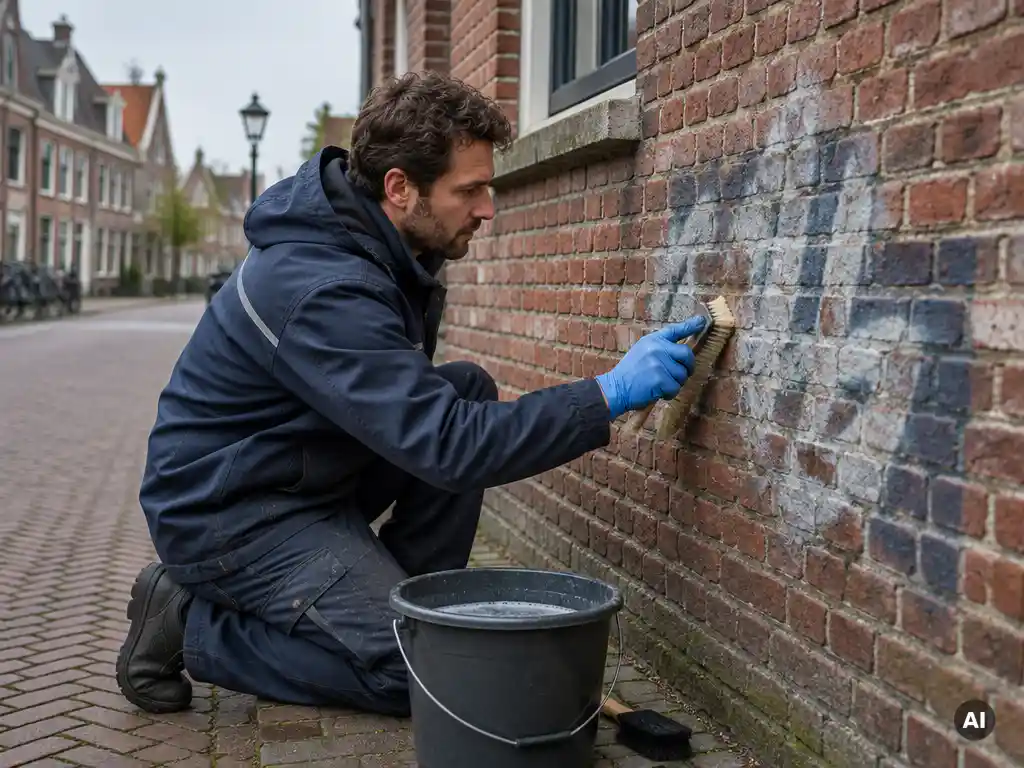
You remove graffiti from a stone facade with a chemical graffiti remover, without needing sandblasting. Sandblasting is aggressive and irreparably damages the surface structure of stone. A professional gel-based cleaning agent dissolves layers of paint without attacking the substrate, provided you choose the right product for the type of stone in question.
Below we answer the most frequently asked questions about removing graffiti from stone: from the risks of the wrong methods to the choice between one-off cleaning and a permanent anti-graffiti treatment.
What damages a stone facade during graffiti removal?
The greatest damage during graffiti removal is caused by methods that are more aggressive than the graffiti itself. Sandblasting, pressure washers with excessively high water pressure, and wrongly chosen solvents attack the surface structure of stone, remove the top layer and make the substrate more porous. As a result, future graffiti penetrates deeper into the material.
Specific risks per approach:
- Sandblasting: Structurally wears down the stone surface. Porous stones such as sandstone or brick are particularly vulnerable. The damage is permanent and increases the risk of moisture infiltration.
- Excessive water pressure: Drives paint deeper into the pores and can damage the pointing.
- Wrong solvents: Strong acids damage calcareous stones such as limestone and marble. Strongly alkaline products are problematic for certain types of natural stone. Not every type of stone reacts in the same way.
- Mechanical abrasion: Leaves scratches and removes the protective top layer of polished stone.
Damage to the facade is often more expensive to repair than removing the graffiti itself. That makes the choice of the right method and the right product directly relevant to the total cost of a project.
Which methods work to remove graffiti from stone without sandblasting?
You remove graffiti from stone effectively with chemical graffiti removers, optionally combined with controlled rinsing with water. The chemical method dissolves the paint layer without damaging the stone structure. This is the most common approach for professional cleaning of facades, walls and infrastructure.
The most commonly used methods are:
- Chemical graffiti remover in gel form: The gel stays in place on vertical surfaces, gives the product sufficient dwell time and prevents it from running off too quickly. Suitable for both porous and non-porous substrates.
- Liquid formulation: Suitable for horizontal or easily accessible surfaces where the dwell time can be controlled.
- Controlled rinsing: After chemical treatment, you rinse the substrate with water, optionally at low to moderate pressure, depending on the type of stone and the product instructions.
Mechanical methods such as sanding or sandblasting are not recommended for stone facades. They do not solve the problem without damaging the substrate. Chemical cleaning, carried out by specialists, delivers the most controlled result.
How do you choose the right graffiti remover for your type of stone?
The choice of a graffiti remover depends on the type of stone, the type of graffiti and the porosity of the surface. Not every type of stone tolerates the same chemical composition. A product that works well on concrete or brick may be unsuitable for natural stone such as granite or limestone.
Take the following factors into account when choosing a product:
- Type of stone: Granite is a natural stone, but not all natural stone reacts identically to chemical products. Calcareous stones are sensitive to acids. Always consult the product data sheet for the specified substrates.
- Porosity: Porous substrates such as untreated concrete or brick absorb paint more deeply. Here a product with a longer dwell time or higher concentration is sometimes needed.
- Type of graffiti: Spray paint, marker, acrylic and lacquer each react differently to solvents. Check whether the product is suitable for the type of paint on the substrate.
- Presence of an anti-graffiti coating: If the substrate has previously been treated with a coating, removal proceeds differently than with untreated stone.
Always test the chosen product first on a small, inconspicuous area before treating the entire facade. For the right product choice, consult the product data sheet and the label, or contact a specialist.
How do you remove graffiti from stone step by step?
You remove graffiti from stone step by step: apply the graffiti remover, let it work, remove the dissolved paint and rinse the substrate. The exact procedure differs per product and substrate. Always follow the instructions on the product data sheet and label.
A general procedure for professional application:
- Assess the substrate: Determine the type of stone, porosity and type of graffiti. Check whether an existing coating is present.
- Choose the right product: Select a graffiti remover that is suitable for the substrate in question and the type of paint. See the product information for the permitted substrates.
- Test on a small area: Apply the product to an inconspicuous section of the substrate to assess the reaction.
- Apply the product: Mavro’s graffiti removers are applied undiluted. When using a gel formulation, make sure to apply an even layer that stays in place on the substrate.
- Allow to work: Observe the dwell time stated on the product data sheet. Do not let the substrate dry out during this phase.
- Remove the dissolved paint: Remove the product, including the dissolved graffiti, with a cloth, brush or low water pressure, depending on the product and the substrate.
- Rinse: Rinse the substrate thoroughly with water to remove residues of the cleaning agent.
- Assess the result: Check whether the graffiti has been completely removed. In the case of stubborn stains or ghosting, a repeat treatment may be necessary.
Leave the work to specialists, especially for large surfaces, vulnerable types of stone or historic facades. Incorrect application can damage the substrate or worsen the cleaning result.
What is the difference between one-off removal and anti-graffiti treatment?
One-off graffiti removal solves the immediate problem, but leaves the substrate unprotected against future attacks. An anti-graffiti treatment applies a protective coating after cleaning that makes future removal easier or repels graffiti entirely.
There are two types of anti-graffiti coatings:
- Semi-permanent coating: This coating disappears together with the graffiti during removal and must then be reapplied. Suitable for locations where graffiti occurs regularly and quick cleaning is desired.
- Permanent coating: This coating withstands multiple cleaning cycles. The exact number differs per system. After cleaning, the protection remains intact without having to be reapplied.
A separate case is Graffitiguard Permanent, an impregnating agent with anti-graffiti properties. This product penetrates the substrate and offers protection from within the material itself, rather than forming a visible top layer.
Anti-graffiti coatings can take over the function of facade impregnation. Therefore, do not recommend the combination of a separate impregnation and an anti-graffiti coating as standard, but assess this case by case based on the substrate and the desired protection.
For locations with graffiti on buildings, a preventive coating is often more cost-effective in the long term than repeated cleaning without protection.
When is professional graffiti removal necessary?
Professional graffiti removal is necessary for vulnerable or historic substrates, large surfaces, stubborn types of paint and situations where incorrect application can lead to structural damage. In those cases, using specialists with the right products and knowledge of the substrate is the only responsible approach.
Specific situations in which professional execution is advisable:
- Historic or listed facades where any damage is irreparable
- Vulnerable types of natural stone where the chemical compatibility of the product is critical
- Large surfaces where consistent application and control of the dwell time are required
- Graffiti that has penetrated deep into the pores or has been present for a long time
- Situations where a graffiti ghost remains after a first cleaning
- Objects in public transport or public infrastructure with specific cleaning requirements
Professional specialists have knowledge of the right product choice per substrate, the required protective equipment and the correct application. That limits the risk of damage and delivers a better end result.
How we help with graffiti removal from stone facades
We develop and produce professional graffiti removers for specialists who work daily on facades, infrastructure and public transport. Our products are tailored to practice: effective on the substrate, applicable without dilution and available in gel form for vertical surfaces.
What we offer:
- Graffiti removers in gel and liquid form for both porous and non-porous substrates, including concrete, brick, natural stone, metal, glass and ceramics
- Anti-graffiti coatings, both semi-permanent and permanent, including Graffitiguard Permanent as an impregnating agent
- Product-specific documentation with technical information on permitted substrates, application and safety
- Tailored advice for specialists who want to match the right product choice to the specific substrate and situation
View our range of graffiti removers for a complete overview of our products. Do you have a specific situation or would you like advice on the right approach? Contact us via our contact form or call directly on +31 (0) 418 680 680.