
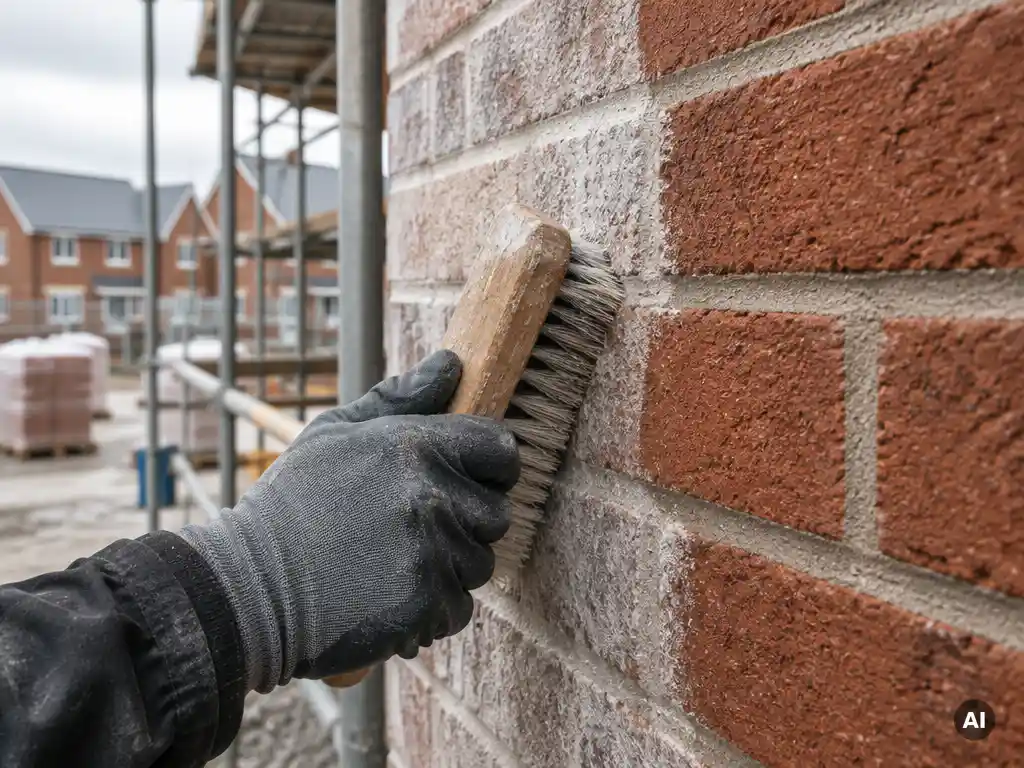
You remove cement haze from facade brickwork with an acidic facade cleaner that you apply in a targeted way, leave to take effect and then rinse off with water. Scrubbing alone or high-pressure cleaning will not dissolve the mineral film and can damage vulnerable brickwork. Choose the product based on the substrate and always do a test patch first.
Cement haze often occurs during construction or renovation work, when cement water or mortar residue dries on the facade. Below, you will read why a regular clean doesn’t work, which product is suitable, how to proceed step by step and when you are better off calling in a specialist.
Why doesn’t ordinary scrubbing work on cement haze?
Scrubbing doesn’t work because cement haze is a mineral layer that bonds to the surface and draws into the pores of the stone. A neutral cleaner does not dissolve this mineral contamination. Mechanical abrasion mainly spreads the residue and damages the joints and the stone structure.
At first glance, cement haze looks like a white, dull grey film. Once the residue dries, it draws deeper into the brickwork. The longer you wait, the harder it is to remove. Blasting and high-pressure cleaning can also cause damage to vulnerable brickwork. A good approach therefore combines a chemical facade cleaner with appropriate pressure.
Efflorescence or cement haze: what is the difference?
Both appear as a white deposit, but the cause differs. Cement haze comes from cement or mortar left behind after bricklaying and often appears immediately after completion. Efflorescence (lime bloom) occurs when moisture transports salts and lime to the surface. Acidic facade cleaners tackle both forms of mineral contamination. With efflorescence, it remains important to also investigate the source of the moisture.
What happens if you leave cement haze in place?
The residue draws deeper into the pores of the facade and becomes increasingly difficult to remove. That is why we recommend having the facade cleaned quickly after completion, before the deposit spreads further.
Which product removes cement haze best?
An acidic facade cleaner removes cement haze best, because the acid component breaks down mineral contamination without attacking the surface, provided you apply the product correctly. For facade cleaning after completion, you can choose between several products, depending on the substrate and the degree of contamination.
These products from our range are suitable:
- Facadeclean: an acidic facade cleaner based on ammonium bifluoride for heavily contaminated mineral substrates such as brick, concrete and stucco. You apply it undiluted with a low-pressure sprayer or brush.
- Facadeclean Gel: the same base, but in gel form. The gel form provides a long contact time and works well on vertical substrates.
- Facadeclean Strong: contains hydrofluoric acid (HF) and phosphoric acid and is intended for situations where other products offer no solution. You dilute it with water, depending on the contamination.
Pay attention to the substrate. Only use acidic products on acid-resistant facades and not on calcareous natural stone. Not every natural stone reacts the same way to acids or alkaline products. Therefore, always check the product data sheet for application and safety information.
How do you tackle cement haze step by step?
You tackle cement haze by first testing the substrate, checking the moisture content of the facade, applying the facade cleaner in a targeted way, leaving it to take effect and then rinsing with water. Specialists always work according to the product data sheet of the chosen product.
- Do a test patch. Test in an inconspicuous spot whether the product is suitable for your type of brick and jointing.
- Protect the surroundings. Be careful around plants, paintwork and finishing materials on the facade.
- Wet the substrate. Before using Facadeclean Extra Strong, among others, first wet the substrate with water.
- Apply the product. Work from bottom to top to prevent streaks and staining.
- Leave the product to take effect. Keep the substrate moist during the contact time and do not let the product dry out.
- Rinse the facade. Use a pressure that suits the substrate, as indicated in the product data sheet.
- Repeat if necessary. For stubborn residue, you can repeat the treatment.
Never mix products with other agents and be especially careful with alkaline products. Low temperatures can slow down the effect, and you should avoid application on hot substrates or in full sun. Would you like to know more about the approach for each type of facade? Then read our overview of professional facade cleaning.
Which mistakes cause damage to facade brickwork?
The most common mistakes are using the wrong product on a sensitive type of stone, skipping a test patch, using too much pressure and letting the product dry out. Each of these mistakes can cause stains, damaged jointing or a damaged stone surface.
- Using acid on calcareous natural stone. Acidic products can damage calcareous types of stone.
- Not doing a test patch. Without a test, you don’t know how the substrate will react.
- Mixing products. Never mix an acidic facade cleaner with other products, especially not with alkaline agents.
- Letting the product dry out. Keep the substrate moist during the contact time, as indicated in the product data sheet.
- Working in full sun or on hot substrates. This is not compatible with the application of our acidic facade cleaners.
- Too much pressure on vulnerable brickwork. It is better to support appropriate pressure with a chemical facade cleaner.
- Ignoring safety. Products containing hydrofluoric acid require protective clothing, gloves, face protection and safety goggles.
Do you want to maintain the result after cleaning? Then you can protect the facade afterwards. You can read more about that topic at facade impregnation and water repellent treatment.
When is professional facade cleaning the better choice?
Professional facade cleaning is the better choice for large facade surfaces, vulnerable or unknown brickwork, mixed substrates and when you need products containing hydrofluoric acid. Specialists assess the substrate, do test patches and work with the right protective equipment.
A specialist can also help you choose between different products, the approach for each substrate and the prevention of damage. This is especially relevant for large projects, such as new builds or renovations, where mistakes quickly become costly.
How Mavro helps with removing cement haze
We offer facade cleaners for professional specialists, tailored to mineral contamination such as cement haze and efflorescence. Our technical advisors visit projects daily to inspect substrates and contamination, do test patches and support customers when starting up large projects.
- A range of acidic facade cleaners, including Facadeclean, Facadeclean Gel and Facadeclean Strong
- Advice on the right product for your type of stone and degree of contamination
- Training sessions in which we show you how to apply the product
- Product data sheets with information on application and safety
Are you facing a facade with stubborn cement haze, or would you like to know more about our products for surface protection and cleaning? Contact us or call +31 (0) 418 680 680. We are happy to think along with you.