
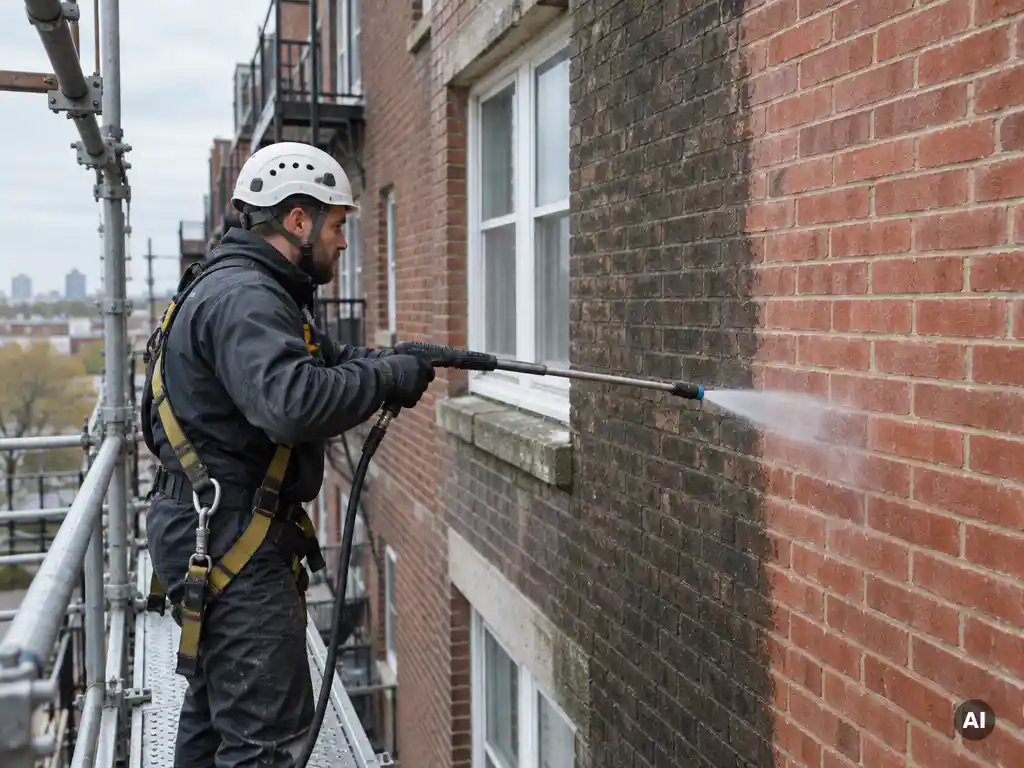
You lower the cleaning cost per square meter by matching the method, the product, and the condition of the façade to one another. A façade that has been impregnated to repel water gets dirty less quickly and needs cleaning less often. The right cleaner on the right substrate also saves time, product, and repair work. Below you can read which factors determine the costs and where you can save the most.
Which factors determine the cleaning cost per square meter?
The cleaning cost per square meter depends mainly on the type of substrate, the nature and degree of soiling, the accessibility of the façade, and the chosen method. In addition, labor hours, material consumption, and the risk of repair work all count toward the total price.
A brief explanation per factor:
- Substrate: brick, concrete, natural stone, and façade cladding each require a different approach and a different type of cleaner.
- Type of soiling: algae and green deposits call for a different solution than lime efflorescence, rust stains, or cement film.
- Accessibility: height, scaffolding, and aerial work platforms drive up labor costs, regardless of the product.
- Method and time: the faster a product does its job, the fewer hours your specialists spend on the façade.
A good inspection beforehand prevents having to adjust course later. Our technical advisors inspect substrates and soiling on site and apply test patches, so you know in advance what works.
Which cleaning method is the most cost-effective per square meter?
The most cost-effective method is the one that achieves the desired result in a single pass without damaging the façade. For light soiling, that is often a neutral cleaner applied at low pressure. For stubborn deposits, a targeted chemical cleaner usually delivers more than extra pressure.
Blasting and high-pressure cleaning seem fast, but they can damage vulnerable masonry. Damage means repair costs, and these outweigh the time saved. By combining appropriate pressure with a chemical façade cleaner, you achieve a good result without forcing the surface. The right cleaner can also speed up the cleaning process.
For an overview of the approach and products, see our page on professional façade cleaning.
How do you choose a façade cleaner that saves time and product?
Choose a façade cleaner based on the substrate and the type of soiling. The substrate is the most important factor. An acidic cleaner works well against rust, but is ruled out on calcareous natural stone. The wrong choice costs you extra work and can cause damage.
A few guidelines for specialists:
- Neutral cleaners have a pH of around 7 and are widely applicable for light contamination. You usually apply them with a low-pressure sprayer or brush.
- Acidic cleaners are used for stubborn deposits such as lime efflorescence, rust stains, and cement film. Apply them only on acid-resistant façades.
- Alkaline cleaners should only be used on alkali-resistant substrates, so not on marble or aluminum.
- Gel or foam form: products in gel form or with a foam booster stay on the façade longer. This provides extra contact time.
Within our Facadeclean line you will find products for different substrates and degrees of soiling, both liquid and in gel form. Always apply a test patch to check suitability, and consult the product data sheet and label for application and safety.
How often should a façade be cleaned?
There is no fixed frequency for all façades. The right interval depends on the substrate, the environment, and the degree of soiling. Rain, wind, and air pollution cause a façade to turn gray, green, or black over time. So plan cleaning based on inspection, not on the calendar.
A façade in a busy environment or with a lot of greenery nearby generally gets dirty faster than a sheltered façade. Regular inspection helps you tackle soiling early. You remove light deposits with a milder approach. If you wait too long, you will need stronger products and the risk of damage increases.
Can façade protection permanently lower cleaning costs?
Yes, façade protection can lower maintenance costs because a protected façade absorbs less dirt. An impregnated façade is water-repellent and weather-resistant, which gives moisture, UV radiation, algae, mosses, and atmospheric pollution less chance to take hold. Cleaning therefore becomes easier and more cost-effective.
For façade impregnation, we work with a combination of alkylsilanes and (poly)siloxanes. Which type of impregnating agent is suitable depends on the substrate and the desired result. Read more about façade impregnation and hydrophobing. If you clean a façade and impregnate it immediately afterward, the façade stays clean and protected for longer.
If you are dealing with weathered, non-porous façade cladding or window frames, impregnation is not the right method. For these we offer renovation and protective coatings, such as semi-permanent coatings (Nitowax, Nitoshield, and Nitocryl®) and the permanent color-restoring coating Nitocolour with a service life of generally up to ten years.
What does an anti-graffiti coating do for your costs?
An anti-graffiti coating protects the façade against graffiti and can take over the function of façade impregnation. That is why we do not recommend the combination as standard. The difference lies in durability: a semi-permanent coating disappears during graffiti removal and has to be reapplied. A permanent coating withstands multiple cleanings, although the number varies per system.
Which products remove graffiti?
Our graffiti removers are applied undiluted. View the range of graffiti removers and choose, together with our advisors, the product that suits your substrate.
How do you avoid costly mistakes in façade cleaning?
You avoid costly mistakes by first identifying the substrate, applying a test patch, and following the product data sheet. Most damage results from the wrong product on a sensitive substrate or from excessive pressure. Have the work carried out by specialists.
Pay attention to these points:
- Determine the type of substrate and the soiling before you choose a product.
- Always apply a test patch to check suitability.
- Apply acidic and alkaline products only on substrates that can tolerate them.
- Protect plants, paintwork, and finishing materials around the façade.
- Follow the instructions on the product data sheet and the label for application and safety.
Keep in mind that not every natural stone reacts the same way to acids or alkaline agents. Granite, for example, is a natural stone, but that does not automatically tell you how it will behave. In doubt? Ask for advice before you begin.
How Mavro helps with lower cleaning costs per square meter
We support you in reducing your façade maintenance costs, from the initial inspection to the execution. This is how we work together:
- Our technical advisors inspect substrates and soiling and apply test patches.
- The Facadeclean line offers cleaners for different substrates, in liquid form and in gel form.
- For impregnation and protection, we advise on façade impregnating agents and on renovation and anti-graffiti coatings.
- We train your specialists in the correct use of our products, because a good result is a combination of products and craftsmanship.
Want to know which approach suits your project? Contact us or call +31 (0) 418 680 680. Our advice is free of charge.