
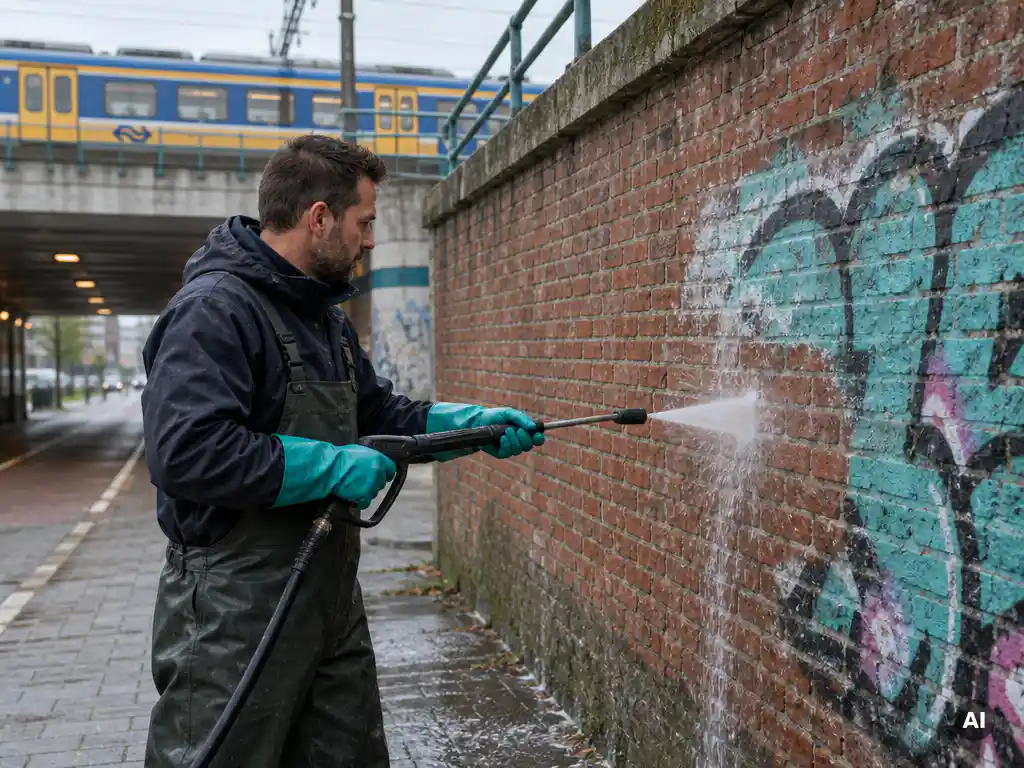
An effective graffiti remover has three characteristics: its formulation dissolves the graffiti medium without damaging the substrate, it can be applied in a practical way by specialists, and its packaging contains complete safety information. Not every product works on every substrate or every type of graffiti. The questions below will help you make the right choice for your situation.
Which substances make a graffiti remover effective?
A graffiti remover is effective when its active substances react chemically with the binders in the graffiti, so that the paint layer comes loose without damaging the underlying substrate. The formulation differs per product type, but the core principle is always the same: the remover breaks the adhesion of the graffiti, not the structure of the surface.
Common active components in professional graffiti removers are organic solvents, alkaline compounds, or combinations of the two. Some products are formulated as a gel, which offers an important practical advantage: the gel form keeps the product on the surface for longer and prevents it from running off. This is particularly useful on vertical surfaces such as facades. Products such as the GraffitiRemover Gel have been specially developed to dissolve virtually all types of graffiti and inks, including on porous and non-porous substrates.
Effectiveness also depends on how fresh the graffiti is, how deeply the graffiti medium has penetrated the substrate, and whether any treatments have been carried out previously. Always consult the product data sheet for the correct application on a specific substrate.
How safe is a graffiti remover for people and the environment?
The safety of a graffiti remover for people and the environment depends directly on its chemical composition and the way the product is applied. Professional graffiti removers contain active substances that are effective but also carry specific risks for the skin, eyes, and respiratory tract. Personal protective equipment is always required for professional use.
Some products are biodegradable, such as the GraffitiRemover Gel. However, biodegradability says nothing about safety during use: a biodegradable product can still be irritating or harmful on direct contact. Therefore, always read the safety data sheet (SDS) before you start.
As for the environment, wastewater from rinsing off graffiti may contain residues that must not simply be discharged into the sewer. Find out about local regulations for the disposal of rinse water during professional cleaning work. Specialists take this into account as part of responsible execution.
We’ll find the answer for you!
Want to talk through your challenge?
Our advisors will be happy to help you find a practical solution.
What do the labels and safety information on the packaging mean?
The labels on a graffiti remover provide mandatory information about hazards, correct use, and safety measures. They are drawn up in accordance with GHS/CLP regulations and contain hazard pictograms, signal words such as “Danger” or “Warning”, and H and P statements that describe the risks and precautionary measures.
What you will find on a professional label:
- Hazard pictograms: symbols that indicate whether a product is flammable, corrosive, harmful, or irritating
- H statements (hazard statements): describe the nature of the hazard, such as “Causes skin irritation”
- P statements (precautionary statements): indicate which precautions you must take, such as wearing gloves or ensuring good ventilation
- Reference to the safety data sheet (SDS): the SDS contains detailed information on composition, first aid measures, and storage
The label is not a substitute for the SDS. For professional use, consulting the full safety data sheet is a requirement, not an option.
What is the difference between a universal and a substrate-specific graffiti remover?
A universal graffiti remover is formulated to work on a wide range of substrates, whereas a substrate-specific remover is tailored to the chemical and physical properties of one type of material. The difference lies in the pH value, the choice of solvent, and the concentration of active components.
Universal products offer practical convenience, but sometimes at the expense of precision. They are generally formulated with a neutral or mild composition to limit damage to sensitive surfaces. On stubborn graffiti on highly porous substrates, they may be less effective.
Substrate-specific removers are tailored to materials such as metal, glass, concrete, ceramic, or natural stone. Important: not every natural stone reacts the same way to an acidic or alkaline graffiti remover. Granite is a type of natural stone, but its mineral composition can vary greatly from one stone type to another. A product that works on concrete can cause damage on limestone or marble. Always consult the product data sheet and carry out a test treatment on an inconspicuous spot.
For professional applications on buildings and infrastructure, it is advisable to choose a product that matches the specific substrate. More information about removing graffiti from buildings will help you make the right choice.
How do you test whether a graffiti remover is suitable for your surface?
You test the suitability of a graffiti remover by always carrying out a test treatment first on a small, inconspicuous part of the surface. Apply the product as described on the product data sheet, let it work for the specified time, and then remove it. Afterwards, assess whether the substrate is undamaged and whether the graffiti has dissolved sufficiently.
During the test treatment, pay attention to the following points:
- Does the substrate discolor or fade after treatment?
- Does the texture or structure of the material change?
- Does the graffiti dissolve completely, or does a ghost image remain?
- Does the surface visibly react to the chemical composition of the product?
A graffiti ghost image after removal indicates that the pigment has already penetrated deeper into the substrate. This is a separate point of attention for porous materials. You can find more about this phenomenon in removing graffiti ghosting. Always have the test treatment carried out by a specialist who can assess the results correctly.
When is a professional graffiti remover necessary?
A professional graffiti remover is necessary when consumer products give insufficient results, the substrate is prone to damage, or the graffiti is located on public infrastructure, facades, or vehicles that are regularly exposed to vandalism. In those situations, the right product choice, the right application, and the right safety measures determine the result.
Professional removers are formulated for intensive use and work on a wide range of substrates and graffiti media. They are applied undiluted and require knowledge of the product, the substrate, and the working conditions. That makes execution by specialists not only sensible but, in many cases, also necessary.
Situations in which professional products and execution are recommended:
- Graffiti on public transport, such as trains, buses, or trams
- Large surfaces on building facades or infrastructure objects
- Sensitive or valuable substrates such as natural stone or historic materials
- Recurring graffiti problems where protection is also necessary
For applications involving removing graffiti from public transport, specific requirements for product choice and working method also apply.
How we help you choose the right graffiti remover
At Mavro International, we develop and produce professional graffiti removers for specialists who work daily on buildings, infrastructure, and vehicles. Our products are geared to practice: formulated for specific substrates, supplied with complete technical documentation, and backed by expert advice.
What we offer:
- Professional graffiti removers in gel form for porous and non-porous substrates
- Product data sheets and safety data sheets for every application
- Tailored technical advice, matched to your substrate and situation
- Training and support for the correct application of our products
Want to know which product best suits your situation? Contact us or call +31 (0) 418 680 680 directly. We’d be happy to think along with you.