
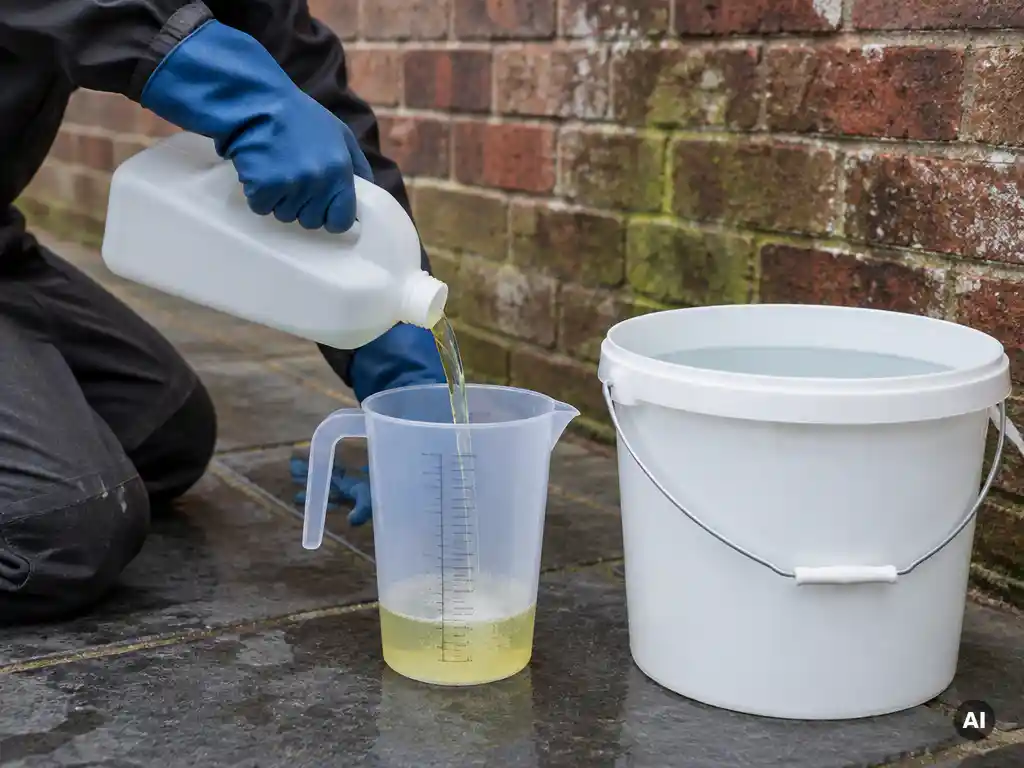
The right dilution of a concentrated facade cleaner depends on the product data sheet, the nature and degree of soiling, and the sensitivity of the substrate. Specialists start with the dilution ratio prescribed by the manufacturer and only adjust it based on a test area.
Every product has its own mode of action, so a ratio that works for one concentrate can cause damage with another. Below you can read how to determine, calculate, test and apply the dilution ratio, and what to watch out for when working safely.
Which factors determine the right dilution ratio?
The right dilution ratio depends on the type of product, the nature and degree of soiling, the porosity and material of the substrate, and the chosen application method. The product data sheet specifies the range within which you may work. Outside that range, you risk damage or an inadequate result.
The approach differs per product. According to the product data sheet, you dilute Facadeclean Strong with water at 1:5 to 1:20, depending on the soiling. Facadeclean Gel, on the other hand, is applied undiluted, because the gel form determines the contact time and effect. For Facadeclean HC, a concentrated cleaner based on sodium hypochlorite, check the dilution in the product data sheet for this specific product. Never carry over a ratio from another product.
These factors also play a role:
- Degree of soiling: light deposits usually call for a stronger dilution (more water) than stubborn, old soiling.
- Type of soiling: green algae, soot and atmospheric pollution require a different approach than rust or limescale.
- Substrate: not every type of stone reacts the same way to acidic or alkaline agents. Calcareous stone types can be attacked by acidic cleaners.
- Porosity: a highly absorbent substrate takes up more product, which changes consumption and dwell time.
- Weather conditions: low temperatures can slow down the effect. Adjust the dwell time accordingly.
How do you calculate the dilution step by step?
You calculate the dilution by splitting the ratio from the product data sheet into parts concentrate and parts water, and converting that into the quantity you need. With a ratio of 1:10, you mix 1 part cleaner with 10 parts water, which together gives 11 parts solution.
Proceed as follows:
- Read the dilution ratio and the consumption specification in the product data sheet of the chosen product.
- Measure the surface to be cleaned in square meters.
- Determine the consumption per square meter. For Facadeclean Strong and Facadeclean HC, the product data sheet gives a theoretical consumption of 5 to 15 m² per liter, depending on the soiling and the porosity.
- Calculate the total volume: the surface divided by the consumption per liter gives the required quantity.
- Divide that volume between concentrate and water according to the ratio.
A worked example: at 1:10 and a required total volume of 11 liters, you mix 1 liter of concentrate with 10 liters of water. Use a measuring cup or dosing pump, not an estimate by eye. When mixing, always pour the concentrate into the water and not the other way around. Never mix the cleaner with other products.
Finding it hard to choose the right product? Then take a look at our explanation of professional facade cleaning.
How do you test the dilution on a test area?
You test the dilution by applying the solution to a small, inconspicuous part of the facade and assessing the result after the prescribed dwell time. Rinse the test area, let it dry and check for discoloration, damage and cleaning effect before you treat the entire surface.
Here is how to approach a test area:
- Choose a spot that is representative of the substrate and the soiling, but not very noticeable.
- Start with the weakest solution (the most parts water) from the range in the product data sheet.
- Observe the dwell time prescribed by the product data sheet and do not let the product dry in.
- Rinse as prescribed, for example with Facadeclean Strong using a high-pressure sprayer at a pressure suited to the substrate.
- Only assess the result once the area is dry. Color differences are often only clearly visible then.
If the result is insufficient and the substrate is undamaged, you can test a stronger solution step by step, still within the range of the product data sheet. Repeat the treatment if necessary, as indicated in the product data sheet.
What happens with a dilution that is too strong or too weak?
A solution that is too strong (too much concentrate) increases the risk of damage, discoloration or harm to the substrate and surrounding materials. A solution that is too weak (too much water) gives an insufficient cleaning effect, so you have to repeat the treatment and spend more time and material.
With a solution that is too strong, sensitive substrates can be damaged. Acidic cleaners can attack calcareous stone types. Facadeclean HC is also corrosive to metals, so protect exposed metal surfaces and use application equipment made of chemically resistant plastic.
With a solution that is too weak, dirt remains or is only partially removed. You will then often see patchy cleaning, with cleaner and dirtier zones side by side. Repeating the treatment is possible, but it is better to increase the strength step by step rather than all at once.
Also pay attention to how the product performs over time. With Facadeclean HC, the effectiveness of the active substance may decrease after about 6 months. The product data sheet then advises applying the product undiluted instead of using the recommended dilutions.
Which dilution suits manual application, spraying or high-pressure cleaning?
The application method mainly determines how you apply and rinse the product, while the dilution ratio from the product data sheet remains leading. You apply Facadeclean Strong with a low-pressure sprayer or brush and then rinse with a high-pressure sprayer. You apply Facadeclean Gel undiluted with a roller, paintbrush or brush.
Manual application with a brush, paintbrush or roller
Manual application gives the most control on small surfaces and in details. You use Facadeclean Gel undiluted in this way. Thanks to the gel form, the product does not drip and stays in contact with the surface for longer, making it suitable for vertical surfaces and hard-to-reach spots.
Spraying with a low-pressure sprayer or foam equipment
When spraying with a low-pressure sprayer, you dilute the cleaner according to the product data sheet. Facadeclean HC has strongly foaming properties and can be applied with foam equipment for a longer contact time. Use equipment made of chemically resistant plastic for this.
Rinsing with high pressure
For Facadeclean Strong, the product data sheet prescribes high-pressure cleaning after a dwell time of approximately 10 to 60 minutes. Depending on the substrate, choose a pressure between 50 and 200 bar, with cold or warm water of at most 50 °C. Facadeclean HC removes soiling without the need for rinsing afterwards. Do rinse the substrate thoroughly afterwards and let it dry before applying a coating or impregnation. You can read more about what follows in facade impregnation and water repellent treatment.
Which safety and environmental rules apply when diluting?
When diluting, wear suitable gloves, protective clothing and safety goggles, avoid skin and eye contact, and follow the safety data sheet and the label of the product. According to the product data sheet, Facadeclean HC and Facadeclean Strong cause severe burns and eye damage.
Also observe these practical points:
- Do not mix products with other agents. Be extra careful with alkaline products when using acidic cleaners, and with acidic products or ammonia when using a bleach cleaner, because of the risk of toxic fumes.
- Do not apply the products on hot substrates or in full sun, and do not let the product dry in.
- Store the concentrate in its original packaging in a ventilated, cool and frost-free place. Facadeclean Strong has a shelf life of at least 24 months in unopened packaging. For Facadeclean HC, it is at least 6 months.
- Leave the execution to specialists who know the product data sheet and know how to handle wastewater and surrounding vegetation.
For application, disposal and safety, we always refer to the product data sheet, the safety data sheet and the label. Local rules for discharging cleaning water may vary, so inquire about them before you begin.
How Mavro helps you determine the right dilution
Together with you, we determine which product and which dilution suit the substrate and the soiling. Our technical advisors and our R&D department work alongside you, both for standard facade cleaning and for difficult situations for which no solution exists yet.
This is what we can do for you:
- Advice on the choice between liquid cleaners and gel cleaners, suited to the substrate.
- Explanation of the dilution ratio, dwell time and consumption according to the product data sheet.
- Help with planning a test area and assessing the result.
- Support with combining with other treatments and graffiti removers, where relevant.
Unsure about the dilution for your project? Contact us or call us on +31 (0) 418 680 680. Our specialists will be happy to help you.