
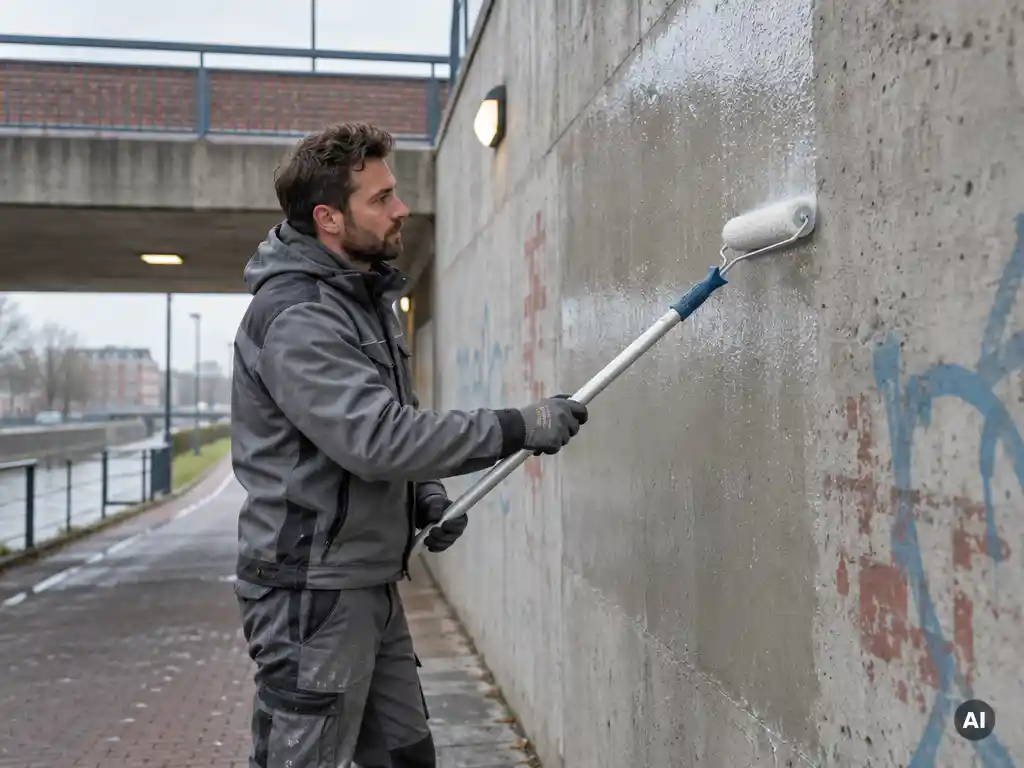
Removing graffiti and then applying a protective coating is the most effective approach to durably protect a surface against repeated vandalism. The type of coating you use determines how you approach the removal process and when you need to reapply the coating. In this article, we answer the most frequently asked questions about combining graffiti removal with anti-graffiti coatings.
What happens to a coating when graffiti is removed?
What happens to a coating during graffiti removal depends entirely on the type of coating present. With a semi-permanent anti-graffiti coating, the coating dissolves along with the graffiti during the removal process. With a permanent coating, the protective layer remains intact and the surface can be cleaned multiple times without having to reapply the coating.
For specialists, this distinction is an important starting point when drawing up a maintenance plan. A semi-permanent coating acts as a sacrificial layer: the graffiti adheres to the coating, and both are removed together. You then apply a new layer. A permanent coating is resistant to the cleaning agents used to remove graffiti, although the exact number of cleaning cycles differs per system. Always consult the product data sheet of the specific coating system for the technical specifications.
What types of anti-graffiti coatings are there?
There are two main categories of anti-graffiti coatings: semi-permanent and permanent coatings. Semi-permanent coatings are reapplied after every graffiti removal. Permanent coatings withstand multiple cleaning cycles and do not need to be replaced after every cleaning. In addition, there is a third variant: impregnating systems with anti-graffiti properties.
Semi-permanent anti-graffiti coatings
Semi-permanent coatings form a washable intermediate layer between the surface and the graffiti. They are relatively easy to apply and suitable for situations where graffiti is expected to be applied and removed regularly. After every removal, the coating must be reapplied to restore the protection.
Permanent anti-graffiti coatings and impregnating agents
Permanent coatings provide a long-lasting protective layer that withstands the agents used in graffiti removal. The number of cleaning cycles a permanent coating can endure differs per system. An example of an impregnating system with anti-graffiti properties is Graffitiguard Permanent, which protects the surface without forming a visible film layer. The service life of anti-graffiti coatings is generally up to ten years, depending on the system and the conditions. Always check the product-specific information for accurate data.
How do you remove graffiti without damaging the underlying coating?
To remove graffiti without damaging the underlying coating, use a graffiti remover that is matched to the coating system present. Apply the product undiluted, let it work for the prescribed dwell time, and then remove it according to the instructions on the product data sheet. Always work with specialists who have knowledge of the applied coating.
With a permanent coating, it is important that the cleaning agent does not attack the coating. Therefore, use only products that are approved for use on the specific coating system. With a semi-permanent coating, removing the coating is part of the process: the graffiti and the coating are removed together, after which a new layer of coating is applied.
For porous surfaces such as concrete, brickwork, and natural stone, gel-based graffiti removers are particularly effective. The gel form ensures that the product stays on the vertical surface longer and can penetrate deeper. For every application, consult the product data sheet and label for the correct working instructions and safety measures. You can find more information about the available products on the graffiti removers page.
When do you apply a new coating after graffiti removal?
With a semi-permanent coating, you apply a new layer immediately after every graffiti removal, because the coating has dissolved during the removal process. With a permanent coating, recoating is only necessary when the coating is demonstrably worn or has reached the maximum number of cleaning cycles.
Before applying a new coating, it is important that the surface is completely clean, dry, and free of cleaning agent residues. The moisture content of the surface plays a relevant role here: a moisture content that is too high can negatively affect the adhesion of the coating. Consult the product data sheet of the coating for the specific surface requirements before you start applying.
Which coating best suits your surface and usage situation?
The choice of an anti-graffiti coating depends on the nature of the surface, the exposure to graffiti, and the desired maintenance effort. For surfaces that are regularly defaced, a permanent coating is generally the most practical choice. For locations with occasional graffiti, a semi-permanent coating may suffice.
Porous surfaces such as concrete, natural stone, and brickwork require a coating that effectively seals or impregnates the pores. Note that not every natural stone reacts the same way to coating systems: granite behaves differently from other types of stone. For non-porous surfaces such as glass, ceramics, and metal, different requirements apply to coating adhesion. Always have the choice of the right system assessed by specialists who know the surface and the usage situation.
Keep in mind that some anti-graffiti coatings can take over the function of facade impregnation. Therefore, do not recommend combining an anti-graffiti coating with a separate facade impregnating agent as standard, but assess this case by case. Where facade impregnation is relevant separately, it generally involves systems based on alkylsilanes and (poly)siloxanes.
Also see our information on removing graffiti from buildings for application-oriented recommendations per surface.
How do you maintain an anti-graffiti system in the long term?
You maintain an anti-graffiti system in the long term by removing graffiti as soon as possible after it appears, periodically inspecting the condition of the coating, and renewing the coating in good time when the protection decreases. The faster graffiti is removed, the less the coating and the surface are strained.
Draw up a maintenance plan that fits the type of coating and the location. For busy locations such as public transport and infrastructure, a regular inspection and cleaning schedule is relevant. Graffiti that stays in place for a long time can be harder to remove and require more effort from specialists. Information about specific applications in public transport can be found on the page about removing graffiti in public transport.
With long-term use, also watch for the phenomenon of graffiti ghosting: residual discolorations that remain after removal. This can occur when pigments have penetrated deep into the surface. You can read more about this specific problem on the page about removing graffiti ghosting. Check the coating after every cleaning and consult the product data sheet for the maximum service life of the system.
How we help with graffiti removal and coating protection
We offer professional solutions for both removing graffiti and protecting surfaces with the right coating. Our approach is aimed at specialists working in construction, infrastructure, facility services, and public transport. This is what we offer:
- Gel-based graffiti removers that are applied undiluted to both porous and non-porous surfaces
- Anti-graffiti coatings in semi-permanent and permanent versions, including Graffitiguard Permanent as an impregnating system
- Technical advice from specialists on the right product and system choice for your specific surface and usage situation
- Support in drawing up a long-term maintenance plan
Want to know which system best suits your situation? Get in touch via our contact form or call directly on +31 (0) 418 680 680.