
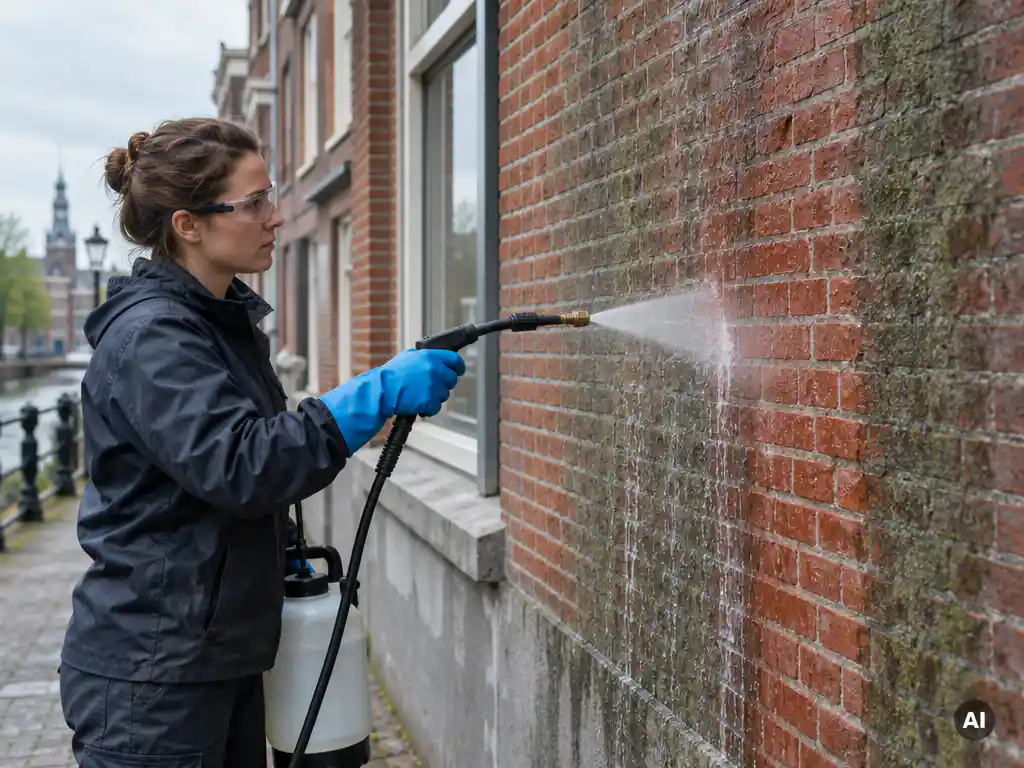
You choose a facade cleaner based on the substrate and the type of soiling: an acidic cleaner for mineral deposits such as efflorescence and rust stains on acid-resistant stone, an alkaline cleaner for grease, oil, and organic soiling, and a neutral cleaner for sensitive or unknown substrates. The pH of the cleaner must always match what the facade can tolerate.
For professional facade cleaning, the substrate therefore determines first what is possible, and only then the soiling and the cleaning power required. In this article you will read which type of cleaner suits which kind of soiling, which materials are sensitive, and how to proceed with mixed soiling. You can find more background on the approach on our page about professional facade cleaning.
Which type of soiling calls for which type of facade cleaner?
The nature of the soiling determines the type of cleaner: inorganic deposits such as lime, cement film, and rust are removed with an acidic facade cleaner, organic soiling such as grease, oil, and soot with an alkaline cleaner, and light or mixed soiling can often be tackled with a neutral cleaner.
This difference follows from the chemistry. Acids dissolve minerals, while alkaline agents emulsify grease and organic residues. Atmospheric soiling, green growth, and algae call for yet another approach. For this we work with, for example, Facadeclean HC, a concentrated cleaner based on sodium hypochlorite that removes organic and green soiling and does not need to be rinsed afterwards.
For mineral substrates such as concrete, brick, and stone, we offer several acidic cleaners of different strengths within the Facadeclean range. Facadeclean is based on ammonium bifluoride (pH approx. 2), while Facadeclean Strong and Extra Strong are based on hydrofluoric acid and phosphoric acid (pH < 1). So you choose not only by type, but also by degree of soiling. When making your choice, always take three points into account:
- the material of the facade
- the type of soiling
- the degree of soiling
Which facade materials are sensitive to acidic cleaners?
Calcareous substrates are the most sensitive to acidic cleaners. Acids react with lime and can damage or etch the surface. Think of calcareous natural stone, marble, and travertine. Glass, metal, paintwork, and plants must also not be exposed to strong acids.
Note: not every natural stone reacts in the same way. The lime content and structure differ per type of stone, so a general statement about a material is unwise. The product data sheet for Facadeclean, Facadeclean Strong, and Facadeclean Extra Strong warns that these cleaners can damage calcareous types of stone. Facadeclean Extra Strong is moreover not permitted on glass or calcareous types of stone such as marble and travertine.
If you are in doubt about the substrate, first do a test patch in an inconspicuous spot and consult a specialist. This prevents discoloration and damage that cannot be repaired afterwards. Cover all parts you are not treating, such as paintwork, paving, metals, glass, and plants, and always follow the instructions on the product data sheet and the label.
When is a neutral facade cleaner the safest choice?
A neutral facade cleaner is the logical choice when you are not sure what the substrate is, when the material is sensitive to acids and alkalis, or when the soiling is light. A pH-neutral agent is less likely to chemically attack the substrate, but it is also less powerful at dissolving stubborn minerals or deposits.
That is the trade-off: neutral means a lower risk of reaction with the substrate, but also more limited cleaning power. For light dust and atmospheric soiling, this is often sufficient. With cement film, efflorescence, or thick deposits, you will quickly hit its limits. In that case, opt for a targeted acidic cleaner on an acid-resistant substrate, or for an alkaline agent for grease-heavy soiling.
Plastic or metal facade cladding calls for a different approach than mineral substrates. For sensitive, non-porous facade cladding, we have separate renovation and protection products. For the right cleaner for such substrates, we are happy to advise you personally.
What is the best working method for facade cleaning with multiple types of soiling?
With multiple types of soiling, you work in phases: you inspect the facade, do a test patch, remove the organic soiling first, and then deal with the mineral deposits. You never mix cleaners with each other and rinse thoroughly between steps.
A practical sequence looks like this:
- Inspect the facade: determine the material, the type, and the degree of soiling.
- Do a test patch: test the cleaner in an inconspicuous spot.
- Cover up: protect glass, metal, paintwork, and plants.
- Treat per type of soiling: tackle green and organic soiling and acidic deposits separately.
- Rinse thoroughly: follow the instructions on the product data sheet for this.
- Repeat if necessary: build up the strength step by step rather than all at once.
Mixing products is an important point of attention. The product data sheets of our acidic cleaners state that you must not mix them with other products and should take particular care with alkaline products. Low temperatures can slow down the action, and you should not apply them to hot substrates or in full sun. Do not let the product dry out. For contact times, dilution, and rinsing pressure, the product data sheet applies per product, as these values differ.
Do you want to keep the facade clean for longer after cleaning? Then facade impregnation and water-repellent treatment is a logical next step, because an impregnated facade is easier to clean later on.
What safety and environmental requirements apply to professional facade cleaners?
Professional facade cleaners require skilled execution, personal protective equipment, and compliance with the product data sheet and label. Strong acidic cleaners require extra caution, especially products containing hydrofluoric acid. Specialists protect themselves, the surroundings, and adjacent materials, and follow local regulations for the disposal of rinse water.
For the exact safety information, we refer to the product data sheet, the label, and the safety data sheet of the product concerned. This also applies to storage: keep products in the original, closed packaging in a ventilated, cool, and frost-free place. The product data sheet of Facadeclean Strong states a shelf life of at least 24 months in the original unopened packaging.
The user always remains responsible for product choice, application, and result. Therefore, have heavy cleaning work carried out by specialized professionals. Properties such as biodegradability moreover say nothing about how mild or safe a product is. Therefore, assess a cleaner on the basis of the product-specific documentation.
How we help you choose the right facade cleaner
We think along with you from the initial question to the application. With the Facadeclean range, we offer cleaners for different substrates and degrees of soiling, both liquid and in gel form. This helps you to work in a targeted way, without unnecessary risk of damage or discoloration.
This is what you can expect from us:
- cleaners matched to the substrate and application
- a controlled action, without unnecessarily aggressive impact
- products suitable for professional use
- advice and training on the application
We also have a separate range for graffiti removal: take a look at our graffiti removers.
Not sure which cleaner suits your project? Contact us or call +31 (0) 418 680 680. Our specialists will advise you on the right approach.