
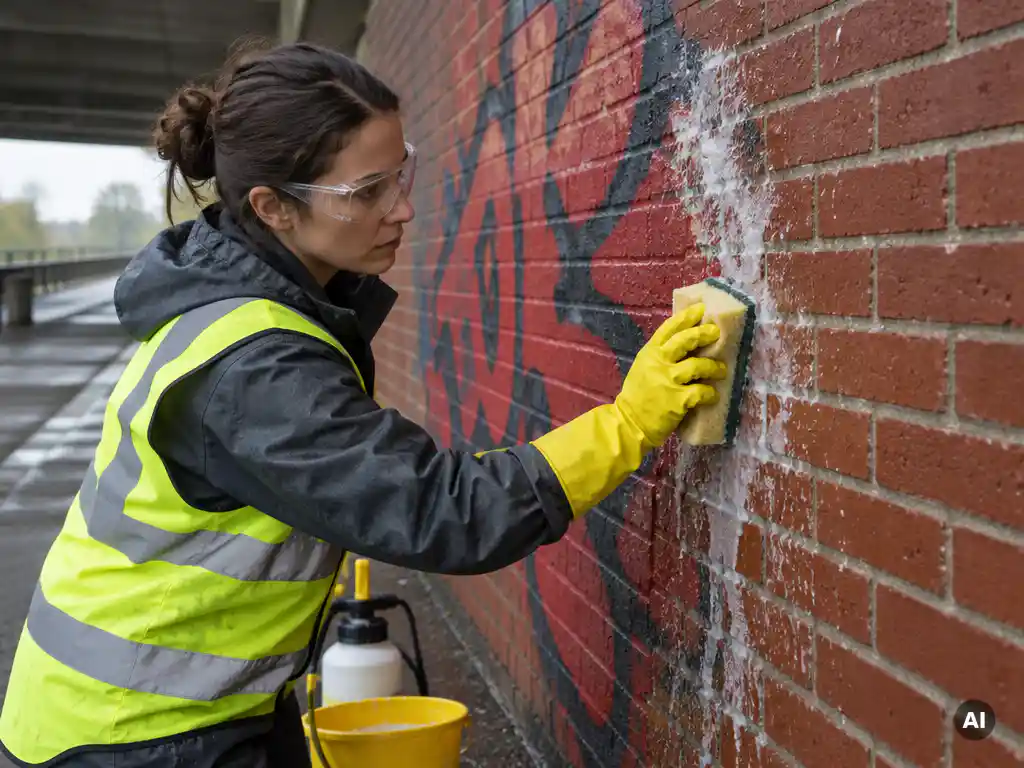
You choose a graffiti remover that meets environmental and safety standards based on the product’s composition, its accompanying safety information, and its suitability for the specific substrate. For professional applications, the product’s legal classification, personal protective equipment, and the correct aftercare are decisive factors. The questions below help you make the right choice step by step.
Which environmental and safety standards apply to graffiti removers?
In the European Union, graffiti removers fall under the CLP Regulation (Regulation (EC) No 1272/2008), which prescribes how hazardous substances are classified, labelled, and packaged. In addition, the REACH Regulation applies to the registration and evaluation of chemical substances, as does national occupational health and safety legislation for safe use in the workplace. Every professional product must carry a correct label and a valid safety data sheet.
For professional graffiti removal specialists, this means in practice that the manufacturer is obliged to state hazard symbols, H statements (hazard statements), and P statements (precautionary statements) on the label. Products used on public buildings or infrastructure must also comply with any additional requirements set by clients or authorities, such as specific restrictions on volatile organic compounds (VOCs). Always check at the time of purchase that the safety data sheet is up to date and consistent with current legislation.
What is the difference between solvent-based and water-based graffiti removers?
Solvent-based graffiti removers contain organic solvents that chemically dissolve graffiti and ink. Water-based removers use water as a carrier in combination with active components. The main practical difference lies in vapour pressure, odour dispersion, and personal protection requirements: solvent-based products generally require stricter ventilation and protection than water-based variants.
When choosing between the two types, the substrate, the type of graffiti, and the working environment play a major role. Solvent-based products are often more effective on stubborn, dried-in graffiti or specific ink types, but place higher demands on safety measures. Water-based formulations can be suitable for less resistant graffiti or situations where vapour emission is a problem, such as in enclosed spaces. Always consult the product data sheet for the specific application conditions. Some professional products are offered in gel form, which improves dwell time on vertical surfaces, regardless of the product’s base.
For an overview of available professional formulations, see the graffiti removers suitable for a wide range of substrates and applications.
How do you read a safety data sheet for a graffiti remover?
A safety data sheet (SDS) for a graffiti remover consists of sixteen mandatory sections. The most relevant sections for day-to-day use are section 2 (hazard identification and classification), section 7 (handling and storage), section 8 (exposure controls and personal protection), and section 11 (toxicological information).
Start with section 2 to determine which hazard classes apply: flammable, corrosive, harmful, or irritant. Then go to section 8 for concrete recommendations on personal protective equipment, such as the type of gloves and respiratory protection. Section 7 indicates under which conditions the product may be safely stored and handled. Also check the revision date in section 1: an outdated SDS may no longer match the current composition or legislation. Specialists who work with graffiti removers are legally obliged to know this document and consult it before starting work.
Which personal protective equipment is mandatory for graffiti removal?
The personal protective equipment (PPE) required for graffiti removal depends on the specific product and is described in section 8 of the safety data sheet. In general, this means chemical-resistant gloves, eye protection, and suitable work clothing. For solvent-based products or work in enclosed spaces, additional respiratory protection is required.
For each product, consult the corresponding SDS and label separately to determine which type of glove (for example nitrile or butyl) and which type of mask or filter is necessary. Generic PPE choices are not sufficient: chemical resistance differs per material and per product. Under the Working Conditions Act (Arbowet), employers are obliged to carry out a risk assessment and to provide the right PPE to specialists who work with these products.
How do you assess whether a graffiti remover is suitable for your substrate?
You assess the suitability of a graffiti remover for a specific substrate based on the manufacturer’s product information, combined with a test treatment on an inconspicuous area. Not every substrate reacts the same way to the same chemical composition: concrete, metal, glass, ceramic, and natural stone each place different demands on the product.
Natural stone is a category that calls for extra caution. Granite, for example, is a type of natural stone, but not every type of natural stone reacts in the same way to acidic or alkaline components. A product that is safe on concrete can cause damage on certain types of natural stone. Therefore, always test on a small, hidden surface before applying on a large scale. Consult the product data sheet for the stated areas of application and limitations.
For applications on buildings, the page about removing graffiti from buildings offers additional information on substrate-specific considerations.
When do you choose a graffiti remover with an anti-graffiti aftertreatment?
An anti-graffiti aftertreatment makes sense when a substrate is regularly targeted by graffiti or when future removal needs to be easier. By applying a coating after cleaning, you change the surface properties so that graffiti adheres less and is easier to remove after the next attack.
Semi-permanent versus permanent anti-graffiti coating
Semi-permanent anti-graffiti coatings are removed along with the graffiti and then have to be reapplied. They are suitable for situations where the coating is renewed after every cleaning as part of the working method. Permanent anti-graffiti coatings withstand multiple cleanings; the exact number differs per system and is stated in the product specifications.
Impregnating agents with anti-graffiti properties
A third option is an impregnating agent with anti-graffiti properties, such as a product based on alkylsilanes and (poly)siloxanes. This type penetrates the substrate instead of forming a film layer. The service life of such a system is generally up to ten years, unless product-specific information indicates otherwise. Discuss with a specialist which system suits the substrate, the expected cleaning frequency, and the environmental conditions. You can find more information about graffiti removal on public transport, where aftertreatment is often a standard part of the maintenance protocol, on the page graffiti removal on public transport.
How we help you choose the right graffiti remover
We develop and produce professional graffiti removers for a wide range of substrates and applications. Our products, including gel formulations for both porous and non-porous substrates, are applied undiluted and are intended for use by specialists. What we offer:
- Professional graffiti removers with accompanying safety data sheet and product data sheet
- Advice on the right product choice based on substrate and type of graffiti
- Anti-graffiti aftertreatments, both semi-permanent and permanent, matched to the specific system
- Technical support and training for specialists who work with our products
- Solutions for buildings, infrastructure, and public transport
Do you have a specific situation in which you are unsure which product or aftertreatment is most suitable? Then get in touch via our contact form or call us directly on +31 (0) 418 680 680. Our specialists will be happy to think along with you.