
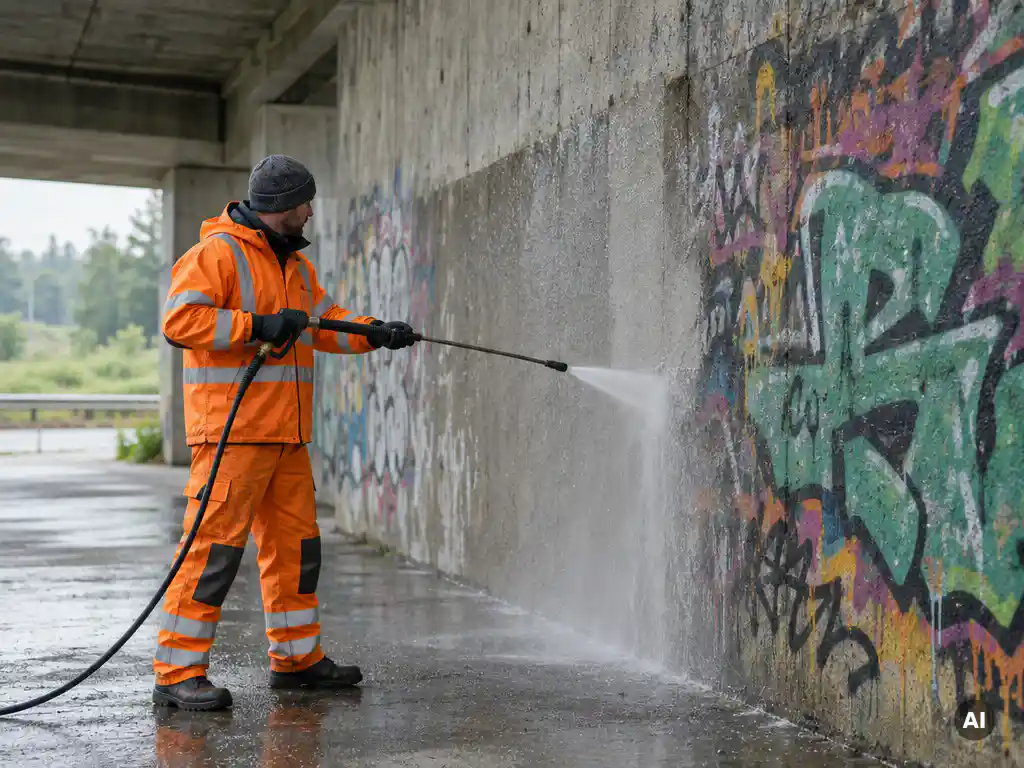
You apply a graffiti remover to large surfaces by applying the product undiluted and in a controlled manner to the affected area, allowing sufficient dwell time, and then removing it mechanically or with water. For large surfaces, a structured approach is important: work in zones, make sure you have the right tools, and match the product to the type of substrate. In this article, we answer the most frequently asked practical questions about using a graffiti remover on a large scale.
What preparation is needed before cleaning large surfaces?
Before cleaning large surfaces, you inspect the substrate, determine the type of graffiti, and make sure you have the right personal protective equipment. Good preparation prevents damage to the surface and ensures the cleaning process runs efficiently. Always consult the product data sheet and label of the graffiti remover you are using.
Start with a visual inspection of the entire surface. Note which materials are present, such as concrete, stone, metal, or glass, and check for damage, cracks, or previously applied coatings. This partly determines which product and which method you use.
For large surfaces, make sure you have a clear work plan. Divide the area into zones and work systematically, preferably from top to bottom. This prevents run-off cleaning agent from re-soiling areas that have already been cleaned. Also prepare the necessary materials: brush, roller, spraying equipment, and rinse water.
Check the weather conditions. In extreme cold or direct, bright sunlight, the action of the cleaning product can be affected. Consult the product data sheet for specific application conditions. Always wear the protective equipment prescribed on the label, such as gloves and safety glasses.
How do you correctly apply a graffiti cleaner on large surfaces?
You apply a graffiti remover undiluted to the affected surface, allow it sufficient time to work, and then remove it mechanically or with water. On large surfaces, you work in demarcated zones and use a brush, roller, or suitable spraying equipment for an even distribution.
Apply the product to the graffiti surface and make sure the affected zone is fully covered. On vertical surfaces, a product in gel form is preferable: the gel stays on the surface better and runs off less quickly, which benefits its action. Products such as the GraffitiRemover Gel have been developed specifically for this type of application on both porous and non-porous substrates.
After the dwell time, which you always match to the information on the product data sheet, you remove the product together with the dissolved graffiti. You do this mechanically with a brush or scraper, followed by thorough rinsing with water. Work zone by zone so that the product does not dry out before removal.
Let specialists determine whether higher pressure is necessary or desirable when rinsing. Excessive pressure can cause damage on delicate substrates. After rinsing, check whether the graffiti has been completely removed and, if necessary, repeat the treatment on stubborn residues.
We’ll figure it out for you!
Want to talk through your challenge?
Our advisors will gladly help you with a practical solution.
Which graffiti cleaner works best on porous substrates?
On porous substrates such as concrete, brickwork, and natural stone, a graffiti remover in gel form works most effectively. The gel form provides a longer contact time with the surface, allowing the product to penetrate deeper into the pores and dissolve the graffiti better.
Porous materials absorb graffiti quickly, causing the paint or ink to seep deep into the structure. A product with the right viscosity stays active on the surface longer and dissolves more components of the graffiti than a thin, free-flowing cleaning agent that runs off quickly.
With natural stone, pay attention to the variation in material properties. Granite is a type of natural stone, but not every natural stone reacts to cleaning agents in the same way. If you are in doubt about the suitability of a product for a specific substrate, always carry out a test treatment on a non-visible part of the surface. Specialists can assess which product and which method are most suitable for the specific situation.
For more information on application to buildings and facades, see our page on removing graffiti from buildings.
How do you prevent damage to the surface during graffiti cleaning?
You prevent damage to the surface by choosing the right product for the specific substrate, always carrying out a test treatment, and strictly following the instructions on the product data sheet and label. Excessive dwell time, incorrect use of tools, or too much pressure when rinsing are the most common causes of surface damage.
For every new project and every unfamiliar substrate, carry out a test treatment on a small, non-visible area. This lets you check that the product does not cause an unwanted reaction, such as discoloration, damage to the top layer, or a change in the surface structure.
Stick to the recommended dwell time as stated on the product data sheet. Letting the product work longer than recommended is not always better and can actually cause damage on sensitive materials. Remove the product and the dissolved graffiti in good time and rinse thoroughly.
If you are in doubt about the suitability of a cleaning product for a particular material, we always advise consulting specialists. Based on the specific situation, they can determine the most responsible approach and rule out unnecessary risks. Also see our information on removing graffiti ghosting, a common problem after unprofessional cleaning.
When does an anti-graffiti coating make sense after cleaning?
An anti-graffiti coating makes sense after cleaning when a surface is regularly targeted by graffiti or when the substrate is difficult to clean because of its porous structure. A coating protects the surface and makes future removal easier and less intensive.
Semi-permanent versus permanent anti-graffiti coating
With a semi-permanent coating, the protective layer disappears with each graffiti removal and must be reapplied afterwards. This type of coating is suitable for situations where occasional graffiti is expected and the substrate is protected again after each treatment.
A permanent anti-graffiti coating withstands multiple cleaning cycles. The exact number varies per system and per product. This type is interesting for locations that structurally deal with graffiti, such as infrastructure and public transport. You can read more about applications in public transport on our page on removing graffiti in public transport.
Impregnating agents with anti-graffiti properties
For porous substrates such as concrete and natural stone, an impregnating agent with anti-graffiti properties is sometimes a suitable choice. Graffitiguard Permanent is an example of an impregnating agent that combines anti-graffiti properties with protection of the substrate. Consult the product data sheet for the specific application conditions and service life, which is generally a maximum of ten years, unless product-specific information states otherwise.
Anti-graffiti coatings can take over the function of facade impregnation. Therefore, do not recommend the combination of coating and impregnation as standard, but assess it case by case based on the properties of the substrate and the expected use.
How we support you with professional graffiti removal
We develop and produce professional graffiti removers that meet the requirements of business specialists, contractors, municipalities, and managers of buildings and infrastructure. Our approach is practical and results-oriented:
- Graffiti removers in gel form, to be applied undiluted on both porous and non-porous substrates
- Products suitable for a wide range of materials, including concrete, brickwork, metal, glass, and ceramics
- Anti-graffiti coatings in both semi-permanent and permanent versions, tailored to the location and use
- Technical advice and support with product selection and application
- Product data sheets and labels with precise application instructions for each product
Would you like to know which product best suits your situation, or do you have a specific question about application on large surfaces? Get in touch via our contact form or call us directly on +31 (0) 418 680 680. We’d be happy to think along with you.