
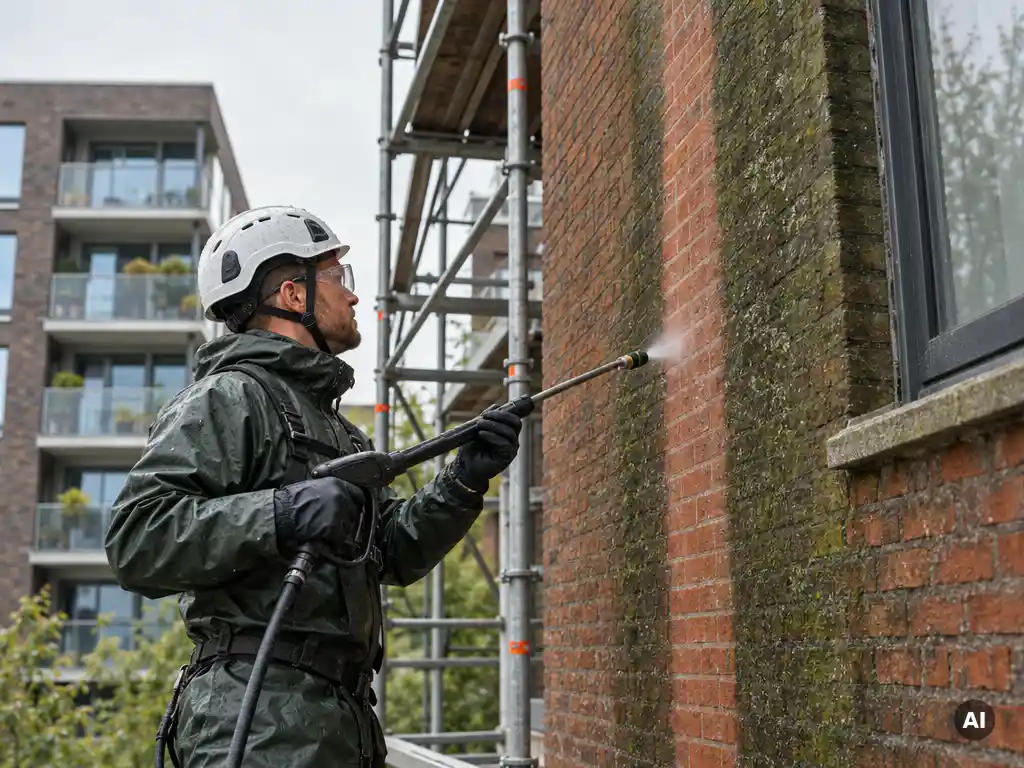
You should have a facade professionally cleaned every five to ten years on average, depending on the material, the location, and the degree of contamination. Facades in urban environments or near busy roads need maintenance more often than facades in rural areas. In this article, we answer the most frequently asked questions about facade cleaning, so you know when action is needed and which approach suits your situation.
Which factors determine how often a facade needs cleaning?
How often a facade needs cleaning depends on several factors: the facade material, the environmental load, the orientation of the building, and the presence of a protective coating. There is no universal standard that applies to every building. Anyone who understands these factors can draw up a realistic maintenance schedule.
- Material: Brick and concrete are porous materials that retain dirt and moisture more readily than non-porous cladding. Porous substrates generally require more frequent maintenance.
- Location and surroundings: Facades along busy roads, in industrial zones, or in city centers are exposed to soot, fine particulate matter, and exhaust fumes. This speeds up contamination considerably.
- Orientation: North- and east-facing facades dry more slowly, which promotes algae growth and moss formation. South- and west-facing facades receive more direct sunlight and are less susceptible to biological growth.
- Presence of impregnation or coating: An impregnated or coated facade repels water and dirt better, so cleaning is needed less often.
- Graffiti and vandalism: Buildings in locations with an increased risk of graffiti require a different approach than standard maintenance.
How often should a facade be professionally cleaned?
As a rule of thumb, a cleaning interval of five to ten years applies to most facades in the Netherlands. Facades in urban or industrial environments may need cleaning every three to five years. Facades with an active protective layer or impregnation can last longer without visible contamination.
For professional clients such as municipalities, housing associations, and property managers, it is wise to have specialists assess the condition of the facade periodically. A visual inspection every two to three years shows whether cleaning is necessary or can still be postponed. This helps you avoid unnecessary costs and prevents contamination from penetrating so deeply that a more intensive, more expensive cleaning becomes necessary.
You can find more information about professional facade cleaning in our product overview.
What are the signs that a facade needs cleaning immediately?
A facade needs cleaning immediately if there is visible biological growth, deep discoloration, efflorescence, or graffiti. If you wait too long, contamination penetrates deeper into the material and the damage increases. Early intervention limits the cleaning effort and protects the substrate.
Specific signs to watch for:
- Algae, moss, or mold: Green or black deposits on the facade indicate biological growth, often the result of prolonged moisture retention in the substrate.
- Efflorescence: White stains on brick or concrete are a sign that salts are migrating out of the material. This points to moisture problems and calls for a targeted approach.
- Soot deposits and discoloration: Gray or black discoloration caused by fine particulate matter or exhaust fumes spoils the appearance and can damage the material with prolonged exposure.
- Graffiti: Graffiti should be removed as quickly as possible. The longer paint dries, the harder it becomes to remove. Take a look at our range of graffiti removers for professional solutions.
- Water infiltration or moisture penetration: If water is visibly seeping through the facade, cleaning is often the first step toward further protection.
What is the difference between facade cleaning and facade impregnation?
Facade cleaning removes dirt, deposits, and biological growth from the facade surface. Facade impregnation is a follow-up step in which a protective substance is applied to the pores of the material to repel water, dirt, and other harmful substances. The two treatments complement each other, but they are not interchangeable.
Facade impregnation generally uses combinations of alkylsilanes and (poly)siloxanes. These components penetrate the pores of the substrate and make the surface water-repellent without blocking vapor permeability. As a result, the facade continues to “breathe” while moisture from outside is kept out. An impregnation typically lasts up to ten years, depending on the product and the conditions.
Cleaning always comes before impregnation: a contaminated or damp substrate reduces the adhesion and effectiveness of the impregnating agent. Specialists assess the moisture content of the facade before proceeding with impregnation.
Which cleaning method is suitable for which type of facade?
The choice of cleaning method depends on the facade material, the nature of the contamination, and the condition of the surface. The wrong method can damage the material or work the contamination in even deeper. Specialists always tailor the method to the specific situation.
- High-pressure cleaning: Suitable for robust materials such as concrete and certain types of brick. Not suitable for weathered or damaged joints, soft natural stone, or facades with existing coatings.
- Chemical cleaning: Effective for stubborn contamination such as soot deposits, efflorescence, or biological growth. The choice between acidic, alkaline, or neutral cleaning agents depends heavily on the material. Granite and other types of natural stone react differently to acids than concrete or brick, so a wrong choice can cause damage.
- Soft cleaning (low-pressure): Suitable for sensitive materials such as sandstone, calcium silicate brick, or historic facades. Combines low water pressure with suitable cleaning agents.
- Steam cleaning: Used for specific contamination or sensitive surfaces where water pressure is not desirable.
Always consult the product data sheet and the label of the cleaning agent for the correct application, safety measures, and contact times.
What does professional facade cleaning cost on average?
The cost of professional facade cleaning varies widely and depends on the surface area, the degree of contamination, the type of facade, and the chosen method. A generally applicable price overview cannot be given without assessing a specific situation. Clients are well advised to request several quotes and to check exactly what is included in the price.
Factors that influence the price:
- The total facade surface area in square meters
- The accessibility of the facade (scaffolding, aerial work platform, or rope access)
- The nature and severity of the contamination
- The type of material and the required cleaning method
- Whether follow-up treatment such as impregnation or coating is included
Investing in periodic cleaning and follow-up treatment saves money in the long run. A well-maintained facade needs less intensive treatments and lasts longer without structural damage.
How we help with facade cleaning and protection
We develop and produce professional products for facade cleaning and facade protection, specifically aimed at the requirements of business clients in construction, property management, and infrastructure. Our product range includes:
- Professional cleaning agents for a wide variety of facade types and contaminants
- Impregnating agents based on alkylsilanes and (poly)siloxanes for durable moisture protection
- Semi-permanent and permanent coatings for non-porous cladding and window frames, such as Nitowax, Nitoshield, Nitocryl® and Nitocolour, with a service life of up to ten years
- Graffiti removers and anti-graffiti coatings for locations with an increased risk of vandalism
All products are developed for professional application by specialists. In addition to products, we offer advice and support in choosing the right product for your specific situation. Get in touch via our contact form or call +31 (0) 418 680 680 directly for expert, tailored advice.