
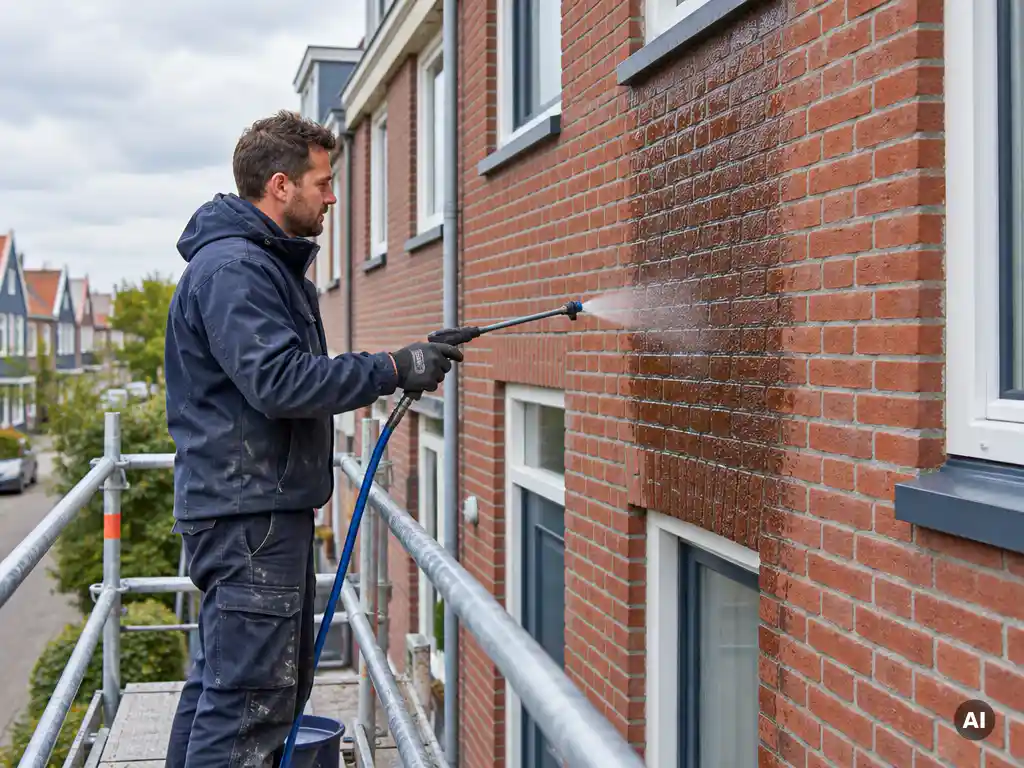
Professionally waterproofing a façade takes one to two days on average, depending on the size of the project and the condition of the substrate. The preparation, including cleaning and drying, takes up most of that time. Below, we answer the most frequently asked questions about the process, from preparation to the duration of the protection.
What factors determine how long impregnation takes?
The total turnaround time of a façade impregnation depends on several variables: the surface area and accessibility of the façade, the porosity and moisture content of the substrate, the weather conditions during application, and the number of coats required. Each of these factors can significantly affect the execution time.
A dry, well-prepared façade of limited size can be impregnated in a single day. For larger projects, or when the façade first needs to be thoroughly cleaned and given sufficient drying time, the job quickly stretches over several days. Accessibility also plays a role: a façade that requires scaffolding or aerial work platforms demands more logistical preparation.
The porosity of the material also determines how much impregnating agent the substrate absorbs and whether a second coat is needed. Stone with high absorption requires more time and product than a denser substrate. Specialists assess this in advance to create a realistic schedule.
How long does an impregnating agent take to dry on a façade?
The drying time of an impregnating agent on a façade typically ranges from a few hours to twenty-four hours, depending on the product, the temperature, the humidity, and the porosity of the substrate. Always consult the product data sheet for the specific drying times of the product used.
Impregnating agents based on alkylsilanes and (poly)siloxanes penetrate the substrate and react chemically with the material. This process, also known as carbonation or crosslinking, depends on the ambient temperature. At lower temperatures, curing is slower. The façade must not get wet during the drying time, as this can impair the effectiveness of the agent.
Specialists therefore plan the application carefully, taking into account the weather forecast for the hours following the treatment.
Does the façade need to be cleaned before impregnation?
Yes, thorough façade cleaning is a required step before impregnation. Dirt, algae, moss, lime, or other deposits block the pores of the substrate, which prevents the impregnating agent from penetrating properly and leaves the protection insufficient.
After cleaning, the façade must be completely dry before impregnation can take place. Too high a moisture content in the substrate prevents the active components of the impregnating agent from soaking properly into the material. Depending on the cleaning method and the weather conditions, the drying time required after cleaning can vary from a few hours to several days.
Specialists assess the moisture content of the substrate before starting the impregnation, for example with a moisture meter. This way you avoid applying the product to a substrate that is not yet ready for it.
How many coats of impregnating agent are needed for an optimal result?
For most applications, one or two coats of impregnating agent are sufficient. The exact number depends on the porosity of the substrate and the recommendations in the product data sheet of the product used. Highly porous materials generally require a second coat to ensure full penetration.
With façade impregnation and water-repellent treatment, the second coat is applied while the first is still wet, or after a specific waiting time as indicated on the product data sheet. This ensures optimal adhesion and a uniform protective effect across the entire surface.
Applying more coats than recommended does not automatically lead to better protection and can even cause an unwanted film layer on the surface. Therefore, always follow the instructions on the product data sheet and the label.
When is the best time to impregnate a façade?
The best time to impregnate a façade is during dry weather, at temperatures between roughly five and twenty-five degrees Celsius, and at low humidity. Frost, rain, or direct sunlight during application can negatively affect the performance of the impregnating agent. Always check the product-specific temperature and weather recommendations.
In practice, spring and autumn are often suitable periods in the Netherlands: temperatures are moderate and the risk of extreme heat or frost is limited. Summer heat can make the agent dry too quickly, which hinders penetration into the substrate. In winter, the risk of frost is too high, which disrupts curing.
Specialists preferably schedule impregnation projects based on the multi-day weather forecast, so that the drying time after application also takes place under good conditions.
How long does professional façade impregnation protect?
A professional façade impregnation typically provides protection for up to ten years, depending on the quality of the product used, the condition of the substrate, and the degree of exposure to the weather. The actual lifespan differs per situation and per product.
Façades that are heavily exposed to rain, wind, or pollution wear out faster than façades in a more sheltered environment. Regular inspection helps determine in good time whether retreatment is needed, before moisture gets free rein in the substrate again.
The combination of a well-prepared substrate, professional application, and a high-quality impregnating agent based on alkylsilanes and (poly)siloxanes offers the best guarantee of long-lasting protection. If in doubt, have the condition of the impregnation assessed by specialists.
How we help with façade impregnation and protection
We develop and produce professional products for the renovation and protection of façades, tailored to the requirements of specialists in construction, property management, and infrastructure. Our approach is concrete:
- Wide product range: from façade cleaners to semi-permanent and permanent coatings such as Nitowax, Nitoshield, Nitocryl® and Nitocolour, designed for different substrates and protection goals.
- Technical advice: we help you think through the right product choice for your specific façade and situation, so you don’t face surprises during execution.
- Application support: we offer training and guidance, so that specialists apply our products correctly and effectively.
- ISO 9001-certified quality: all products are developed, tested, and produced in-house according to strict quality standards.
Want to know which impregnating agent or coating best suits your project? Contact us or call +31 (0) 418 680 680 directly. We’ll be happy to help.