
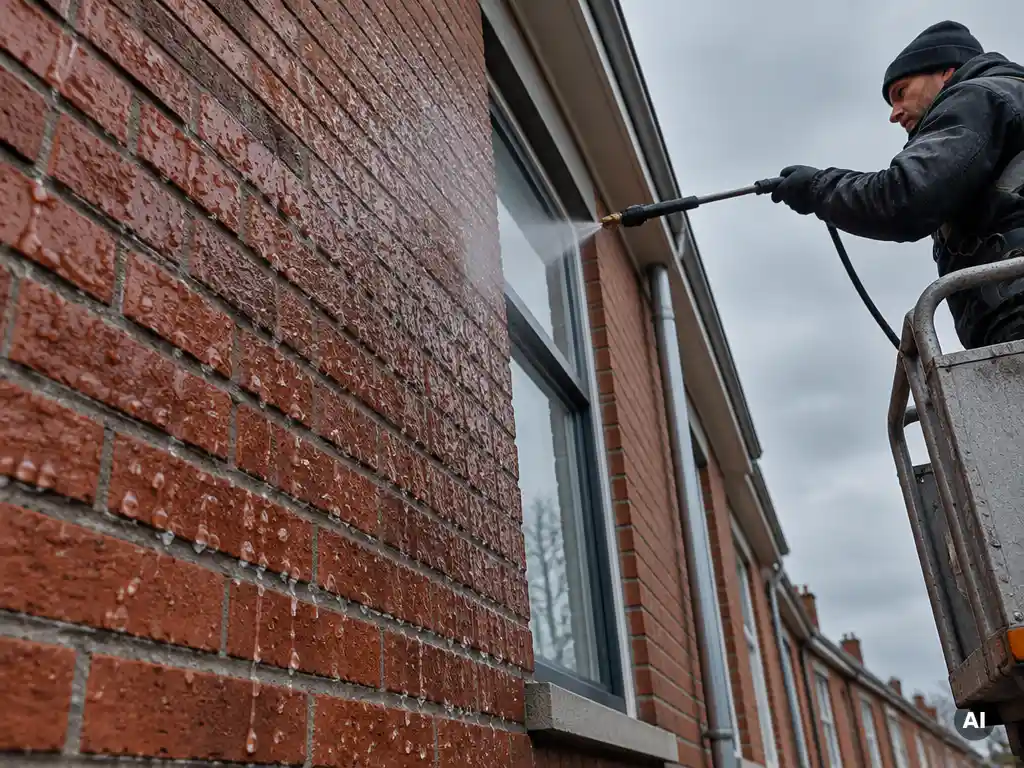
Facade impregnation is a treatment in which a water-repellent substance penetrates deep into the pores of the facade material, so that moisture can no longer be drawn into the substrate. The surface remains vapour-permeable, but liquid water is repelled. For professional clients and specialists, this is one of the most effective ways to prevent long-term facade damage. In this article, we answer the most frequently asked questions about impregnating facades: from how it works to how long it lasts.
How does moisture actually penetrate a facade?
Moisture penetrates a facade through capillary action: the tiny pores and hairline cracks in the material actively absorb moisture, much like a sponge. Rain, condensation and rising damp can thus be drawn deep into brickwork, concrete or natural stone. Once in the substrate, this moisture content causes damage through freeze-thaw cycles, salt efflorescence and biological growth.
The speed at which moisture enters a facade depends on the porosity of the material and the condition of the surface. A weathered or damaged facade has larger pores and absorbs more moisture. Without protection, this process continues year after year, leading to structural damage that is costly to repair. Facade cleaning beforehand is therefore a logical first step, so that the impregnating product can penetrate optimally.
What exactly does facade impregnation do to the surface?
Facade impregnation penetrates the pores of the substrate and forms a water-repellent layer there from the inside out. The active components, usually a combination of alkylsilanes and (poly)siloxanes, react chemically with the substrate and make the pore walls hydrophobic. Liquid water is repelled, while water vapour can still escape through the material.
This is what distinguishes impregnation from a coating: no visible layer forms on the surface. The facade material retains its natural appearance and texture. Because the treatment works from the inside out, it is also less susceptible to mechanical wear than surface coatings. The vapour permeability of the substrate is preserved, which prevents moisture build-up behind the treatment.
Which materials are suitable for facade impregnation?
Facade impregnation is suitable for porous mineral substrates such as brick, concrete, calcium silicate brick, sandstone and various other types of natural stone. These materials have enough pores to absorb the active components. Non-porous substrates such as glass, metal or glazed ceramics do not absorb the product and are therefore unsuitable for impregnation.
An important point for specialists: not every type of natural stone reacts in the same way. Porosity, mineral composition and surface condition all influence how well an impregnating product can penetrate and what result is achieved. If in doubt, always carry out a test treatment on an inconspicuous area and consult the product data sheet for the specific application guidelines.
What are the concrete benefits of an impregnated facade?
An impregnated facade repels moisture, which greatly limits moisture-related damage such as frost damage, salt efflorescence and biological growth. In addition, the facade stays clean longer because dirt adheres less readily to a hydrophobic substrate. This reduces maintenance frequency and total management costs in the long term.
The main benefits at a glance:
- Moisture repellence: rainwater beads off instead of soaking in
- Frost protection: less water in the pores means less risk of frost damage
- Less salt efflorescence: dissolved salt migrates to the surface less easily
- Limited biological growth: algae and moss have less moisture available to grow
- Lower maintenance costs: the facade stays in good condition longer, which limits cleaning and repair costs
- Preserved appearance: the surface does not visibly change in colour or texture
For building owners and facility managers who want to extend the lifespan of their facade, impregnation is a practical and well-founded choice. You can find more information about the application options on the page about facade impregnation and water-repellent treatment.
When is facade impregnation necessary and when is it not?
Facade impregnation makes sense when a porous facade visibly absorbs moisture, when there is frost damage or salt efflorescence, or when the facade is structurally exposed to rain and fluctuating humidity. Impregnation is also a relevant measure in renovation projects where the facade needs to be protected again.
Impregnation is less advisable or even ineffective in the following situations:
- The facade is non-porous or already has a dense coating
- There is active rising damp from the foundation, in which case the cause must be eliminated first
- The substrate is heavily contaminated or damaged and requires repair first
- An anti-graffiti coating has been applied that already takes over the function of impregnation
Always check the condition of the facade beforehand. An impregnation treatment on a damaged or dirty substrate will not deliver the desired result.
How long does facade impregnation last?
The lifespan of facade impregnation is generally up to ten years, depending on the product used, the substrate and the degree of exposure to the weather. Facades facing north or in locations heavily exposed to rain may require reapplication sooner than facades with less direct exposure to the elements.
The effectiveness gradually decreases as the treatment ages. A water droplet test, in which you check whether water still beads and runs off or starts to soak in, gives a practical indication of when retreatment is needed. Consult the data sheet of the specific impregnating product for the recommended retreatment intervals and application conditions.
How Mavro helps with impregnating and protecting facades
We develop and produce professional products for facade cleaning and protection, tailored to the requirements of specialists in construction, renovation and property management. Our approach combines technical knowledge with practical support. Here is what we offer:
- Impregnating products based on alkylsilanes and (poly)siloxanes for porous mineral substrates
- Semi-permanent and permanent coatings such as Nitowax, Nitoshield, Nitocryl® and Nitocolour for the protection and renovation of facade cladding and window frames, with a lifespan of up to ten years
- Technical advice and product support when choosing the right product for your specific substrate and application
- Training and guidance for specialists who apply our products in practice
Would you like to know which product best suits your project? Get in touch via our contact form or call us directly on +31 (0) 418 680 680. We’d be happy to think along with you.