
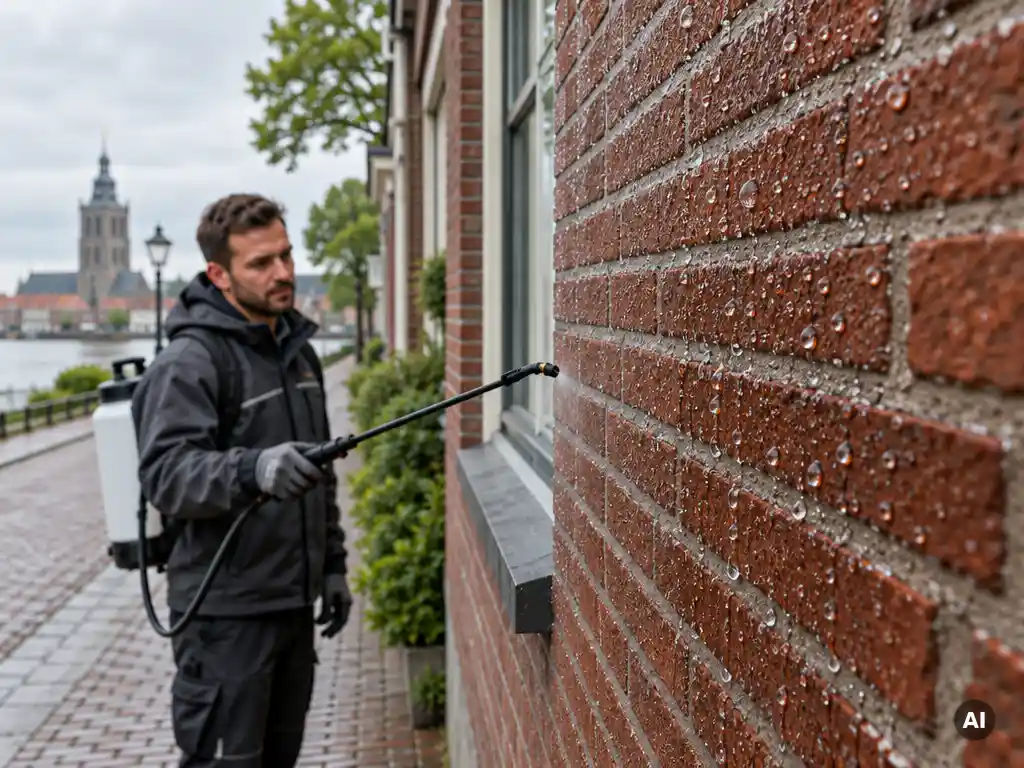
Façade impregnation contributes to sustainable building management by protecting the substrate against moisture penetration, contamination and weathering, which significantly reduces the need for extensive repairs. For professional building managers, contractors and facility managers, this means lower maintenance costs over a building’s entire life cycle. Below, we answer the most frequently asked questions about impregnating façades, from the protection it offers to the right re-treatment frequency.
What exactly does façade impregnation protect against?
Façade impregnation primarily protects a façade against moisture penetration. An impregnation treatment based on alkylsilanes and (poly)siloxanes penetrates deep into the pores of the substrate and makes the surface water-repellent, without blocking vapour permeability. This allows the façade to keep breathing while rainwater, condensation and splash water are repelled.
In addition to moisture, façade impregnation also offers resistance to:
- Contamination and algae growth, because a dry substrate offers less of a breeding ground for biological attack
- Frost damage, because less moisture penetrates the material and therefore less expansion occurs in freezing weather
- Salt efflorescence, which occurs when moisture transports soluble salts to the surface
- Weathering caused by UV radiation and temperature fluctuations, which are intensified when materials are damp
It is important to note that façade impregnation is not a coating layer. The treated surface remains visually unchanged. This makes it particularly suitable for façades where the original appearance must be preserved, such as brick, concrete, natural stone and calcium silicate brick.
How does façade impregnation extend the lifespan of a building?
Façade impregnation extends the lifespan of a building because it structurally addresses the primary cause of material damage, namely moisture penetration. Moisture is responsible for a large share of the degradation processes in façade materials: from concrete rot and joint deterioration to mould growth and structural weakening. By interrupting this mechanism, you significantly slow down the ageing process of the façade.
In practice, this means that impregnating façades increases the intervals between costly repair work. Well-impregnated façades need façade cleaning less often, are less susceptible to frost damage in winter and require repairs to pointing or plasterwork less quickly. For building owners and property managers, this translates directly into lower maintenance costs in the long term.
In addition, an impregnated façade protects the structural layers behind the façade surface. When moisture is structurally kept out, the insulation value of the building envelope also remains better, which is relevant for the building’s energy performance.
What is the difference between façade impregnation and façade coating?
The main difference between façade impregnation and façade coating is that impregnation penetrates the substrate and remains invisible, while a coating forms a continuous protective layer on the surface. Both methods protect the façade, but through a different mechanism and with a different visual result.
Façade impregnation
With impregnation, the active components, usually alkylsilanes and (poly)siloxanes, penetrate deep into the pores of the material. They make the substrate hydrophobic from the inside out. The surface remains open, the façade can breathe and the appearance does not visibly change. This makes impregnation suitable for materials where the texture and colour must be preserved.
Façade coating
A façade coating forms a closed, visible protective film on the surface. This offers broader protection, including against mechanical stress, graffiti and chemical attack. Coatings can also be used to restore the colour of weathered façades. Products such as Nitocolour are specifically developed for colour restoration on non-porous façade cladding and window frames, with a lifespan of generally up to ten years. When damaged, coatings require a different approach than impregnating agents and are not always suitable for porous, breathable substrates.
The choice between impregnation and coating depends on the substrate, the degree of weathering, the desired protection and the visual result. A specialist assesses which method is most suitable for the specific situation.
When is façade impregnation necessary for building maintenance?
Façade impregnation is relevant when a façade demonstrably has moisture problems or when the substrate is naturally porous and susceptible to moisture absorption. Indicators pointing to the need for an impregnation treatment include visible damp patches after rainfall, algae or moss growth, frost damage to brickwork, joint failure and salt efflorescence.
Preventive impregnation is also a good choice for:
- New-build or renovated façades where the substrate is still in good condition
- Buildings in a humid or weather-prone climate
- Historic buildings where the existing façade structure must be preserved
- Façades that are open and clean again after professional façade cleaning
Please note: façade impregnation is only effective on a clean, dry and structurally intact substrate. If there are cracks, serious joint damage or an excessively high moisture content in the façade, the substrate must first be repaired before impregnation makes sense.
How environmentally friendly are modern façade impregnating agents?
Modern façade impregnating agents based on alkylsilanes and (poly)siloxanes are generally water-based and have lower VOC emissions than solvent-based alternatives. This makes them better suited in many situations to environments with ventilation restrictions or in the vicinity of people. Whether a specific product meets certain standards or qualifications depends on the product-specific composition and documentation.
What does apply in general: a well-executed façade impregnation extends a building’s maintenance cycle. Less frequent repairs also mean less use of materials, less transport and fewer labour-intensive interventions. From a building management perspective, that is a relevant consideration when opting for preventive maintenance.
Always consult the product data sheet and label of the specific impregnation product for the exact technical and safety information.
How often should a professionally treated façade be re-treated?
A professionally applied façade impregnation generally has a lifespan of up to ten years, depending on the product used, the substrate and the degree of exposure to weather conditions. There is no universal re-treatment frequency; the condition of the treated façade determines when a re-treatment is needed.
Factors that influence the lifespan of an impregnation treatment include:
- The porosity and moisture content of the substrate at the time of treatment
- The amount of precipitation and UV exposure to which the façade is subjected
- The quality of the execution and the preparation of the surface
- Mechanical stress or damage to the façade surface after treatment
A visual inspection by a specialist provides a reliable indication: when water no longer beads on the surface but is absorbed immediately, the water-repellent effect has diminished and re-treatment is due. Have the assessment carried out by a specialist who can measure the condition of the substrate and the moisture content before a new treatment is applied.
How Mavro helps with façade impregnation and façade protection
We develop and produce professional products for façade cleaning, impregnation and protection, tailored to the requirements of business specialists in construction, the real estate sector and facility services. Our range for façade protection includes, among others:
- Impregnation products based on alkylsilanes and (poly)siloxanes for porous substrates such as brick, concrete and calcium silicate brick
- Semi-permanent and permanent coatings such as Nitowax, Nitoshield and Nitocryl® for non-porous façade cladding and window frames
- Nitocolour for colour restoration of weathered façades, with a lifespan of generally up to ten years
- Graffiti removers and anti-graffiti products, including Graffitiguard Permanent, an impregnating agent with anti-graffiti properties
Would you like to know which product is most suitable for your façade type and maintenance situation? Then get in touch via our contact form or call us directly on +31 (0) 418 680 680. Our specialists will be happy to help you find the right solution.