
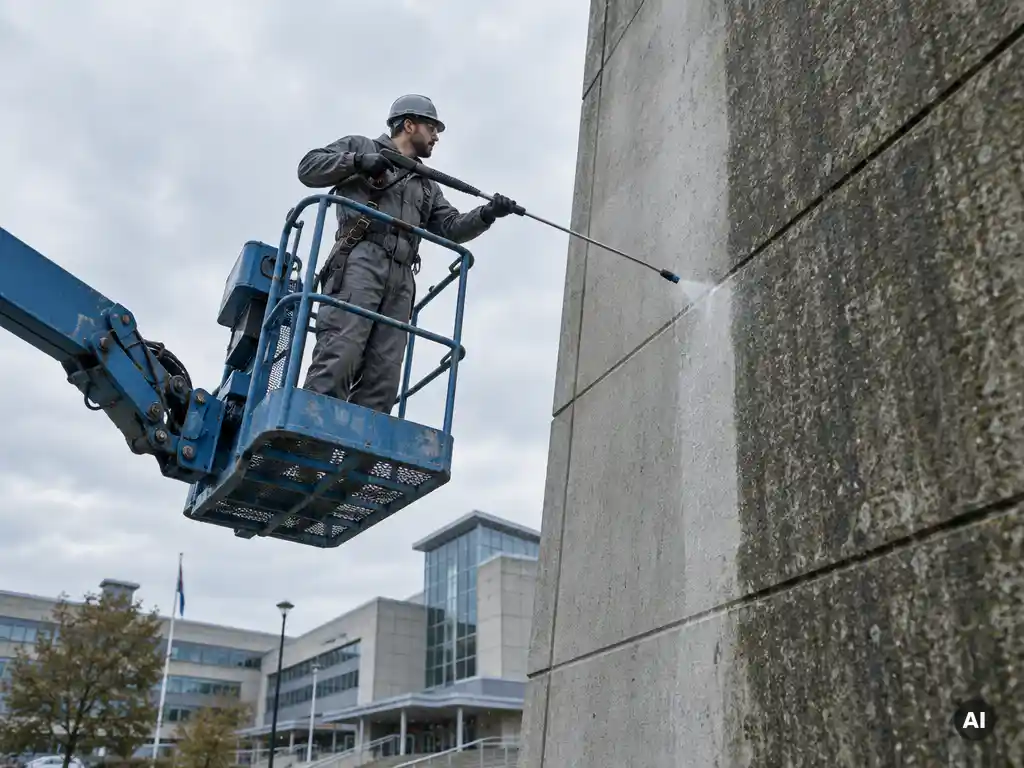
Facade cleaning for industrial and public buildings is a specialized process in which dirt, biological growth, and discoloration are removed from the facade using professional cleaning methods and products, tailored to the type of substrate and the nature of the contamination. For industrial and public buildings, this is particularly relevant because these properties are used intensively, exposed to harsh environmental conditions, and visible to a large audience. The questions below give you a clear picture of how professional facade cleaning works in practice and when which approach is the right one.
Which types of contamination are most common on industrial and public facades?
Industrial and public facades mainly suffer from biological growth (algae, moss, lichen), black crusts caused by soot and exhaust fumes, efflorescence, rust streaks, graffiti, and general atmospheric pollution. The combination of intensive use, traffic, and weather conditions makes these facades especially vulnerable to stubborn contamination.
Public buildings such as train stations, town halls, and schools regularly have to deal with graffiti and vandalism. Industrial buildings more often struggle with oil and grease residues, soot deposits, and chemical contamination from the immediate surroundings. Efflorescence occurs when dissolved lime from the masonry migrates to the surface and dries out. Rust streaks often originate from metal fasteners or roof edges. All of these types of contamination require a specific approach, because a cleaning agent that is effective on algae does not necessarily work on baked-on soot or graffiti.
Which cleaning methods are used in professional facade cleaning?
Professional facade cleaning uses three main methods: mechanical cleaning (high-pressure cleaning, sandblasting), chemical cleaning with specialized cleaning agents, and combinations of the two. The choice depends on the type of substrate, the nature of the contamination, and the desired result.
High-pressure cleaning is effective for removing loose dirt and biological growth, but requires the right pressure setting to avoid damaging the substrate. Sandblasting or similar abrasive techniques are used for stubborn crusts, but are not suitable for sensitive materials such as softer types of natural stone. Chemical cleaning offers more control: the right agent penetrates the contamination, dissolves it, and makes mechanical follow-up treatment easier or unnecessary. For graffiti on facades, specialized graffiti removers are applied undiluted, with the product working into the paint layer without attacking the substrate. Specialists always assess the material and condition of the facade first before choosing a method.
How often should an industrial or public facade be cleaned?
There is no universal cleaning frequency for industrial or public facades. The required frequency depends on the location, the type of substrate, the degree of exposure to contamination, and whether the facade has a protective coating or impregnation. Urban or industrial environments require cleaning more often than rural areas.
Buildings along busy roads or near industrial activity can accumulate more dirt than buildings in quieter surroundings. Public buildings with a high visitor density also run a greater risk of graffiti and mechanical soiling. A facade that is inspected regularly gives you the opportunity to intervene in time, before contamination penetrates deep into the material and cleaning becomes more invasive and costly. Based on a facade inspection, specialists can draw up a realistic maintenance schedule that fits the specific situation of the building.
What is the difference between facade cleaning and facade protection?
Facade cleaning removes existing dirt from the surface. Facade protection, such as facade impregnation, treats the surface after cleaning to slow down or prevent future contamination. The two processes complement each other, but serve a fundamentally different function.
With facade impregnation, substances based on alkylsilanes and (poly)siloxanes are applied into the pores of the substrate. These substances make the surface water-repellent without blocking vapor permeability. Moisture can no longer penetrate easily, which reduces algae growth, efflorescence, and frost damage. The service life of an impregnation is generally up to ten years, depending on the substrate and the conditions. Coatings such as those from the Nitowax, Nitoshield, and Nitocryl lines go further than impregnation: they form an active protective layer on the surface that repels moisture, oils, solvents, and graffiti. Nitocolour is a color restorer with a service life of up to ten years and gives weathered facades their original appearance back. Cleaning is always the first step, because a protective coating or impregnation only adheres well to a clean, dry substrate.
When is chemical facade cleaning the right choice?
Chemical facade cleaning is the right choice when mechanical methods alone give insufficient results, when the substrate is too sensitive to high pressure or abrasion, or when the contamination is chemically bonded to the surface. Think of rust, lime, biological growth, or baked-on soot crusts.
Chemical agents work selectively: an acidic cleaner dissolves lime deposits, while an alkaline agent works better on grease and soot. Not every substrate tolerates every type of cleaning agent. Granite is admittedly a natural stone, but not all types of natural stone react in the same way to acids or alkaline agents. Always consult the product data sheet and the label of the cleaning agent, and leave the choice to specialists who know the substrate. Chemical cleaning also requires the right safety measures and personal protective equipment; the product documentation provides the authoritative information on this.
What are the risks of improper facade cleaning?
Improper facade cleaning can lead to damage to the substrate, loss of moisture-regulating properties, frost damage, accelerated soiling, and, in the worst case, structural damage to the masonry or the facade finish. The risks increase the more sensitive the substrate is and the more aggressive the method.
Excessive water pressure can blast out soft joints or damage the surface structure of natural stone or brick. Wrong chemical agents can cause discoloration, clog pores, or weaken the bond between mortar and stone. When acidic agents are used on sensitive substrates, there is a risk of chemical reactions that permanently damage the material. Incomplete cleaning, where dirt is removed superficially but remains deeper in the material, also leads to faster re-soiling. Professional execution by specialists who use the right products, methods, and safety protocols prevents these problems and protects the investment in the building over the long term.
How we help with facade cleaning and facade protection
We offer professional solutions for facade cleaning and facade protection, tailored to the specific requirements of industrial and public buildings. Our range includes:
- Specialized cleaning agents for a wide variety of contamination types and substrates
- Graffiti removers that are applied undiluted and work effectively without damaging the substrate
- Impregnating agents based on alkylsilanes and (poly)siloxanes for durable water repellency
- Semi-permanent and permanent coatings such as Nitowax, Nitoshield, Nitocryl, and Nitocolour for facade protection and color restoration with a service life of generally up to ten years
- Technical advice and support with product selection and application
Would you like to know which approach best suits your building or project? Get in touch via our contact form or call us directly on +31 (0) 418 680 680. Our specialists will be happy to help you think it through.