
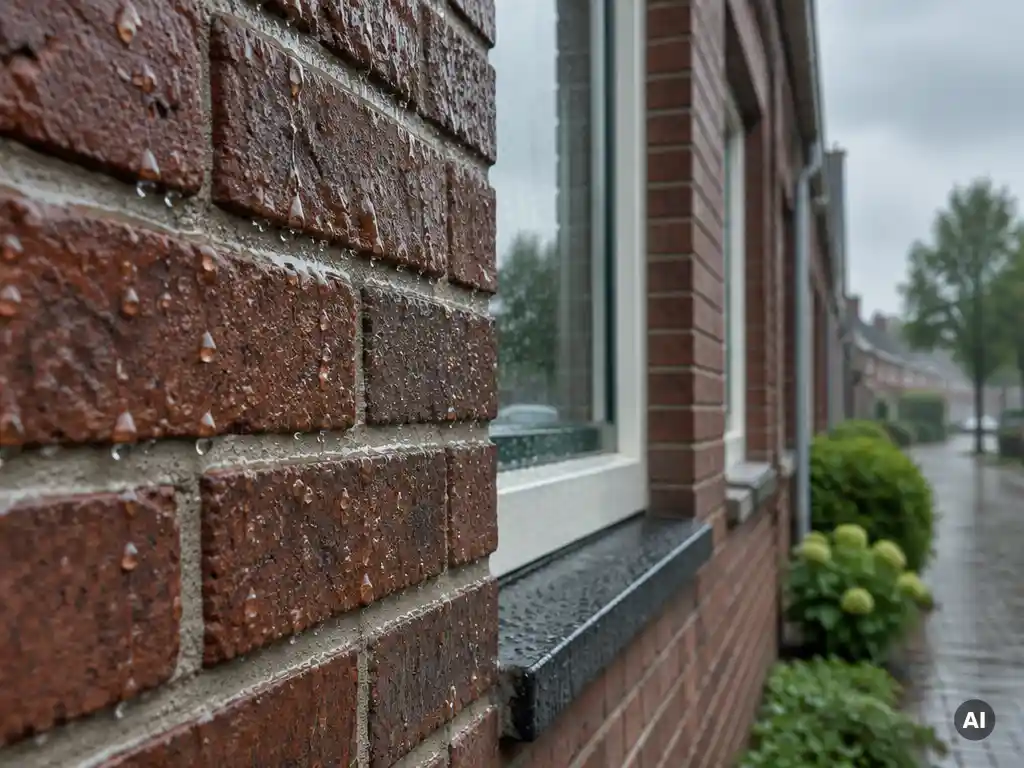
Façade impregnation protects a façade against moisture and the elements by creating a water-repellent effect within the material. Rainwater literally beads off the façade instead of soaking in. This prevents moisture damage, algae growth and temperature-related damage in the long term. The level of protection depends on the product used, the façade material and the quality of the application. Below we answer the most frequently asked questions about façade impregnation.
How does moisture penetrate a façade?
Moisture penetrates a façade through microscopic pores and hairline cracks in the material. During rain, frost or condensation, water is drawn in through these openings. Once inside the material, the moisture can cause damage through expansion in freezing weather, salt efflorescence and deterioration of the façade material’s structure.
Brick, concrete and natural stone are naturally porous. This means they absorb moisture like a sponge, especially if the surface has not been treated. During persistent rain or damp conditions, the material slowly becomes saturated. When the temperature drops, the absorbed water freezes and expands. This pressure from within causes cracks and spalling, a process also known as frost damage.
In addition to direct rainfall, rising damp also plays a role, particularly in façades that are in contact with the ground. Combined with wind driving rain diagonally against the façade, façades are continuously exposed to moisture loads from multiple directions.
What exactly does façade impregnation do to the material?
Façade impregnation penetrates deep into the pores of the façade material and forms a water-repellent barrier there. The material remains permeable to water vapour, so moisture can escape from the inside, while liquid water from the outside is kept out. This hydrophobic effect greatly reduces moisture absorption without changing the appearance of the façade.
The active components in professional impregnation products generally consist of a combination of alkylsilanes and (poly)siloxanes. These substances bond to the pore walls and make the surface water-repellent at the molecular level. Rainwater forms droplets that roll off the façade instead of soaking in.
An important advantage is that façade impregnation retains the material’s vapour permeability. The façade can continue to breathe, which prevents condensation on the inside. This distinguishes impregnation from a dense coating that seals the surface completely and can therefore cause internal moisture problems.
Want to know more about how façade impregnation and hydrophobic treatment work in practice? Take a look at our overview of applications and products.
We’ll figure it out for you!
Want to talk through your challenge?
Our advisers will gladly help you find a practical solution.
Which façade materials are suitable for impregnation?
Façade impregnation is suitable for porous materials such as brick, concrete, natural stone, calcium silicate brick and decorative plaster. These materials naturally absorb moisture and benefit immediately from a hydrophobic treatment. Non-porous materials such as glass, metal or smooth plastic are not suitable, because the impregnation product cannot get a grip on the surface.
For façades with a coating or paint, impregnation only works if the existing layer has been removed or is permeable. A treated surface that is already waterproof will not absorb the impregnation product. It is therefore always wise to first check whether the material is sufficiently porous and has a suitable moisture content before starting the impregnation.
For non-porous façade cladding and window frames, other protection solutions exist, such as semi-permanent or permanent coatings that protect the surface and restore the colour. But for most traditional façade materials used in Dutch construction, impregnation is the most effective and least invasive way to achieve moisture protection.
How long does façade impregnation protect against the elements?
A high-quality façade impregnation generally protects a façade against the elements for up to ten years. The exact service life depends on the product used, the porosity of the material, the exposure to sun and rain, and the quality of the application. Consult the product data sheet for product-specific information on the expected service life.
Over time, the hydrophobic effect slowly breaks down due to UV radiation, temperature fluctuations and mechanical wear. You will notice this when rainwater no longer beads off but soaks into the material again. That is the moment to repeat the treatment.
Regular façade cleaning extends the service life of the impregnation. Dirt, algae and moss attack the treated layer and reduce its water-repellent effect. A clean façade is therefore a prerequisite for optimal and long-lasting protection.
When is professional façade impregnation necessary?
Professional façade impregnation is important when a façade shows visible moisture problems, such as damp patches after rain, efflorescence, algae growth or flaking pointing. A professional treatment is also the right step when renovating older buildings, after façade cleaning, or for façades that are heavily exposed to wind and rain.
For large façade surfaces, hard-to-reach sections or façades with a complex structure, professional application is not only practical but also necessary for even and complete coverage. Incorrect application, an insufficient dosage, or impregnating a façade with too high a moisture content or inadequate preparation results in a treatment that quickly loses its effectiveness.
Professional application by specialists also ensures that the right product is chosen for the specific material. Not every impregnation product works equally well on every substrate. A specialist assesses the condition of the façade, prepares the surface and applies the product in the way that provides the best and most durable protection. For application and safety, always consult the product data sheet and label.
What are the consequences of an untreated or aged façade impregnation?
An untreated or aged façade impregnation gives moisture free rein. In the long run, this leads to frost damage, salt efflorescence, algae and moss growth, discolouration and structural deterioration of the façade material. Repair costs quickly mount in cases of severe moisture damage, whereas preventive impregnation costs only a fraction of that.
Moisture infiltration not only affects the façade, but can also reach the structure behind it. Insulation material that gets wet loses its insulating properties. Woodwork in the façade construction can start to rot. In the long term, moisture damage can lead to structural problems that are costly and time-consuming to repair.
In addition, a neglected façade increases the risk of graffiti damage. A porous, untreated façade absorbs graffiti deep into the material, making graffiti removal considerably more difficult and expensive. Mavro graffiti removers are applied undiluted; consult the product data sheet for the correct method for each substrate.
How we help with façade impregnation and façade cleaning
We develop and produce professional products for the protection and renovation of façades, tailored to the requirements of contractors, property managers and maintenance companies. Our range offers solutions for every stage of façade maintenance:
- Hydrophobic impregnation products based on alkylsilanes and (poly)siloxanes, which penetrate deep into porous materials and provide long-lasting moisture protection
- Professional façade cleaners that thoroughly prepare the surface for impregnation or coating
- Semi-permanent and permanent coatings such as Nitowax, Nitoshield, Nitocryl and Nitocolour, for non-porous façade cladding and window frames; the service life differs per system and is stated on the product data sheet
- Anti-graffiti and graffiti-removing products that protect the façade against vandalism; anti-graffiti coatings can take over the function of façade impregnation, so an additional impregnation treatment is generally not needed
Want to know which product best suits your façade or project? Contact us and we will help you further with tailored advice.