
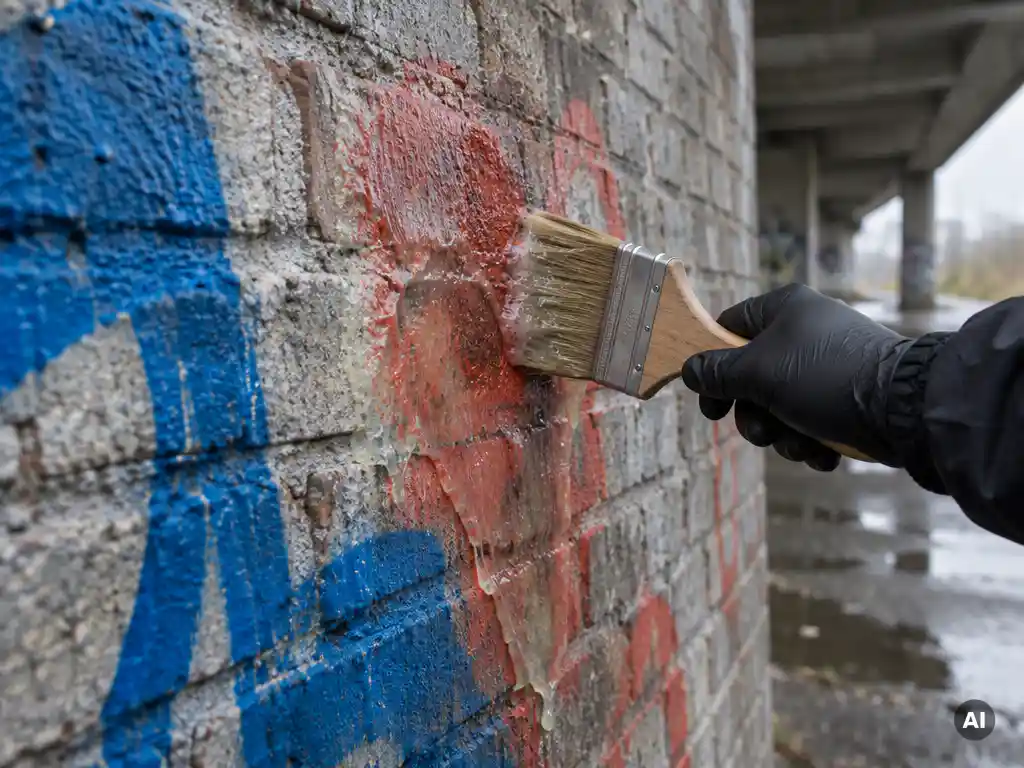
A gel-based graffiti remover works by keeping the active chemical components in contact with the paint or ink on the surface for longer. Where a liquid product quickly runs off, gel stays in place where it is applied and gives the active ingredients time to dissolve graffiti thoroughly. This makes gel-based removers particularly suitable for vertical surfaces and hard-to-reach areas. The questions below go into more detail on how it works, how to apply it, and how to choose the right approach.
What makes a gel base more effective than a liquid remover?
The gel form ensures the product stays on the surface instead of running off immediately. This extended contact gives the active components the chance to penetrate deeper into the paint layer and loosen graffiti more effectively. On vertical surfaces, such as facades and tunnel walls, this difference is clearly noticeable in practice.
A liquid graffiti remover has its value on horizontal surfaces or with fresh graffiti that has not yet fully soaked in. But as soon as graffiti is older, has penetrated deeper into a porous surface, or is located on a vertical substrate, the gel form offers a clear advantage. The gel does not run off, evaporates more slowly, and therefore works in a more targeted way. That makes it a more reliable choice for specialists on more complex removal jobs.
How does the gel chemically dissolve graffiti?
The active components in a graffiti gel penetrate the paint film and break down the binders in the graffiti. As a result, the paint or ink loses its adhesion to the surface and the whole can be rinsed off or removed. The gel form slows the evaporation of active substances, so the chemical reaction proceeds longer and more effectively.
Graffiti generally consists of synthetic paints, markers, or lacquers made up of pigments, solvents, and binders. The chemical components in a gel-based graffiti gel target those binders. Once the bond is broken, the paint layer detaches from the underlying surface. The result is that the graffiti is effectively lifted off and can be removed without damaging the material underneath, provided the right product is used for the substrate in question. Always consult the product data sheet and label for the correct procedure.
On which surfaces does a graffiti gel work best?
A gel-based graffiti remover works on both porous and non-porous surfaces, including concrete, masonry, ceramics, metal, and glass. On porous materials the gel form is especially useful because the longer dwell time gives the active substances the chance to work deeper into the pores. Consult the product data sheet for each specific substrate.
Not every substrate reacts the same way to chemical products. Natural stone, such as granite or limestone, calls for extra caution because the mineral composition differs per type of stone. Some types of stone are sensitive to acids or strongly alkaline products. When in doubt, it is therefore important to first clean a test area and consult the product specifications. For applications on buildings and facades, the substrate and the nature of the graffiti determine the choice of product. Specialists assess this on a case-by-case basis.
On non-porous surfaces such as metal, glass, and glazed ceramics, the gel adheres well and the remover can do its work without penetrating the material. On vehicles and rolling stock, such as trams and trains, this is a commonly used approach. More information on removing graffiti from public transport provides insight into the specific requirements that apply.
How do you correctly apply a gel-based graffiti remover?
A graffiti gel is applied undiluted to the affected surface, preferably with a brush, spatula, or sprayer. After application, you let the gel work, after which the dissolved graffiti is rinsed off or removed mechanically. For dwell times and specific working instructions, always follow the product data sheet and label.
Correct application calls for a structured approach:
- Apply the gel undiluted to the graffiti area and ensure even coverage
- Let the gel work in accordance with the instructions on the product data sheet
- Remove the dissolved graffiti by rinsing with water or cleaning mechanically
- Repeat the treatment if residues remain, depending on the severity of the contamination
- After cleaning, check for any graffiti ghosting and treat it separately if necessary
Graffiti ghosting, the discoloration that remains in the surface after removal, sometimes requires an additional treatment. You can find more information about this at removing graffiti ghosting. Always have complex removal jobs carried out by specialists who are familiar with the product specifications and the properties of the substrate.
When is an anti-graffiti coating the better choice?
An anti-graffiti coating is the better choice when a surface is regularly targeted by graffiti. The coating protects the underlying material and makes future removal easier. At locations with a high frequency of graffiti, preventive protection is preferable to repeated corrective intervention.
There are two main types of anti-graffiti coatings, each requiring a different approach:
- Semi-permanent coating: this coating protects the surface, but disappears during graffiti removal and must then be reapplied. Suitable for locations where protection is desired but the coating is renewed periodically.
- Permanent coating: this withstands multiple cleaning cycles. The exact number varies per system and depends on the product specifications.
A special case is Graffiti Removal Permanent (Graffitiverwijdering Permanent), an impregnating agent with anti-graffiti properties that protects the surface without forming a visible film layer. Anti-graffiti coatings can also take over the function of facade impregnation, but do not recommend the combination of coating and impregnation as standard without assessing the specific situation. The choice between corrective removal and preventive protection depends on the location, the surface material, and the frequency of attacks.
How we help with graffiti removal
We develop and produce professional graffiti removers, including gel-based formulations, that meet the requirements of specialists in the cleaning, infrastructure, and real estate sectors. Our products are tailored to a wide range of substrates and application situations. This is what we offer:
- Professional graffiti removers in gel form, suitable for porous and non-porous surfaces
- Product data sheets and technical documentation for each product for correct application
- Tailored advice on the right product choice per substrate and situation
- Anti-graffiti coatings for preventive protection, both semi-permanent and permanent
- Support and training for specialists who work with our products
Would you like to know which product best suits your situation? Get in touch via our contact form or call directly on +31 (0) 418 680 680. We are happy to think along with you.