
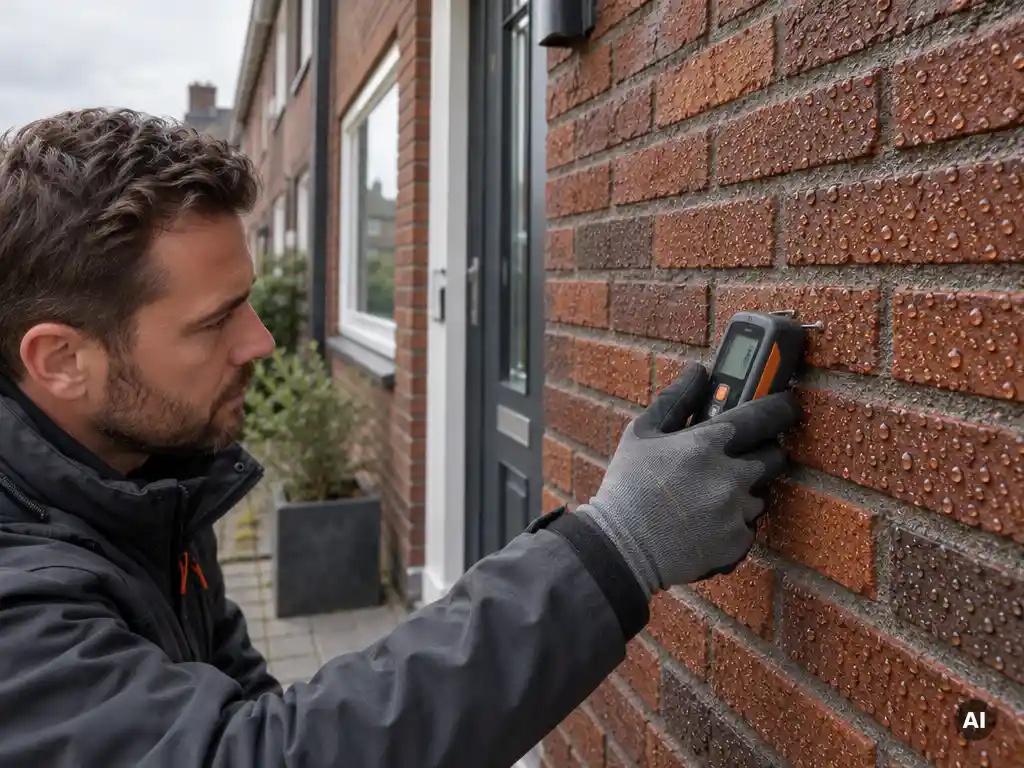
You can demonstrate the quality of an impregnation treatment by measuring the moisture content of the substrate beforehand, testing the effect after curing with a water repellency test, and recording everything in a quality file. That way, your clients can see exactly what was applied, on which substrate, and with what result.
A facade impregnation usually consists of a combination of alkylsilanes and (poly)siloxanes that make the facade water-repellent. You can’t always see the result with the naked eye, so backing it up with measurements and documentation makes the difference between a claim and proof. Below, you can read how to approach this as a facade specialist.
Which measurements prove that an impregnation works?
An impregnation demonstrably works when you record the water-repellent effect in a measurable way on the treated facade, preferably with a comparative measurement on an untreated reference area. This lets you show the difference between before and after the treatment in concrete terms, rather than merely pointing to the product description.
In practice, specialists use various methods to make this visible:
- Measuring moisture content: you measure the moisture content of the substrate before application, so you can be sure the facade is dry enough for the treatment.
- Water repellency test: after curing, you apply water to the treated facade and record whether the water beads off or is absorbed after all.
- Comparison with a reference area: a small untreated section of facade immediately shows the difference in water absorption.
- Photographic documentation: photos of the tests, with date and location, make the results transferable.
Choose the measurement method in consultation with your client and record in advance which method you will use. For the correct application conditions of a product, we always refer to the product data sheet and the label.
What belongs in a quality file for the treatment?
A quality file records all the data needed to trace and assess the treatment: the facade details, the pretreatment carried out, the product used with batch number, the conditions during application, and the measurement results afterwards.
A useful file contains at least the following components:
- Project details: address, type of substrate (for example brick or concrete), treated surface area, and date of application.
- Initial situation: photos of the facade before treatment and any special circumstances such as soiling, efflorescence, or defects.
- Pretreatment: which cleaning you carried out, which product you used for it, and how long the facade was left to dry afterwards.
- Product information: name of the impregnating agent, batch number, the product data sheet, and the quantity applied.
- Weather conditions: dry or wet conditions and the temperature during application.
- Measurement results: the outcomes of your moisture measurements and water repellency tests, including the location on the facade.
- Final situation: photos of the completed treatment and a signed handover.
With such a file, you can still explain what was done years later. This helps in the event of a complaint and makes your work easier to assess for property managers and housing associations.
How do you prepare the facade so that the result is demonstrable?
You prepare the facade by first cleaning it thoroughly, rinsing it completely, and allowing it to dry sufficiently, so that the impregnating agent can reach the pores. A well-prepared substrate makes the treatment more effective and your measurement results more reliable.
Start with an inspection of the substrate. Check whether there is soiling, efflorescence, algae, or cement residue, because these can hinder the effect of the impregnation. For facade cleaning, choose a cleaner that suits the type of substrate. Always do a test patch first to check suitability, because not every substrate reacts the same way to acidic or alkaline products.
After cleaning, make sure the substrate is completely rinsed and dry before you start impregnating. With Facadeclean HC, for example, the substrate must be completely rinsed and dried before you apply a coating or impregnating agent. Then measure the moisture content and note the value in your file. A facade that is too damp gives poor penetration and an unreliable measurement result.
For the application of each product, read the product data sheet and the safety data sheet, and wear the prescribed protective equipment.
Which warranty and certification give clients confidence?
Clients mainly place their trust in a written warranty from the specialist, supported by products from a manufacturer with a certified quality system. Documented application and clear agreements about service life make that warranty credible and verifiable.
When drawing up a warranty, pay attention to the following points:
- Realistic term: the service life of a facade impregnation is generally a maximum of ten years, unless product-specific information indicates otherwise. Don’t promise more than the product can deliver.
- Dependence on application: link the warranty to documented preparation and application in accordance with the product data sheet.
- Exclusions: state what is not covered by the warranty, such as mechanical damage or later changes to the facade.
- Manufacturer’s quality system: Mavro International is ISO 9001 certified, which provides a guarantee of quality in both products and advice.
Keep in mind that an anti-graffiti coating can take over the function of a facade impregnation. Therefore, do not combine both systems by default. If in doubt, first determine which function the client needs. Information about facade impregnation and water repellent treatment helps you substantiate that choice.
When is a follow-up measurement after handover advisable?
A follow-up measurement after handover is advisable when the client wants demonstrability over the longer term, for large or high-risk facades, and before the warranty period expires. By repeating the measurement under the same conditions, you can see whether the water-repellent effect is still present.
Schedule a follow-up measurement in the following situations:
- For large projects: for housing associations or property managers with multiple buildings, a fixed inspection gives insight into the performance per facade.
- For facade types under special load: facades that endure a lot of rain or soiling require extra attention.
- At the end of the warranty period: a final measurement shows whether the treatment is still functioning or whether retreatment is needed.
- After a complaint: a measurement at the location in question helps determine whether the cause lies with the impregnation.
For the follow-up, use the same method and the same measuring points as at handover, so that you can compare the results fairly. Add the outcomes to the quality file.
How we help you demonstrate impregnation quality
We support you as facade specialists at every step of the process, from product selection to handover. Our technical advisors are out in the field every day to inspect substrates, apply test patches, and guide customers when starting up large projects.
- Tailored advice: we assess the substrate with you and recommend a suitable cleaner and impregnation.
- Product documentation: you receive product data sheets and safety data sheets that you can include directly in your quality file.
- Training: we show you how to achieve perfect results, because a successful result is an interplay of products and craftsmanship.
- Technical support: our R&D department helps think through questions about specific situations.
Do you have a project where you want to substantiate the quality of the impregnation? Contact us or call +31 (0) 418 680 680. We are happy to think along with you.