
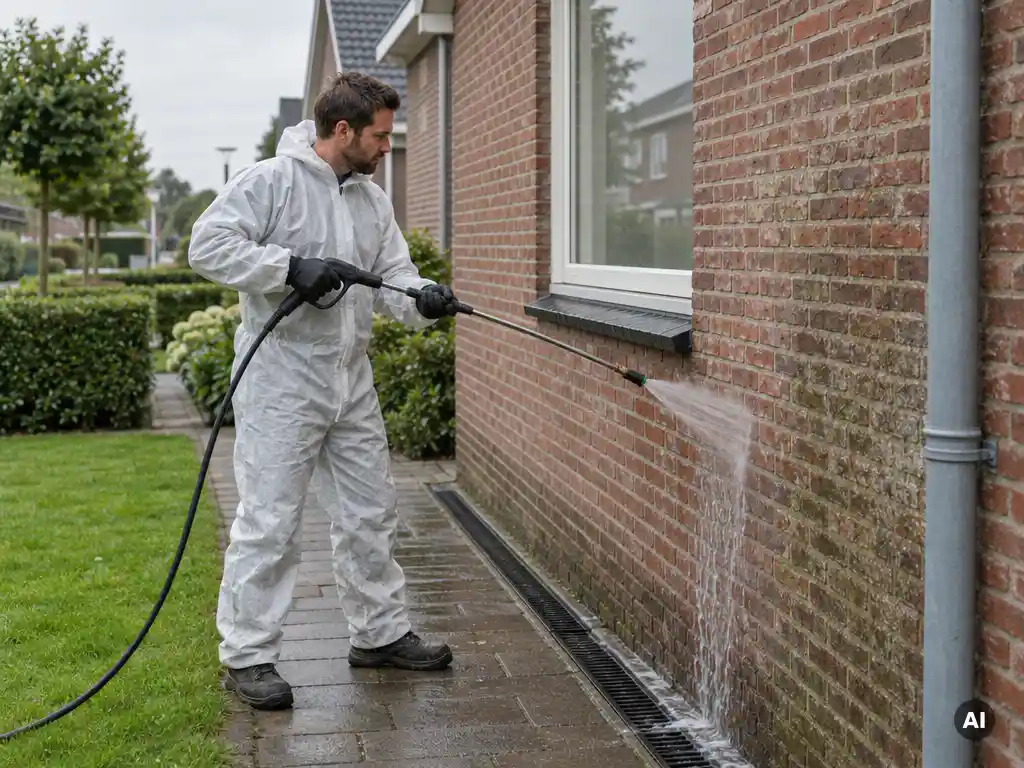
In 2026, stricter requirements apply to facade cleaning products in terms of chemical composition, biocide authorisation and safety classification. Professional users are required to use only approved products that comply with European regulations such as the REACH Regulation and the Biocidal Products Regulation (BPR). Below you will find an overview of the most relevant questions and answers for anyone who works professionally with facade cleaning.
What laws and regulations apply to cleaning products in construction?
In 2026, cleaning products used in construction fall under several European and national regulatory frameworks. The most important are the REACH Regulation (registration, evaluation and authorisation of chemical substances), the CLP Regulation (classification, labelling and packaging) and the Biocidal Products Regulation (BPR, EU 528/2012). Together, these frameworks determine which substances are permitted, how products must be labelled and under what conditions they may be used professionally.
For professional facade cleaning, this means in practice that every product placed on the market or used professionally must demonstrably comply with these regulations. Products with a biocidal effect, such as agents that control algae, moss or mould, also require a specific product authorisation. Without that authorisation, their use is in violation of the law.
In addition to European regulations, national authorities may impose additional requirements, for example through the Statutory Instructions for Use (WG) or through tender requirements set by municipalities and housing associations. Professional users are well advised to consult these documents for each product before starting work.
Which substances are banned or restricted in facade cleaning products?
Various chemical substances are banned or subject to strict restrictions in facade cleaning products. These include certain biocides that are harmful to aquatic organisms, persistent organic pollutants (POPs) and substances on the REACH authorisation list. In practice, heavy metals, chlorinated solvents and certain quaternary ammonium compounds are restricted or no longer permitted in many applications.
Acids such as hydrochloric acid and strongly alkaline products are not banned, but their use is subject to strict safety requirements and application guidelines. Not every substrate can tolerate such products, and professional specialists are responsible for selecting the right one based on the product data sheet and the label.
The REACH Regulation includes a candidate list of Substances of Very High Concern (SVHC). Suppliers are required to be transparent about the presence of these substances above threshold values. For every product, check the safety data sheet (SDS) for current SVHC entries.
We’ll figure it out for you!
Want to talk through your challenge?
Our advisors will gladly help you find a practical solution.
What does the Biocidal Products Regulation (BPR) mean for facade cleaners?
The Biocidal Products Regulation (BPR, EU 528/2012) requires that facade cleaners with a biocidal effect, such as products that kill or prevent algae, lichens or mould, hold a valid product authorisation in each Member State. Without this authorisation, the product may not be placed on the market or used professionally, regardless of its composition.
The product types covered by the BPR for facade cleaning applications are mainly PT2 (disinfectants and algaecides not intended for direct application to humans or animals) and PT10 (construction material preservatives). Suppliers are required to apply for and maintain an authorisation for each product type.
For professional users, this means that when purchasing facade cleaning products you must always request and verify the authorisation number. In the Netherlands, the Ctgb (Board for the Authorisation of Plant Protection Products and Biocides) is the competent authority. Using non-authorised biocides can lead to enforcement action by the NVWA and liability for damage.
How do you recognise an environmentally friendly certified facade cleaning product?
A certified facade cleaning product can be recognised by recognised quality marks and documentation that substantiate its chemical composition and application profile. Think of the EU Ecolabel, the Nordic Swan Ecolabel or a REACH-compliant composition with a complete safety data sheet. Please note: a quality mark is no guarantee of suitability for every substrate or every cleaning purpose.
In addition to quality marks, always check the safety data sheet (SDS) for the presence of SVHC substances, the pH value of the product and its classification under the CLP Regulation. Products with a low hazard classification and a fully documented composition provide greater certainty of compliance with current standards.
Be wary of general claims on packaging that are not backed up by the product documentation. A product that describes itself as “green” or “safe” without demonstrable certification or SDS substantiation offers insufficient certainty for professional use in 2026.
What are the consequences of non-compliance for professional users?
Professional users who apply non-authorised or non-compliant facade cleaning products risk enforcement action by regulators such as the NVWA, liability for damage to property or the environment, and exclusion from tenders. In serious cases, the use of banned biocides can lead to criminal prosecution.
Contractors, maintenance companies and facility managers are themselves responsible for the products they use. The responsibility does not lie solely with the supplier: the user is also obliged to check whether a product holds the correct authorisation and whether it is applied in accordance with the label and the WG.
Non-compliance can also affect insurance coverage. Damage caused by the use of a non-authorised product is regularly rejected by insurers. Therefore, always document which product you used, including the authorisation number and the safety data sheet applied.
How do you choose a facade cleaning product that meets the 2026 standards?
You select a facade cleaning product that meets the 2026 standards based on three criteria: a valid product authorisation under the BPR (if biocidal), complete REACH-compliant documentation, and suitability for the specific substrate and type of contamination. Always check the safety data sheet and the label before starting work.
Step 1: Determine the nature of the contamination and the substrate
Not every cleaning product is suitable for every substrate. Acidic products can damage certain types of natural stone, while strongly alkaline products are not suitable for aluminium facade cladding. Always match your choice to the specific situation and consult the product data sheet.
Step 2: Verify authorisation and documentation
Ask the supplier for the Ctgb authorisation number for biocidal products and check that the safety data sheet is up to date. Products without demonstrable authorisation do not meet the 2026 requirements and may not be used professionally.
After cleaning, it is advisable to consider whether facade impregnation makes sense to protect the substrate against moisture and soiling. Impregnating products based on alkylsilanes and (poly)siloxanes penetrate deep into the substrate and generally offer protection for up to ten years, depending on the system and the substrate.
How Mavro helps with compliant facade cleaning
We develop and produce facade cleaning and protection products tailored to the requirements of professional specialists. Our products are documented, technically substantiated and supplied with the necessary product data sheets and safety data sheets. What we offer:
- Facade cleaning products tailored to specific substrates and types of contamination
- Protective coatings such as Nitowax, Nitoshield and Nitocryl® for non-porous facade cladding and window frames
- Colour restoration coatings such as Nitocolour with a service life of up to ten years
- Complete product documentation, including up-to-date safety data sheets
- Technical advice and training for correct on-site application
Want to know which product suits your specific situation? Get in touch via our contact form or call our specialists directly: +31 (0) 418 680 680.