
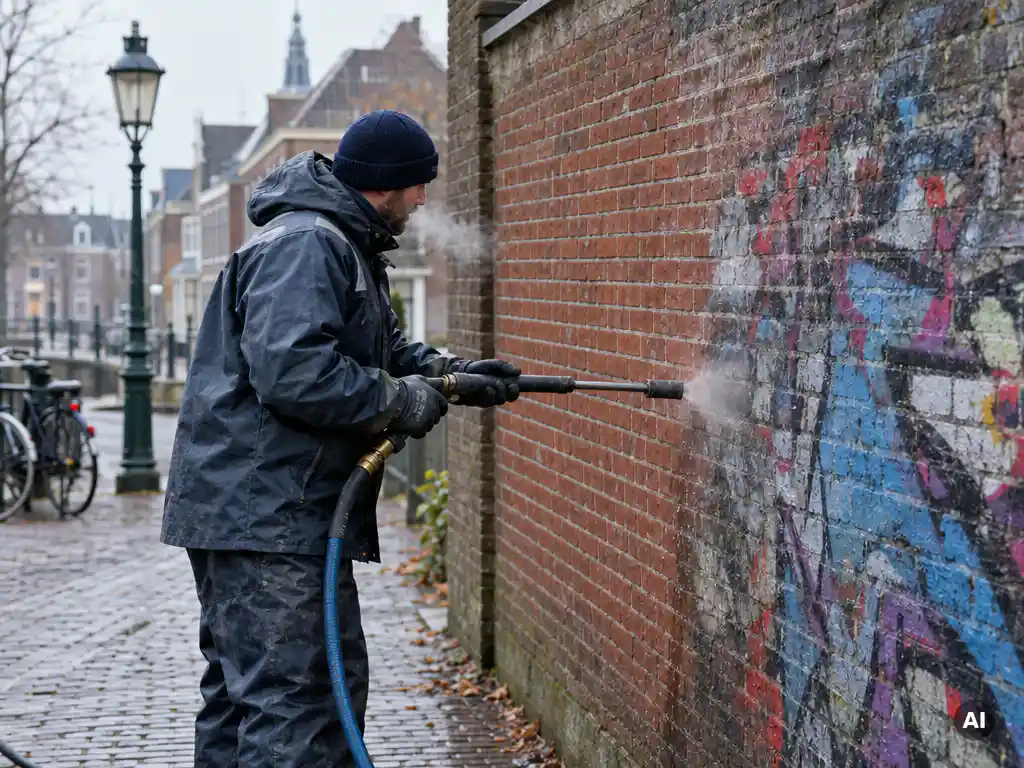
Yes, removing graffiti at low temperatures is possible, but it requires an adapted approach. Standard cleaning agents perform differently in freezing weather, which directly affects removal effectiveness and increases the risk of surface damage. Which methods do work, how do you prevent damage, and when should you call in a specialist? You’ll find the answers to those questions below.
What happens to graffiti cleaning agents in freezing weather?
At temperatures around or below freezing, the properties of graffiti cleaning agents change drastically. Liquids become more viscous or partially freeze, so the active components penetrate the surface less effectively. The result: longer dwell times, reduced solubility of paint and ink, and a higher risk of incomplete removal.
The moisture content of the substrate also plays an important role. Stone, concrete, and brickwork absorb liquid less well at low temperatures. If a cleaning agent does not soak sufficiently into the substrate, it keeps working on the surface and the chance of residue or graffiti ghosting increases. With frozen substrates the situation is even more complex: the product cannot adhere properly and the risk of surface damage increases.
Gel-based formulations behave differently in the cold than water-based liquids. Gels stay on the substrate longer and evaporate more slowly, but their effectiveness is also temperature-dependent. Always consult the product data sheet for the minimum application temperature of the specific product you are using.
Which graffiti cleaning methods do work at low temperatures?
At low temperatures, professional graffiti removers in gel form generally work better than water-based alternatives. Gels cling to vertical surfaces, dry out more slowly, and stay in contact with the graffiti longer, which improves their action even when the ambient temperature is low.
Besides product choice, there are practical measures that increase effectiveness in winter conditions:
- Preferably work at the warmest time of day, when the surface temperature is at its highest.
- Temporarily cover the treated surface with film or cloth to retain heat and limit drying out.
- Check that the substrate is free of ice or frost before applying the cleaning agent.
- Keep a close eye on the dwell time and extend it if necessary based on the product instructions.
Mechanical methods such as high-pressure cleaning can serve as a supplement, but are risky in frost because water in the substrate can freeze. Only use them if conditions allow and the substrate can handle it. Consult the label and the product data sheet for specific application instructions.
How do you prevent surface damage when removing graffiti in winter?
You prevent surface damage when removing graffiti in winter by combining the right product choice with careful preparation of the substrate. Frozen or moisture-rich substrates are more susceptible to damage, especially with aggressive cleaning agents. Always test the product first on a small, inconspicuous area before treating a larger surface.
When removing graffiti from buildings, the type of substrate determines the approach. Not every natural stone, type of concrete, or metal surface reacts the same way to cleaning agents. Granite, for example, is a dense natural stone, but other types of natural stone can be more porous or acid-sensitive. Use only products that are suitable for the specific substrate in question.
Additional points of attention to prevent damage:
- Apply the cleaning agent undiluted, as prescribed for professional graffiti removers.
- Rinse the substrate thoroughly after treatment to remove product residue before it freezes.
- Let the surface dry completely before applying a protective coating.
- Call in specialists if you are unsure whether a product is suitable for a specific substrate or condition.
Does an anti-graffiti coating play a role in winter maintenance?
An anti-graffiti coating makes graffiti removal in winter considerably easier. Thanks to the coating, the cleaning agent does not have to work as deep into the substrate, which improves effectiveness at low temperatures and reduces the chance of surface damage.
There are two types of anti-graffiti coatings, each with its own behavior under repeated cleaning:
- Semi-permanent anti-graffiti coating: This coating disappears during graffiti removal and must be reapplied after each treatment. In winter this requires extra attention, because retreatment under cold conditions is not always immediately possible.
- Permanent anti-graffiti coating: This withstands multiple cleaning cycles; the exact number varies per system. This type is more practical for winter maintenance because retreatment is needed less frequently.
Graffitiguard Permanent is an impregnating agent with anti-graffiti properties. An anti-graffiti coating can take over the function of facade impregnation; therefore, do not routinely recommend the combination of a coating and a separate impregnation. The lifespan of a coating is generally a maximum of ten years, unless product-specific information indicates otherwise. Consult the product data sheet for the correct application temperature when applying the coating itself.
Do you also want to remove graffiti ghosting after a cleaning session? Here too, a good coating protects the substrate and reduces the chance of permanent discoloration.
When is professional advice required for removing graffiti in frost?
Professional advice is required as soon as the conditions or the substrate fall outside the standard application guidelines. In case of persistent frost, frozen substrates, sensitive materials, or extensive graffiti on infrastructure, calling in specialists is the right choice to prevent damage and incomplete removal.
Specific situations in which you should always involve a specialist:
- Graffiti on sensitive or historic substrates such as certain types of natural stone, brick, or polished material.
- Graffiti on vehicles and public transport, where material damage has direct operational consequences.
- Situations where the graffiti has soaked deep into the substrate due to delayed treatment.
- Conditions where the outdoor temperature is structurally below the minimum application temperature of the product.
- Large surfaces where a wrong approach entails high repair costs.
Are you unsure whether the conditions are suitable for treatment? Then consult the product data sheet or contact a specialist before you begin. Incorrect application in frost not only leads to a poor result, but can permanently damage the substrate.
How we help with graffiti removal in all seasons
We develop and produce professional graffiti removers suitable for a wide range of substrates and conditions. Our range includes gel-based formulations that are applied undiluted on both porous and non-porous surfaces, including concrete, brickwork, metal, glass, and ceramics. This gives contractors, municipalities, housing associations, and facility service providers solutions that let them work effectively during the winter months too.
What we offer:
- Professional graffiti removers in gel form, suitable for vertical surfaces and longer dwell times.
- Anti-graffiti coatings, both semi-permanent and permanent, that simplify winter maintenance.
- Technical advice on the right product choice per substrate and condition.
- Training and support in product application for specialists in the field.
Do you have a specific situation where you are unsure about the right approach at low temperatures? Contact us or call directly on +31 (0) 418 680 680. Our specialists are happy to think along with you.