
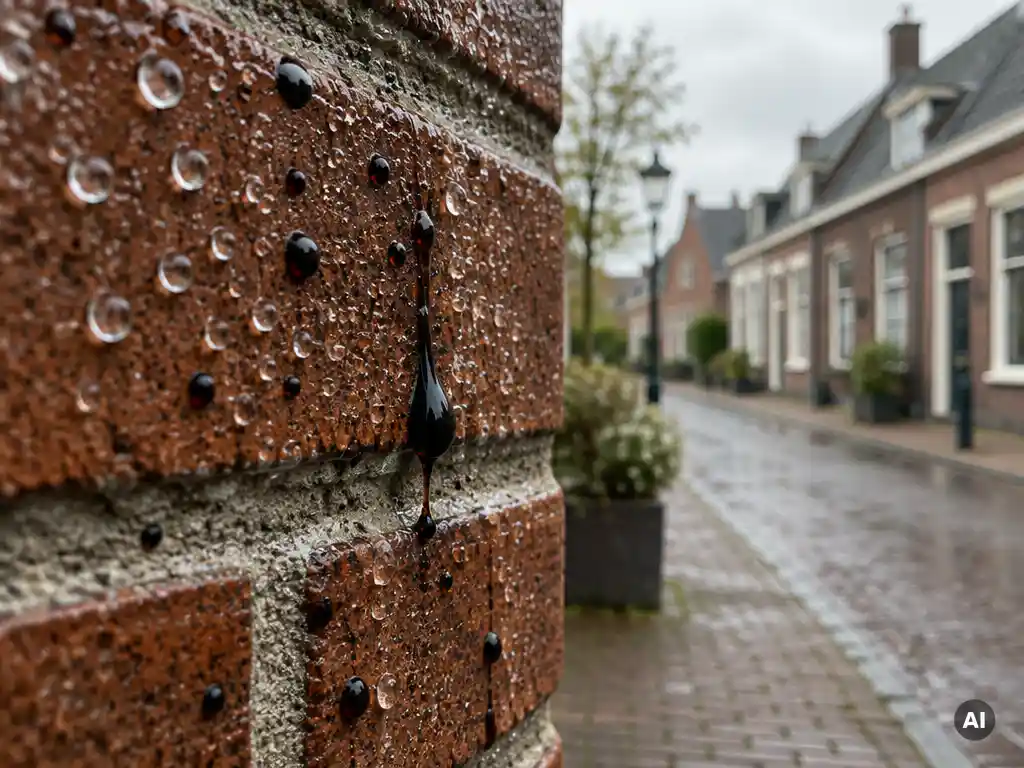
Standard facade impregnation primarily protects against moisture and water penetration, but in most cases offers little or no protection against oil and solvents. Whether an impregnation can also withstand chemical exposure depends on the chemistry used and the type of product. For environments with oil or solvent contact, a targeted facade treatment is needed that goes beyond water repellency alone. In this article we answer the most frequently asked questions about facade impregnation and chemical resistance.
What exactly does facade impregnation protect against?
Facade impregnation primarily protects a substrate against water penetration. The product penetrates the porous material and makes the substrate water-repellent, without blocking its vapor-permeable properties. This prevents moisture absorption, slows down soiling, and protects the facade against weather influences such as rain, frost, and salty precipitation.
Professional facade impregnations are generally made up of a combination of alkylsilanes and (poly)siloxanes. Alkylsilanes penetrate deep into the substrate and react chemically with the material. Polysiloxanes form an additional hydrophobic layer. Together they provide durable water repellency that does not cover the substrate but protects it from within.
What facade impregnation does not do is form a closed surface film. As a result, a standard impregnation offers little to no resistance against:
- Oils and greases
- Solvents and chemicals
- Graffiti and paint deposits
- Mechanical wear
Other treatments are needed for these types of exposure. You can find more information about the options on our page about facade impregnation and water repellent treatment.
Does facade impregnation also protect against oil?
Standard facade impregnation based on silanes and siloxanes does not offer reliable protection against oil. These products are designed for water repellency, repelling water, but oil has different chemical properties than water and will still penetrate the material of untreated or standard impregnated substrates.
Oil is a non-polar medium. Hydrophobic impregnations repel water on the basis of polarity differences, but non-polar substances such as oils and greases are not repelled by the same coating. In practice, this means that an impregnated brick or concrete facade can still show stains that are difficult to remove when it comes into contact with motor oil, lubricating grease, or vegetable oil.
For facades in environments where oil contamination is a realistic risk, such as parking garages, workshops, loading and unloading zones, or industrial sites, a surface coating or a specific product with oil- and stain-repellent properties is needed. Some semi-permanent or permanent coatings offer broader chemical resistance than standard impregnations.
We’ll figure it out for you!
Want to talk through your challenge?
Our advisors will gladly help you with a practical solution.
Can solvents damage an impregnated facade?
Yes, solvents can damage an impregnated facade. Most facade impregnations are not resistant to direct exposure to solvents. Solvents can break down or dissolve the hydrophobic compounds in the impregnation, causing the protection to be lost locally or completely.
This is relevant in situations where solvents regularly come into contact with the facade, such as in industrial production environments, painting work nearby, or chemical storage sites. But even incidental contact, for example when cleaning a facade with solvent-based products, can damage the impregnation layer.
When an impregnated facade comes into contact with aggressive solvents, it is advisable to have the treatment assessed by specialists afterwards. Depending on the damage, retreatment may be necessary. Always consult the product data sheet of the impregnation used for information on chemical resistance and safety.
What are the differences between impregnating, coating, and sealing?
Impregnating, coating, and sealing are three different methods of protecting a facade, each with its own working principle and area of application. The main difference lies in how the product protects the substrate: from within, as a surface film, or as a sealing layer.
Impregnating
With facade impregnation, the product penetrates the pores of the substrate and reacts chemically with the material. The substrate remains vapor-permeable and the structure remains visible. Impregnation is suitable for porous materials such as brick, concrete, and natural stone, and primarily protects against water penetration. The service life is generally up to ten years, depending on the product and the conditions.
Coating
A coating forms a closed film on the surface of the facade. This provides broader protection, including against oil, solvents, graffiti, and mechanical stress, but it also blocks vapor permeability unless the product is specifically formulated to be vapor-permeable. Coatings such as Nitoshield and Nitocolour are aimed at renovating and protecting non-porous facade cladding and window frames, with a service life that can extend up to ten years.
Sealing
Sealing is the closing off of the surface, often applied to floors, joints, or dense materials. A sealant forms a protective layer that shuts the material off from moisture and soiling. In the context of facades, sealing is used less often than impregnating or coating, but it can be relevant for specific components such as joints or connections.
Which facade treatment is suitable for chemically exposed environments?
For facades that are regularly exposed to oil, solvents, or other chemical substances, a surface coating with proven chemical resistance is the right choice. Standard facade impregnation is not sufficient in such environments. The treatment must form a closed, resistant layer that can withstand direct chemical exposure.
Several factors play a role when choosing a suitable treatment:
- The type of chemical substances the facade comes into contact with
- The frequency and intensity of the exposure
- The material and porosity of the substrate
- The desired service life and maintenance level
In environments with a risk of graffiti vandalism, a permanent anti-graffiti coating can serve a broader protective function. Some of these systems combine water repellency with resistance to paint, oil, and certain solvents. Read more about the options on our page about graffiti protection and removal. When graffiti protection is not needed but chemical resistance is, coatings such as Nitoshield or Nitocryl are a relevant option. Always have the situation assessed by specialists, so that the treatment matches the specific exposure at the location. Consult the product data sheet for technical specifications and application instructions.
Do you want to know which treatment is suitable for your facade or project? Read more about our approach to professional facade cleaning or get in touch directly. You can reach us via the contact form or by phone on +31 (0) 418 680 680. We’ll gladly think along with you about the right solution.