
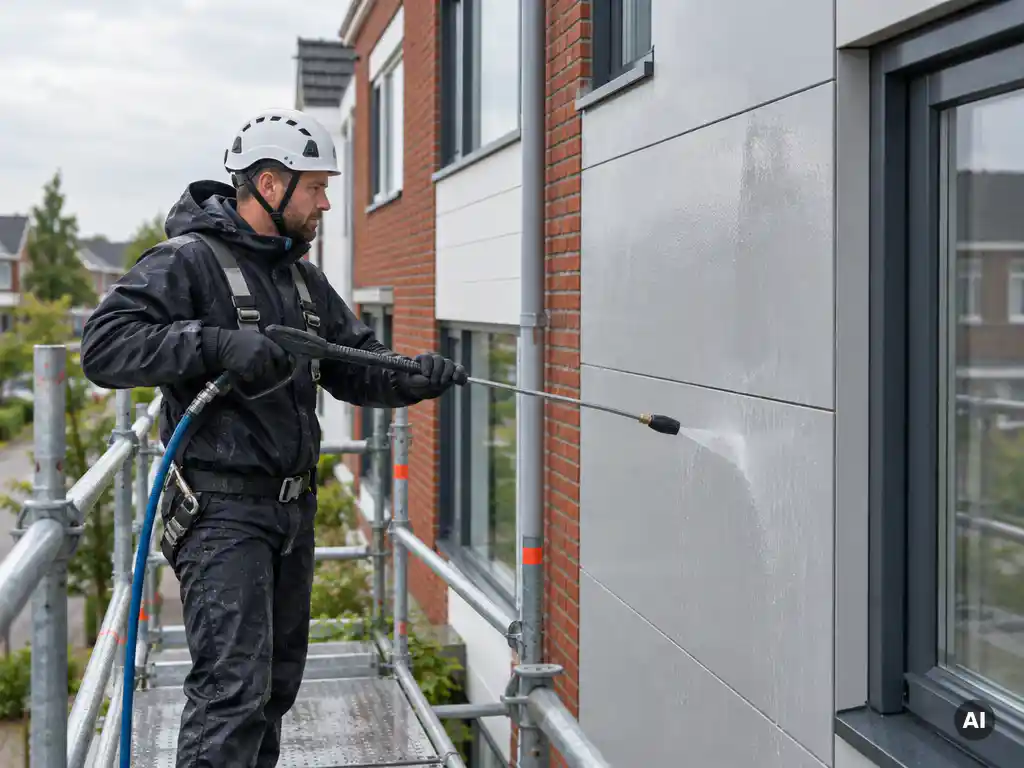
Yes, facade cleaning can prevent damage to facade cladding. By removing dirt, algae, moss, and other harmful substances in time, you prevent them from penetrating deeper into the material and causing structural damage. This applies to virtually all facade materials, from brick to natural stone and concrete. In this article, we answer the most frequently asked questions about facade cleaning as a protective measure.
What damage occurs if a facade is not cleaned?
If a facade is not cleaned, moisture, algae, moss, and contaminants penetrate deeper and deeper into the material. This leads to frost damage, efflorescence, discoloration, and, over time, structural deterioration of the facade cladding. The damage is often invisible in the early stages, but can develop into costly repairs.
Biological growth such as moss and algae traps moisture against the surface. In freezing weather, that moisture expands in the pores of the material, leading to what is known as frost damage: small cracks that deepen over time. At the same time, acids released during biological decomposition chemically attack lime- and cement-based materials. On facades in urban environments, soot deposits also play a role: fine particulate matter and combustion residues adhere to the surface and accelerate ageing. Anyone who postpones facade cleaning for too long ends up paying more for repairs than for regular maintenance.
How does facade cleaning work as protection against material damage?
Facade cleaning removes the substances that cause material damage before they penetrate deeper. By cleaning the surface regularly, you break the cycle of dirt, moisture, and biological growth that together accelerate the ageing process. Facade cleaning is therefore not a cosmetic intervention, but a functional maintenance measure.
The cleaning process removes attachment points for algae and moss, reduces the moisture load on the material, and restores the surface’s original water permeability or water repellency. After professional facade cleaning, the surface is also better prepared for any follow-up treatment, such as impregnation or coating. Cleaning and protection reinforce each other: a cleaned facade absorbs an impregnating product better, making the protection more effective.
Which facade materials are most vulnerable to damage from contamination?
Porous and lime- or cement-based materials are the most vulnerable to damage from contamination. Think of untreated brick, sandstone, calcium silicate brick, and concrete. These materials absorb moisture quickly, offer good adhesion for biological growth, and are sensitive to acidic or alkaline compounds.
Natural stone is a special category: sensitivity varies greatly by type of stone. Limestone and marble, for example, are sensitive to acidic cleaning agents, while other types of stone are more resistant. It is therefore important that specialists identify the material before choosing a cleaning method or agent. Facades made of concrete and rendered masonry are susceptible to moisture infiltration through small cracks, while non-porous materials such as ceramic facade cladding are less likely to suffer structural damage, but can still be affected by stubborn deposits and discoloration.
When is facade cleaning necessary and when is it too late?
Facade cleaning is necessary as soon as biological growth, stubborn deposits, or visible discoloration are present. It is too late for cleaning alone when the material has been structurally damaged: think of deep cracks, frost damage, flaking, or severe deterioration of the pointing. In that case, repair or renovation is needed before or in combination with cleaning.
A rule of thumb for professionals: if the deposits are superficial and the material is still intact, cleaning is sufficient. If there are already signs of moisture penetration on the inside, efflorescence indicating salt migration, or damaged pointing, you must address the cause first. Cleaning does not resolve underlying damage, but it does prevent the situation from deteriorating further. Early intervention is always cheaper than late repair.
What is the difference between facade cleaning and facade impregnation?
Facade cleaning removes existing dirt, deposits, and biological growth from the surface. Facade impregnation then treats the material with a product that penetrates the pores and makes the surface water-repellent, without changing its appearance. Cleaning is the preparation; impregnation is the protective follow-up step.
A facade impregnation works on the basis of components such as alkylsilanes and (poly)siloxanes that are absorbed into the pores of the material. They form a hydrophobic barrier that repels moisture, without completely blocking vapor permeability. This inhibits water absorption and thereby reduces the risk of frost damage, salt migration, and biological growth. The service life of a facade impregnation is generally a maximum of ten years, depending on the product and conditions. Cleaning and impregnation are complementary: a dirty or damaged facade absorbs an impregnating agent less well, making the protection less effective.
How often should a facade be professionally cleaned to prevent damage?
There is no universal cleaning frequency that applies to all facades. The required cleaning frequency depends on the facade material, environmental factors, and the presence of a protective coating or impregnation. Specialists assess on a case-by-case basis how often cleaning is needed to prevent damage.
Facades in an urban or industrial environment with heavy soot and dust loads require more frequent inspection than facades in a rural setting. North-facing facades are more susceptible to biological growth due to less sunlight and greater moisture retention. A previously applied impregnation or coating can reduce the need for cleaning, because dirt adheres less well and the material is better protected. Have specialists inspect the facade periodically and draw up a maintenance program on that basis. This way you prevent small problems from growing into major damage.
How Mavro helps with facade renovation and protection
We offer a complete product range for cleaning, impregnating, and protecting facades, tailored to professional application by specialists. Whether it involves restoring weathered facade cladding or preventing future damage, our products are developed for durable results in practice.
- Facade renovation and coating: Products such as Nitowax, Nitoshield, and Nitocryl® are semi-permanent coatings for non-porous facade cladding and window frames. They repel moisture, oils, solvents, and graffiti.
- Color restoration: Nitocolour is a permanent color-restoring coating with a service life of generally up to ten years, which restores the appearance and function of weathered facades.
- Graffiti removal and protection: Our graffiti removers are applied undiluted and are designed for professional use.
- Advice and training: We actively think along with you about the right approach for your specific situation, from product selection to application.
Would you like to know which approach best suits your facade or project? Get in touch via our contact form or call +31 (0) 418 680 680 directly. We are happy to help.