
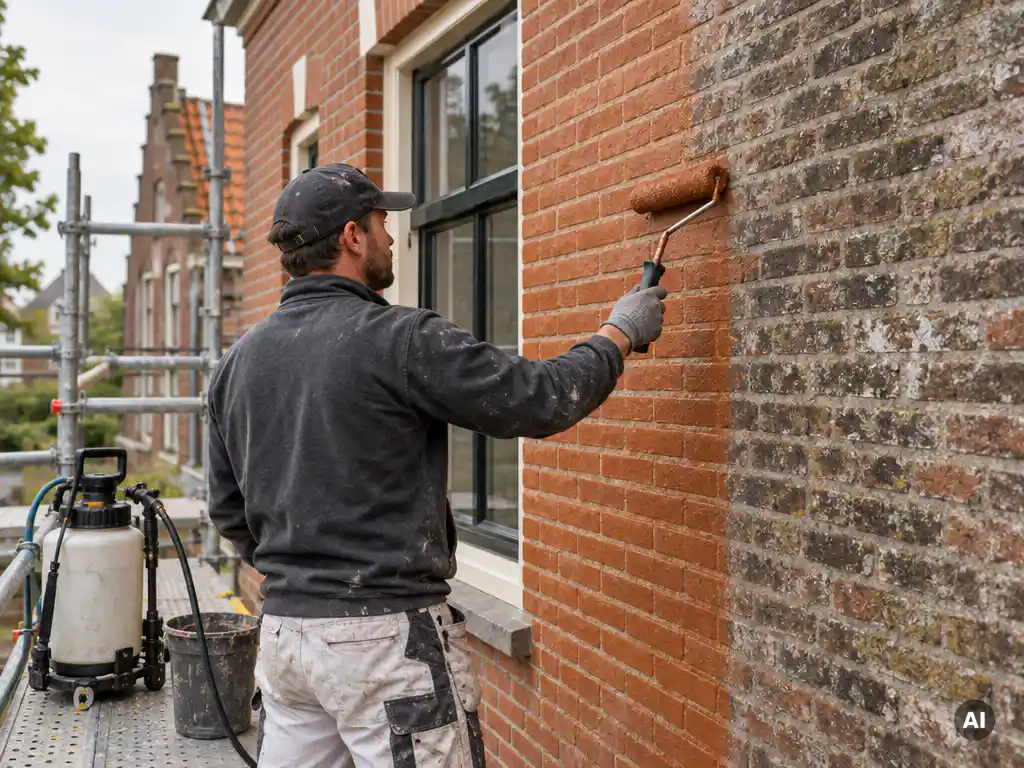
A weathered facade can in many cases be fully restored with a coating, but not always. Whether a coating is sufficient depends on the nature and depth of the damage. For superficial weathering, color loss or increased moisture absorption, a facade coating or impregnation is an effective solution. For structural damage, such as deep cracks or loose material, prior repair is necessary. In this article, we answer the most frequently asked questions about facade renovation with coating.
What are the signs that a facade is too weathered for coating?
A facade is too weathered for direct coating when there is structural damage that a coating cannot fill or conceal. Think of deep cracks, loose plasterwork, flaking layers or active moisture penetration through structural joints. In those cases, the substrate must first be mechanically repaired before coating makes sense.
Superficial weathering, such as discoloration, dirt, moss growth or increased water absorption, generally falls within the scope of coating. The limit lies in the integrity of the substrate: if the facade is firmly bonded, dry and stable, a coating can complete the restoration process. If that is not the case, a coating is only a temporary measure that does not solve the underlying problems.
- Loose or hollow-sounding brickwork or plasterwork
- Active cracks larger than a few millimeters
- Moisture damage originating from the structure (condensation, rising damp)
- Severe biological deterioration deep within the substrate
- Flaking or poorly adhering existing paint layers
If these signs are present, additional structural repair is necessary before a specialist can apply a coating.
Which damage can facade coating repair, and which can it not?
Facade coating repairs superficial damage: color loss, dirt, increased moisture permeability and light erosion of the outer layer. A coating cannot repair structural defects, such as cracks in the brickwork, frost damage in the core of the brick or structural subsidence. This distinction is important for choosing the right product and setting the right expectations.
What coating can address
A color-restoring coating such as Nitocolour brings back the original appearance of facade cladding while protecting against moisture, oils and dirt. Semi-permanent coatings such as Nitowax and Nitoshield restore the hydrophobic effect of the substrate and improve resistance to water and dirt. Facade impregnation with a combination of alkylsilanes and (poly)siloxanes is suitable for porous substrates where the water-repellent effect has decreased without the structure being damaged.
What coating cannot solve
A coating does not penetrate deeply enough to bridge cracks or anchor loose material. Moisture problems that come from within, such as condensation or rising damp, are also not resolved by an exterior coating. In those cases, the coating temporarily masks the problem but makes the situation worse in the long run because moisture becomes trapped.
How is a weathered facade prepared for coating?
Good preparation is the foundation of a durable coating result. The facade must be clean, dry, firmly bonded and free of loose parts before a coating is applied. Without this preparation, the coating will not adhere properly and its service life will be significantly shortened.
Preparation generally follows a fixed sequence:
- Facade cleaning: Remove dirt, algae, moss and deposits. Professional facade cleaning ensures that the substrate is free of biological growth and loose contaminants that hinder adhesion.
- Mechanical repair: Repair cracks, refill missing pointing and remove loose layers.
- Drying: The substrate must have an acceptable moisture content. A coating applied to a substrate that is too damp does not adhere well and can cause blistering.
- Substrate inspection: Check that the facade is firmly bonded and stable before the coating is applied.
Specialists assess the condition of the substrate beforehand and adapt the preparation to the type of material and the degree of weathering.
Which type of facade coating is suitable for a weathered substrate?
For a weathered facade, color-restoring coatings and semi-permanent protective coatings are the most suitable, depending on the nature of the substrate and the desired result. For porous substrates with reduced water repellency, impregnation with alkylsilanes and (poly)siloxanes is a relevant option. For non-porous facade cladding and window frames, film-forming coatings offer more possibilities.
Within the product range, the following solutions are available for weathered facades:
- Nitocolour: A permanent color-restoring coating for non-porous facade cladding and window frames, with a service life of generally up to ten years.
- Nitowax and Nitoshield: Semi-permanent coatings that protect the facade against moisture, dirt, oils and graffiti.
- Nitocryl®: A semi-permanent coating within the same product line, suitable for specific applications on facade cladding.
The choice between impregnation and a film-forming coating depends on the porosity of the material and the desired level of protection. Consult the product sheet and the label for the correct application and safety instructions.
How long does a facade coating last on a renovated facade?
The service life of facade coating on a renovated facade is generally up to ten years, depending on the type of coating, the quality of the preparation and exposure to weather conditions. A well-prepared, stable substrate is the most important factor for a longer service life.
Semi-permanent coatings such as Nitowax and Nitoshield offer protection for a longer period, but the coating layer must be reapplied after graffiti removal. Permanent color-restoring coatings such as Nitocolour are designed for a service life of up to ten years on non-porous facade cladding. The actual service life also depends on the orientation of the facade, local weather conditions and the maintenance carried out after application.
When is facade renovation with coating not sufficient?
Facade renovation with coating is not sufficient when the underlying structure has been damaged, when moisture penetrates the facade from the inside, or when the load-bearing capacity of the substrate is insufficient for an adhering coating layer. In those situations, a coating does not solve the problem and can even make the damage worse.
Specific situations in which a coating is not enough:
- Structural cracks that keep moving due to settlement or temperature fluctuations
- Frost damage affecting the core of the brick or concrete
- Rising damp or condensation problems originating from the structure
- Severe deterioration from salts or chemical action deep within the substrate
- Facades where the base material must be replaced or extensively repaired
In these cases, a structural assessment is necessary before a coating makes sense. A specialist will then determine which repair steps must be carried out beforehand.
How Mavro helps with the restoration of weathered facades
We offer a targeted product range for the renovation and protection of facades, tailored to the specific condition of the substrate and the desired result. Our approach is practical:
- Semi-permanent coatings (Nitowax, Nitoshield, Nitocryl®) for protection against moisture, dirt and graffiti on renovated facades
- Permanent color-restoring coating (Nitocolour) for non-porous facade cladding and window frames, with a service life of up to ten years
- Advice on the correct sequence of facade cleaning, mechanical repair and coating selection
- Product-specific guidance for specialists, including technical documentation for each product
Would you like to know which coating is suitable for your specific situation? Then get in touch via our contact form or call us directly on +31 (0) 418 680 680. Our specialists are happy to think along with you.