
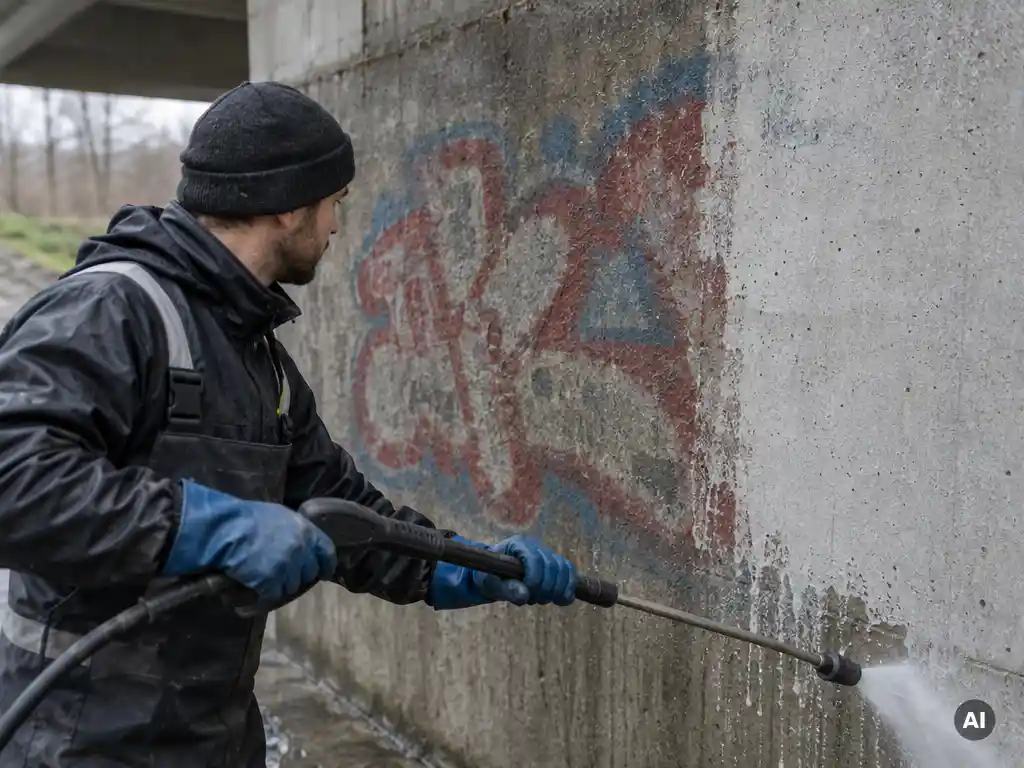
Yes, a graffiti remover can also tackle old, dried-on graffiti, but the result depends heavily on how long the graffiti has been there, which type of paint was used, and what surface it was applied to. Fresh graffiti is usually removed faster and more easily than graffiti that has been drying for weeks or months. In this article, we answer the most frequently asked questions about removing stubborn, dried-on graffiti.
How long does it take for graffiti to become ‘old’?
In the context of removal, graffiti is considered ‘old’ after just 24 to 72 hours. Within those first hours, the paint has not yet fully cured and responds better to cleaning products. After 72 hours, the removal process starts to take noticeably more effort, especially on porous surfaces such as concrete or natural stone.
After a week, the paint is usually completely dry and has bonded to the surface. With spray paint, which dries quickly and penetrates deep into the material, this process can happen even faster. The longer you wait, the stronger the chemical bond between paint and surface becomes. This is also why quick action after a graffiti attack is always preferable.
Does a standard graffiti cleaner work on dried-on graffiti?
In many cases, a standard graffiti cleaner also works on dried-on graffiti, but it requires a longer dwell time and sometimes multiple treatments. Regular water-based cleaning products are often less effective on fully cured paint. Gel formulations deliver better results because they stay on the surface longer and penetrate more deeply.
Gel-based graffiti removers are specifically suited to situations where the paint has already dried. The gel consistency ensures that the product does not run off vertical surfaces, giving it enough time to break down the paint layer. On non-porous surfaces such as glass, metal, and ceramic, results are generally better than on porous materials such as brick or untreated concrete. Always consult the product data sheet and label for the correct application.
Take a look at our range of graffiti removers for an overview of products suitable for both fresh and dried-on graffiti on a wide variety of surfaces.
We’ll figure it out for you!
Want to talk through your challenge?
Our advisors are happy to help you find a practical solution.
Which factors determine whether old graffiti can be removed completely?
Whether old graffiti can be removed completely depends on four key factors: the type of paint, the porosity of the surface, how long the graffiti has been there, and whether an anti-graffiti coating was applied beforehand. Each of these factors directly influences the choice of cleaning product and the approach.
- Type of paint: Spray paint and permanent markers penetrate deeper into the surface than water-based paints. Oil-based paints require stronger solvents.
- Porosity of the surface: Porous materials such as brick, concrete, and natural stone absorb paint more deeply, making complete removal more difficult. On non-porous surfaces such as glass and polished metal, complete removal is usually possible.
- Age of the graffiti: The longer the paint has been there, the stronger the chemical bond with the surface. Graffiti that has been present for a considerable time requires a more intensive treatment.
- Presence of an anti-graffiti coating: A protective coating prevents paint from penetrating the surface, which makes removal considerably easier.
In some cases, a slight discoloration or shadow remains visible in the surface after removal. This is called a graffiti ghost. For more information on how to deal with this, read our article on removing graffiti ghosting.
We’ll figure it out for you!
Want to talk through your challenge?
Our advisors are happy to help you find a practical solution.
How do you remove dried-on graffiti step by step?
You remove dried-on graffiti by giving the cleaning product sufficient dwell time and repeating the treatment if necessary. The process differs from that for fresh graffiti: you need a more powerful product and more patience. Follow the steps below for the best result.
- Choose the right product: Select a graffiti remover that is suitable for the specific surface and type of paint. For dried-on graffiti on vertical or porous surfaces, a gel formulation is generally the most effective choice. Consult the product data sheet for the right product selection.
- Protect the surroundings: Cover adjacent surfaces, plants, and drains to prevent damage from the cleaning product.
- Apply the product: Mavro’s graffiti removers are applied undiluted. Spread the product generously over the soiled surface and make sure to apply an even layer so the product can work in properly everywhere.
- Allow sufficient dwell time: Let the product work in longer than you would for fresh graffiti. Always consult the product instructions on the label for the recommended dwell time.
- Remove the graffiti: Use a brush, sponge, or pressure washer to remove the loosened paint. Work from the outside in to prevent spreading.
- Repeat if necessary: For stubborn or very old graffiti, a second treatment may be needed. Consult the product data sheet for the recommended approach when multiple treatments are required.
- Clean the surface: Rinse the surface thoroughly with clean water to remove any residue of the cleaning product.
For graffiti on buildings, specific approaches sometimes apply depending on the material. You can find more information on our page about removing graffiti from buildings.
When is professional graffiti removal necessary?
Professional graffiti removal is necessary when the graffiti is very old, covers a large area, is located on a sensitive or valuable surface, or when previous removal attempts have failed. In those cases, specialist knowledge and equipment are needed to prevent damage to the surface.
Also consider situations involving sensitive surfaces, such as historic buildings or delicate natural stone. Natural stone is a broad category in which different types of stone react differently to cleaning products; in such cases, leave the assessment and execution to specialists. For municipalities, housing associations, and public transport operators, a professional approach is also relevant because of the scale and frequency of graffiti incidents. In addition, specific requirements for cleaning products and methods apply to rolling stock.
You can read more about graffiti on vehicles and public transport on our page about removing graffiti in public transport.
How do you prevent graffiti from becoming difficult to remove again?
The most effective way to prevent graffiti from becoming difficult to remove again is to apply an anti-graffiti coating to vulnerable surfaces. A protective coating prevents paint from penetrating the surface, making future removal much easier and faster.
In addition, there are two practical habits that make the difference:
- Act quickly: Remove graffiti as soon as possible after discovering it. The sooner you act, the less the paint bonds and the easier the removal is.
- Regular inspection: Check vulnerable locations regularly so that graffiti never gets the chance to become old and dried-on.
Anti-graffiti coatings are available in permanent and semi-permanent variants. Permanent coatings withstand multiple cleaning cycles; the exact number differs per system. Semi-permanent coatings are removed along with the graffiti and must then be reapplied. Graffitiguard Permanent is an impregnating agent with anti-graffiti properties. The choice of coating depends on the location, the material, and the frequency of graffiti attacks. Consult the product data sheet for the right application and consult specialists if you are unsure about suitability for a specific surface.
How Mavro helps with removing dried-on graffiti
We develop and produce professional graffiti removers that are also effective on dried-on and stubborn graffiti. Our products are suitable for a wide range of surfaces. Consult the product data sheet and label for information on application and safety. This is what we offer:
- Gel-based graffiti removers that stay on vertical surfaces for a long time for maximum dwell time
- Products that are applied undiluted on both porous surfaces and non-porous surfaces (metal, glass, ceramic)
- Anti-graffiti coatings in permanent and semi-permanent versions that make future removal considerably easier
- Advice and training for professional application by specialists
Want to know which product best suits your situation? Get in touch with us and we’ll help you further with concrete advice.