
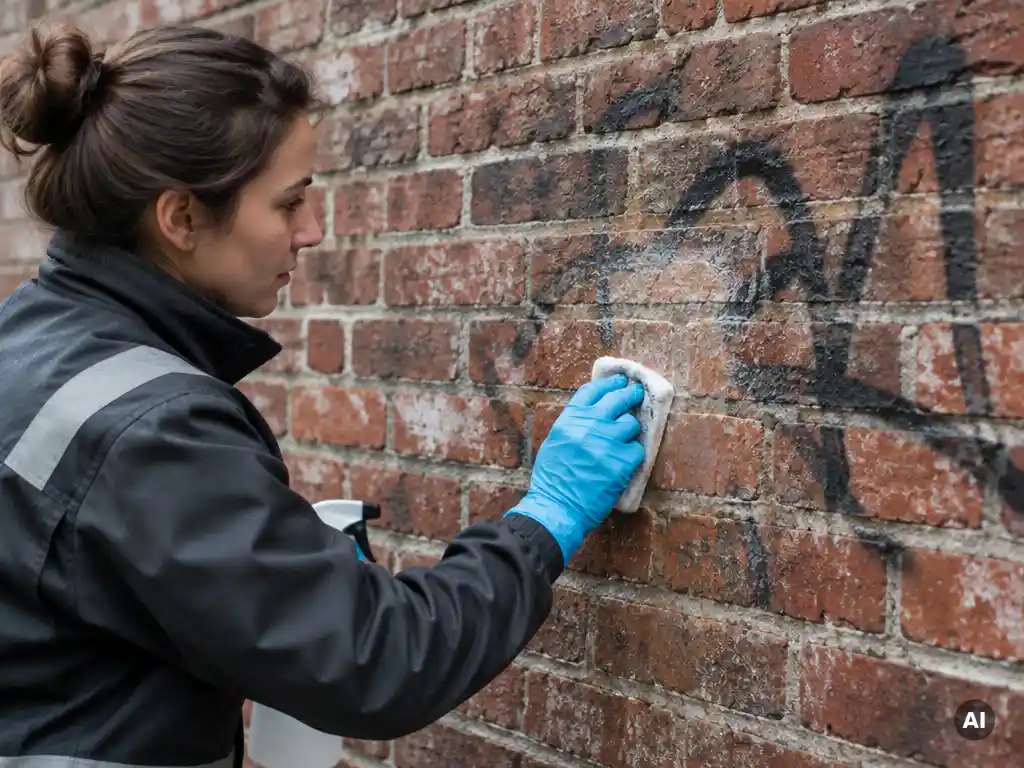
Yes, in many cases a professional graffiti remover can also tackle ink and tags. Professional graffiti cleaners are specially formulated to treat a wide range of paint types and inks, including spray paint, marker tags and permanent markers. Whether a product also removes ink effectively depends on its composition and the type of surface. In this article we answer the most frequently asked questions about graffiti removers and ink removal.
What types of graffiti can a graffiti remover dissolve?
A professional graffiti remover is designed to tackle a wide range of graffiti materials. That includes oil-based spray paint, acrylic paint, permanent markers, marker tags and ink-based graffiti. Most high-quality graffiti cleaners work on both water-resistant and solvent-based paint types, which makes them versatile in practice.
In professional practice, graffiti comes in many forms. The most common types are:
- Spray paint (acrylic or alkyd): the classic form of graffiti on walls and facades
- Permanent markers and pens: often used for tags on smooth surfaces such as glass and metal
- Ink tags: thin, fluid ink that can soak deep into porous materials
- Etching and scratching: mechanical damage that cannot be removed chemically
For most of these types, a professional graffiti remover does the job. Etching and scratching are an exception: they are applied mechanically and require a different approach than chemical cleaning.
How does a graffiti remover work on ink and tags?
A graffiti remover dissolves ink and tags by breaking the chemical bonds in the paint pigment or ink. The active substances in the cleaner penetrate the paint layer, loosen its adhesion to the surface and allow the material to be removed mechanically, for example with a cloth, brush or pressure washer. Mavro’s graffiti removers are applied undiluted; consult the product data sheet and label for the correct method.
Gel formulations are particularly effective here. They stay on the surface longer than liquid products, giving the active substances more time to soak into the ink or paint. This is especially relevant on porous surfaces such as concrete or natural stone, where ink can penetrate deeply. On smooth surfaces such as glass or coated metal, both gel and liquid formulations generally work well, because the ink penetrates less deeply.
We’ll figure it out for you!
Want to talk through your challenge?
Our advisors will gladly help you find a practical solution.
Does the surface matter when removing ink and graffiti?
Yes, the surface has a major influence on the approach and the result of graffiti and ink removal. Porous materials such as concrete, brick and natural stone absorb ink and paint more deeply, so removal can take more time and a stronger or more specialized product. Non-porous surfaces such as glass, coated metal and ceramics keep paint on the surface, which generally makes removal easier.
Relevant factors per surface type:
- Concrete and masonry: porous, ink soaks in deeply; gel formulations are often the most effective here
- Natural stone: different types of natural stone do not react the same way to cleaning agents; leave the choice of product to specialists who assess the surface
- Metal: non-porous; choose a product that does not damage the surface and consult the product data sheet for the correct application
- Glass and ceramics: smooth and non-porous; ink adheres superficially and is generally relatively easy to remove
For graffiti on buildings, the type of facade determines the choice of the right cleaning product. You can find more information about specific applications on the page about removing graffiti from buildings.
When is a separate ink remover better than a graffiti cleaner?
A separate ink remover can be more suitable than a standard graffiti cleaner for small, concentrated ink stains on delicate or specific surfaces where a broad-spectrum graffiti product would be too aggressive or unnecessarily strong. Think of ink stains on fabric, leather or finely finished surfaces, where a specialized formula can give cleaner results without the risk of damage.
In most professional situations, such as graffiti and tags on facades, vehicles or infrastructure, a high-quality graffiti remover is powerful enough to tackle ink tags effectively as well. In that context, a separate ink remover generally adds little. Consider a specialized ink product only when:
- the area to be treated is small and isolated
- the surface is sensitive to the broader chemical action of a graffiti product
- the issue specifically concerns ink on textiles, leather or finely finished materials
For large-scale applications on public transport, such as trains and buses, a professional graffiti remover is the right choice. See the information on removing graffiti from public transport.
How do you prevent future graffiti and ink stains with a coating?
The most effective way to prevent future graffiti and ink stains is to apply an anti-graffiti coating to vulnerable surfaces. Such a coating forms a protective layer that prevents paint and ink from bonding to the surface, making graffiti easier to remove and with less damage. Leave the choice and application of a coating to specialists; consult the product data sheet for the correct method.
There are two main types of anti-graffiti coatings:
- Permanent coatings: withstand multiple cleaning cycles; the exact number varies per system and can be found in the product documentation
- Semi-permanent coatings: are removed together with the graffiti and must then be reapplied; effective for surfaces where a permanent layer is not desired
A coating is also relevant for preventing graffiti ghosting, the discoloration marks left behind after cleaning on porous surfaces. By applying a coating before the first graffiti attack, you limit not only the cleaning effort but also the risk of permanent damage to the surface. Graffitiguard Permanent is an impregnating agent with anti-graffiti properties that can take over the function of facade impregnation; therefore, do not recommend the combination of coating and impregnation as standard without assessing the specific situation.
How we help with graffiti and ink removal
At Mavro International, we develop and produce professional graffiti cleaners tailored to the requirements of contractors, municipalities, housing associations and facility service providers. Our products are designed for broad applicability, from porous facade materials to smooth metal and glass surfaces.
What we offer:
- Gel formulations that are effective on both ink and spray paint
- Graffiti removers that are applied undiluted by specialists
- Anti-graffiti coatings for preventive protection of buildings and infrastructure
- Advice and guidance for correct product application in practice
Want to know which product best suits your situation? Contact us and we’ll help you further with a concrete recommendation.