
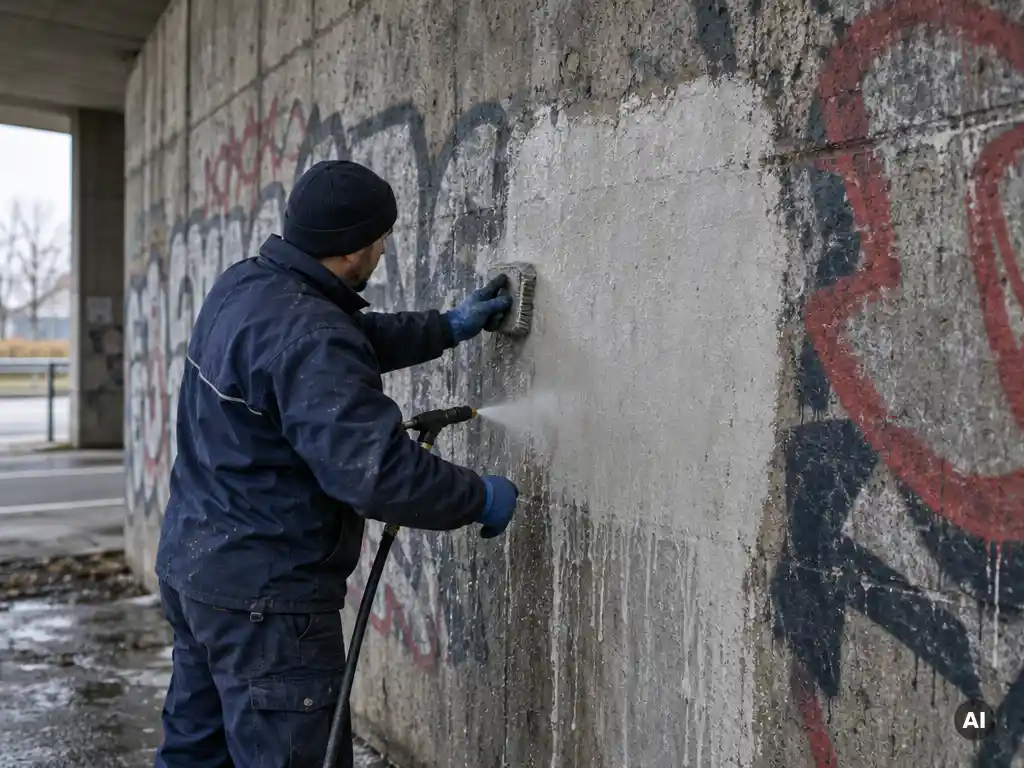
For concrete, a gel-based graffiti remover generally gives the best result. Gel clings to vertical surfaces, penetrates deeper into the pores of the concrete, and stays active longer than a liquid product. The right choice also depends on the type of paint, the age of the graffiti, and the condition of the concrete surface. Below, we answer the most frequently asked questions about removing graffiti from concrete.
Why is concrete so difficult to remove graffiti from?
Concrete is a porous substrate, which means paint, lacquer, and ink soak deep into the material as soon as they are applied. This makes graffiti on concrete considerably harder to remove than on non-porous surfaces such as glass or coated metal. The paint doesn’t just adhere to the surface; it settles into the open structure of the material itself.
The rougher and more open the concrete structure, the larger the surface area to which the graffiti layer can bond. Spray paint also penetrates further than pen or marker. A graffiti remover therefore has to tackle not only the top layer, but also the pigments that have soaked deeper into the concrete. That calls for a product with sufficient dwell time and the right chemical composition to break the bond without damaging the concrete structure itself.
What types of graffiti cleaners are there for concrete?
For concrete, there are two main categories of graffiti cleaners: liquids and gels. Liquid products work quickly and are suitable for flat, horizontal surfaces or lightly soiled substrates. Gel formulations are better suited to vertical concrete surfaces because they stay in place, work for longer, and penetrate deeper into the pores.
Within these categories there are also differences in chemical action. Some products are solvent-based and aimed at synthetic lacquers and spray paint. Others are based on alkaline or neutral formulations and have broader applications. For professional use on concrete, a gel-form graffiti remover is often the most effective choice, because the longer contact time breaks the paint’s bond more effectively. Our GraffitiRemover Gel is an example of such a gel formulation, suitable for both porous and non-porous substrates and capable of dissolving virtually all types of graffiti and ink.
Always consult the product data sheet and label for the correct application and safety information, and leave the work to specialists.
Does the age of the graffiti matter?
Yes, the age of the graffiti has a direct effect on how difficult it is to remove. Fresh graffiti has not yet fully cured and bonds less strongly to the substrate. The longer paint or ink has to dry and soak into the concrete, the deeper the bond and the more intensive the treatment required.
With old or weathered graffiti on concrete, it is sometimes necessary to apply the product several times or to let it work for longer. In some cases a faint shadow remains visible in the concrete after cleaning. This is called a graffiti ghost and requires an additional treatment. Acting quickly after a graffiti attack therefore always gives a better result than waiting.
When is an anti-graffiti coating the better choice?
An anti-graffiti coating is the better choice when a concrete surface is regularly targeted by graffiti. Instead of cleaning over and over again, a coating protects the underlying concrete so that graffiti can be removed more easily and with fewer products. This is particularly relevant for buildings, infrastructure, and public transport in vulnerable areas.
There are two types of anti-graffiti coatings relevant to concrete:
- Semi-permanent coating: This disappears together with the graffiti during removal and must then be reapplied. Suitable for situations where occasional protection is sufficient.
- Permanent coating: This withstands multiple cleaning cycles; the exact number varies by system. Suitable for locations with a high frequency of graffiti attacks.
Graffitiguard Permanent is an impregnating agent with anti-graffiti properties that protects the concrete from within. Anti-graffiti coatings can also take over the function of facade impregnation; therefore, do not recommend the combination as a default. The lifespan of a coating is generally up to ten years, unless product-specific information states otherwise. Always leave the selection and application to specialists.
How do you choose the right graffiti cleaner for your situation?
You choose the right graffiti remover for concrete based on four factors: the porous or non-porous nature of the concrete surface, the type of graffiti (spray paint, pen, ink), the age of the graffiti, and whether the surface already has a coating. Without a coating on a porous substrate, a gel formulation is almost always the most effective choice.
Practical questions to help you decide:
- How porous is the concrete? Rough, open structures call for a product with a longer dwell time.
- What kind of graffiti is it? Spray paint requires a different product than a permanent marker or ink.
- How old is the graffiti? Freshly applied graffiti is easier to remove than dried-in or weathered paint.
- Is a coating already present? On a coated surface, a milder product is sometimes sufficient.
If you are unsure about the right approach, particularly with sensitive or historic concrete substrates, it is wise to carry out a test treatment first in an inconspicuous spot. Consult the product data sheet for specific instructions. For removing graffiti from buildings, the right product choice and professional application together make the difference between complete restoration and a lasting shadow in the concrete.
How we help with removing graffiti from concrete
We develop and manufacture professional graffiti removers specifically tailored to the requirements of specialists in construction, infrastructure, and facility services. Our products are applied undiluted and are suitable for both porous and non-porous substrates, including concrete, masonry, natural stone, metal, glass, and ceramics.
What we offer:
- Gel formulations that cling to vertical surfaces and penetrate deep into the pores of concrete
- Products that dissolve virtually all types of graffiti and ink without damaging the substrate
- Anti-graffiti coatings for both occasional and structural protection of concrete surfaces
- Product documentation and technical advice for choosing the right product for each situation
- Training and support during application, so specialists achieve the best possible result
Would you like to know which product best suits your specific situation? Get in touch via our contact form or call us directly on +31 (0) 418 680 680. Our specialists would be glad to help.