
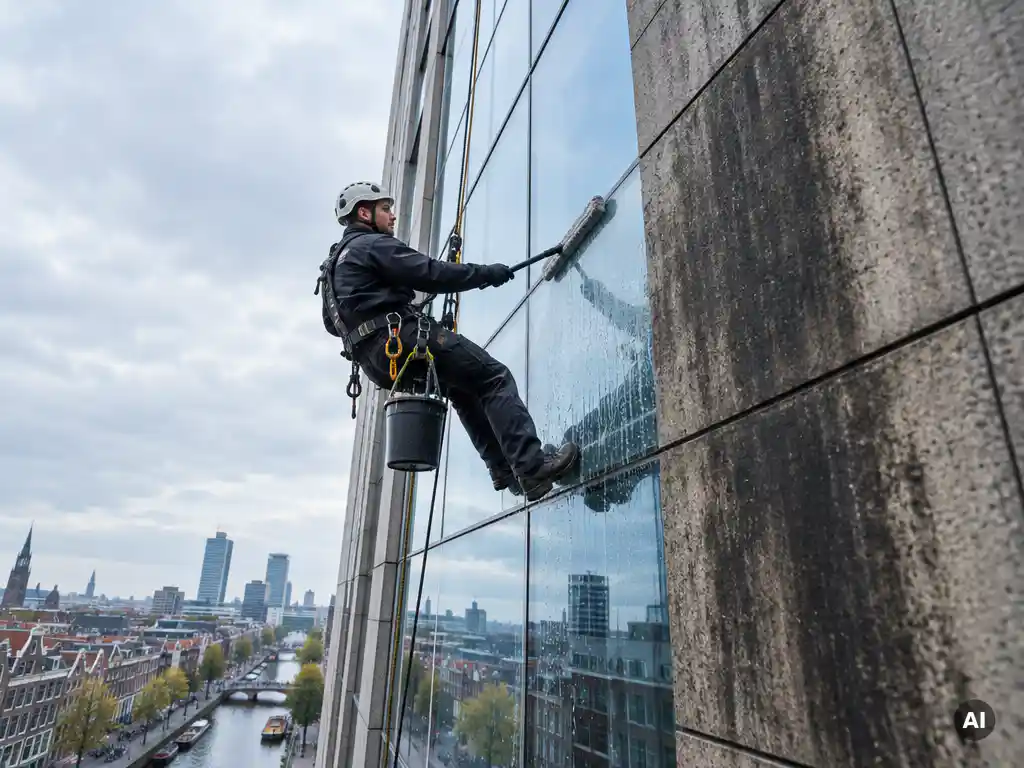
The best approach to facade cleaning for large buildings depends on the type of substrate, the nature of the contamination and the condition of the facade. There is no universal method: a brick facade requires a different approach than a concrete or rendered one. In this article, we answer the most frequently asked questions about professional large-scale facade cleaning.
What factors determine the right cleaning method for a facade?
The right cleaning method for a facade is determined by the substrate material, the type and degree of contamination, the condition of the facade and the environmental conditions. Together, these factors determine which technique and which cleaning agent are suitable without damaging the substrate.
Before you start facade cleaning, a thorough inspection is necessary. Brick, concrete, natural stone, rendered facades and composite materials each react differently to cleaning agents and pressure. For example, acidic cleaners are suitable for efflorescence on brick, but they can damage natural stone such as limestone or marble. Alkaline agents work well on organic growth such as moss and algae, but are not always suitable for sensitive surfaces.
The nature of the contamination also plays a major role. Rust staining, black crust, biological growth and graffiti each require a specific approach. With large buildings, the accessibility of the facade is another factor: aerial work platforms, scaffolding or rope access techniques influence which methods are practically feasible.
What are the most commonly used cleaning techniques for facades?
The most commonly used techniques for facade cleaning are high-pressure cleaning, low-pressure cleaning with chemical agents, steam cleaning and dry abrasive blasting. The choice depends on the material and the contamination; combinations of techniques often deliver the best result.
- High-pressure cleaning: effective for stubborn growth on robust substrates such as concrete. Not suitable for sensitive or weathered materials due to the risk of damage.
- Low-pressure cleaning with chemical agents: the most commonly used method for facades that are sensitive to pressure. The cleaning agent is applied, left to take effect and then rinsed off.
- Steam cleaning: suitable for finer surfaces and historic buildings. Low risk of damage, but more labor-intensive to carry out.
- Dry abrasive blasting (dry blasting): used for stubborn contamination or corrosion on steel and concrete, where abrasive material is applied at low pressure.
In practice, specialists often combine a chemical pre-treatment with a mechanical cleaning technique. The sequence and the product must always be matched to the specific substrate and the type of contamination.
How does cleaning the facades of large buildings differ from small-scale projects?
Facade cleaning on large buildings differs from small-scale projects in scale, logistics, risk management and required expertise. Larger projects call for structured work preparation, professional access equipment and consistent execution across large surfaces with potentially varying facade conditions.
With large buildings, achieving a uniform result is a challenge. Different sections of the facade may be in very different condition due to sun exposure, water drainage or previous treatments. A specialist must recognize these variations and adapt the approach per zone.
Safety and planning also play a bigger role. Working at height requires certified access methods and a clear safety plan. On large-scale projects, coordination with building owners, neighbors and any tenants is also relevant. The amount of cleaning agent, water and wastewater released also demands well-considered logistics and collection solutions.
What environmental regulations apply to professional facade cleaning?
Professional facade cleaning is subject to rules on wastewater discharge, the use of chemical agents and the protection of the immediate surroundings. Which specific regulations apply differs by municipality and situation; always consult the relevant product data sheets and local permit requirements before you begin.
In most cases, cleaning water containing chemical agents may not be discharged unfiltered into the sewer or surface water. Specialists use collection trays or purification systems to collect the wastewater and dispose of it correctly. On large-scale projects, it is advisable to contact the municipality or the water board in advance.
The choice of cleaning agents is also subject to rules. Products must be accompanied by a safety data sheet (SDS) and be stored and applied correctly. Always consult the product data sheet and label for the correct method of application and safety measures.
When is a follow-up treatment or facade impregnation worthwhile?
A follow-up treatment or facade impregnation is worthwhile when the substrate is porous and sensitive to moisture, contamination or biological growth. A good impregnation protects the facade after cleaning and extends the period before it needs to be cleaned again.
Facade impregnation works on the basis of a combination of alkylsilanes and (poly)siloxanes that penetrate deep into the substrate. They make the surface water-repellent without blocking the vapor-permeable properties of the material. The service life of a facade impregnation is generally a maximum of ten years, depending on the product and the environmental conditions.
Impregnation is particularly useful after cleaning brick, concrete and natural stone that are regularly exposed to rain, pollution or biological growth. For facades that also need to be protected against graffiti, anti-graffiti coatings offer an alternative that can take over the function of facade impregnation. Do not combine these systems as standard without advice from a specialist.
How do you choose a reliable partner for large-scale facade cleaning?
A reliable partner for large-scale facade cleaning has demonstrable experience with comparable projects, works with product-specific knowledge and can provide well-founded cleaning advice based on an inspection. Always ask for references, product data sheets and a concrete work plan before awarding a contract.
When selecting a partner, look at the following points:
- Does the company have experience with the specific facade material and type of contamination?
- Are the right cleaning agents and techniques used, matched to the substrate?
- Is there a clear plan for wastewater disposal and protection of the surroundings?
- Does the partner also offer advice on follow-up treatment or impregnation after cleaning?
- Does the company work with certified access methods for working at height?
A good partner thinks along on the entire process: from inspection and product selection to execution and any follow-up treatment. This prevents the facade from becoming soiled again too quickly or being damaged by the wrong approach.
How we help with facade cleaning and facade impregnation
We develop and produce professional products for facade cleaning and facade impregnation, tailored to the requirements of large-scale and professional applications. Our range includes:
- Facade cleaners for a wide range of substrates and contaminants, from biological growth to mineral soiling
- Facade impregnators based on alkylsilanes and (poly)siloxanes for durable moisture repellency
- Protective coatings such as Nitowax, Nitoshield and Nitocryl® for non-porous facade cladding and window frames, and Nitocolour for color restoration with a service life of generally up to ten years
- Anti-graffiti products for facades that need extra protection, see our range of graffiti removers
We advise specialists on the basis of product-specific knowledge and offer support with product selection and application. Contact us via our contact form or call +31 (0) 418 680 680 directly for advice on your project.