
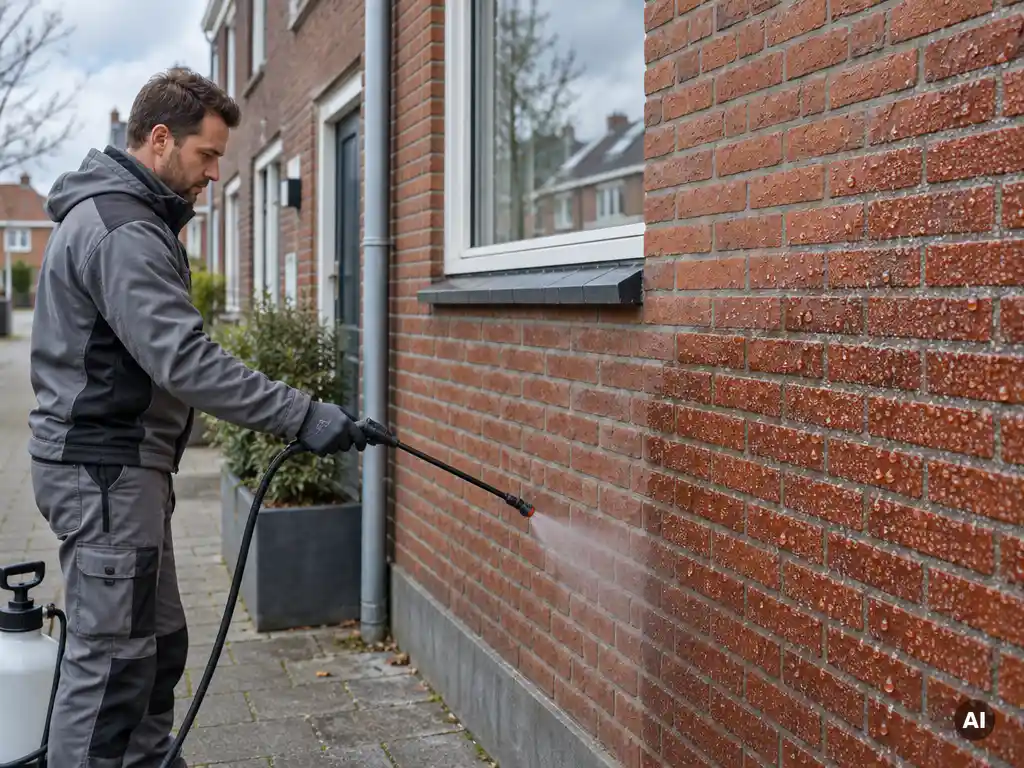
The difference between impregnating and coating a facade lies in how the protection works: with impregnation, the active components penetrate deep into the material and make it water-repellent from the inside out, whereas a coating forms a visible protective layer on the surface. Both methods protect facades against moisture, dirt and weathering, but they do so in a fundamentally different way. Which approach suits best depends on the material, the condition of the facade and the desired result.
What visibly changes on a facade after treatment?
After impregnation, a facade looks virtually identical to how it did before. The active components penetrate the material without leaving a layer behind, so the natural colour and texture are preserved. After coating, the appearance does change: the coating forms a visible film that gives the facade a more even, sometimes glossier or more colourful look.
This is an important distinction for anyone who wants to preserve the authentic character of a facade. Impregnated facades still show their original structure, whether it is brick, concrete or natural stone. A coating, on the other hand, can be used specifically to visually renew weathered or discoloured facades. Some coatings are transparent and almost invisible, while others contain pigments and fully restore the colour.
How does facade impregnation work at the molecular level?
Facade impregnation works by allowing a combination of alkylsilanes and (poly)siloxanes to penetrate deep into the pores of the facade material. These components bond to the walls of the pores and make the surface water-repellent without clogging the pores themselves. Water beads off, but the material remains vapour-permeable: moisture from the inside can still escape.
That vapour permeability is precisely why impregnating a facade is so effective for porous materials such as brick, calcium silicate brick and concrete. The material breathes, but rain and splashing water can no longer penetrate. This prevents moisture damage, frost splitting and the growth of algae or moss. The treatment is invisible, but the protection is fully active from within.
We’ll figure it out for you!
Want to talk through your challenge?
Our advisors will gladly help you find a practical solution.
How does a facade coating work as a protective layer?
A facade coating forms a closed or semi-permeable film on the surface of the facade. This layer acts as a physical barrier against moisture, dirt, oils and other aggressive substances. Depending on the formulation, a coating can also be UV-resistant, colour-restoring or anti-graffiti.
Coatings are available in various versions, from transparent to fully opaque. Semi-permanent coatings protect the surface for several years and are easy to clean. Permanent coatings, such as colour-restoring variants, can generally last up to ten years and at the same time give weathered facades a fresh look again. Coatings are less suitable for highly porous materials that need to be able to breathe freely, but are excellent for non-porous facade cladding and window frames.
When should you choose impregnating and when coating?
You choose impregnating when the facade material is porous, the original appearance needs to be preserved and vapour permeability is important. You choose coating when the surface is non-porous, visual restoration is desired, or when you want an extra barrier against graffiti, oils or heavy contamination.
In practical terms: for a brick facade that looks good but has moisture problems, impregnating is the right choice. For weathered plastic or aluminium facade cladding that needs both protection and colour restoration, a coating is the better solution. If a facade is exposed to graffiti, an anti-graffiti coating offers targeted protection. Consult the product data sheet for the correct application and consult specialists for proper execution.
- Choose impregnating: porous materials (brick, concrete, natural stone), preserving the appearance, vapour permeability required
- Choose coating: non-porous surfaces, visual restoration desired, protection against graffiti or chemical substances
Can impregnating and coating be combined?
Impregnating and coating can be combined in certain situations, but this is not standard practice and not always sensible. Anti-graffiti coatings can take over the function of facade impregnation; therefore, do not recommend the combination as a matter of course. When a combination is being considered, the sequence is always: first impregnate, then coat.
A combination adds value when a facade needs to be protected both internally and externally, for example with materials that are sensitive to both moisture penetration and surface contamination. It is important, however, that the products are compatible and that the moisture content of the substrate falls within the values specified by the manufacturer. Always consult the product data sheet and the label, or call in specialists before combining both treatments.
How long does facade impregnation or coating last?
Facade impregnation and facade coatings generally offer protection for up to ten years. The exact lifespan depends on the specific product, the facade material and the weather conditions. Consult the product data sheet for product-specific information on the expected lifespan.
The lifespan also depends on the preparation. A properly cleaned substrate with a correct moisture content as a starting point ensures better adhesion and longer-lasting effectiveness of both impregnation and coating. Regular facade cleaning extends the lifespan of the treatment, because deposits and dirt gradually break down the protective effect. Over time, re-treatment may be necessary, depending on the visual and functional condition of the facade.
How we help with facade impregnation and coating
At Mavro International, we develop and produce professional products for facade cleaning, impregnation and coating, specifically aimed at the needs of contractors, property managers and maintenance companies. Our range offers a suitable solution for every situation:
- Nitowax and Nitoshield: semi-permanent coatings for non-porous facade cladding and window frames, water-repellent and resistant to oils and graffiti
- Nitocryl®: a durable protective coating that shields the surface against weathering and contamination
- Nitocolour: a permanent colour-restoring coating with a lifespan of generally up to ten years, ideal for weathered facades that need visual and functional restoration
- Professional impregnation products based on alkylsilanes and (poly)siloxanes for porous materials such as brick, concrete and natural stone
Our specialists are happy to help you think through which approach best suits your facade, material and situation. Get in touch for personal advice or a tailored product recommendation.