
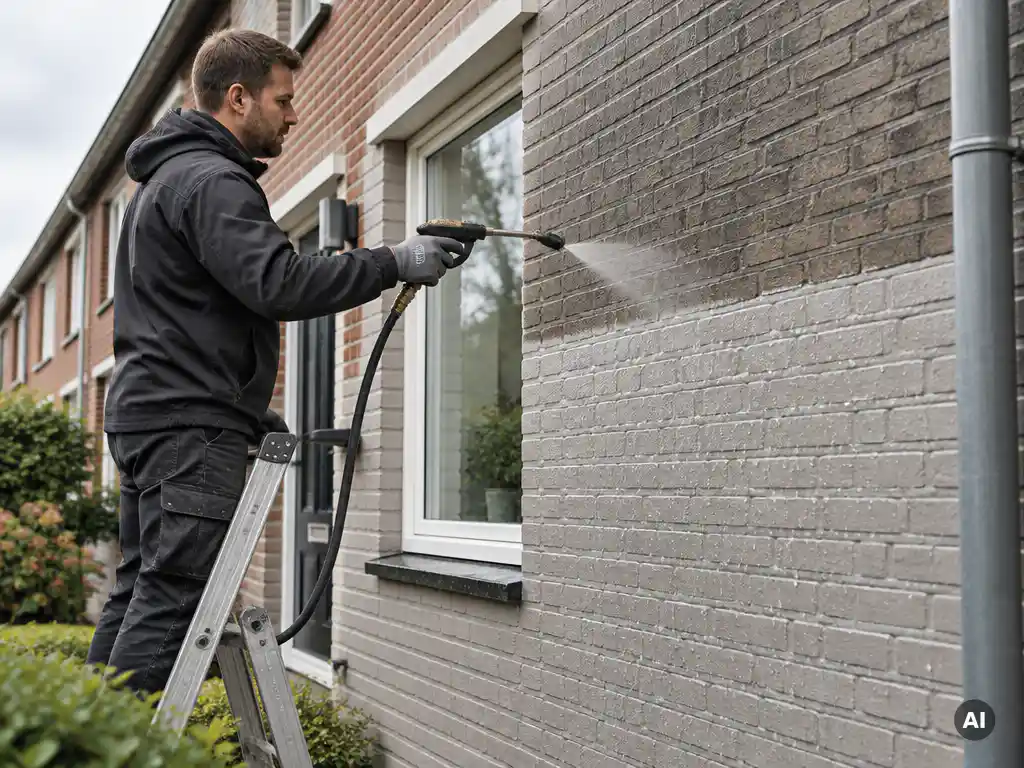
Impregnating a facade after cleaning is necessary when the substrate is porous and is left unprotected after cleaning. A cleaned facade is clean, but also open: dirt, moisture and biological growth can immediately penetrate it again. Impregnation seals the pores in a hydrophobic way and thereby significantly extends the effective protection of the facade. Below we answer the most frequently asked questions about when and how best to impregnate after facade cleaning.
What happens to a facade if you don’t impregnate after cleaning?
A facade that you clean without impregnating afterwards remains porous and vulnerable. Cleaning removes dirt, algae, moss and deposits, but at the same time slightly affects the surface structure. The pores are left open and immediately absorb moisture, efflorescence, biological growth and fine dust again. Without impregnation, new contamination develops considerably faster than before the cleaning.
Moisture is the main driver of damage here. Water that penetrates the facade expands during frost, dissolves binders and promotes the growth of algae and moss. In the long term, this leads to flaking, frost damage and structural deterioration of the facade material. Impregnation after professional facade cleaning is therefore not an optional finishing touch, but a logical next step to preserve the cleaning result.
Which facade materials benefit most from impregnation?
Porous mineral materials benefit most from facade impregnation. Brick, sandstone, concrete, calcium silicate brick and cement-bound facade elements have an open porosity that allows moisture and dirt to penetrate easily. Impregnation based on alkylsilanes and (poly)siloxanes penetrates deep into the pores and makes the material water-repellent without blocking vapor permeability.
Materials with a closed, non-porous surface structure, such as polished granite, ceramic tiles or glass, barely absorb an impregnating agent. For these facades, impregnation makes little sense; a coating may then be a better alternative. Please note: even within the natural stone category, there are major differences in porosity and chemical sensitivity. If in doubt, consult a specialist and always carry out a test area before working on the entire facade.
How long must a facade dry before impregnation can begin?
A facade must be completely dry before you apply impregnation. Impregnating agents based on alkylsilanes and (poly)siloxanes react with the mineral substrate and do not adhere well if the moisture content of the material is too high. A wet substrate blocks penetration and greatly reduces the effectiveness of the treatment.
How long drying takes depends on the facade material, the cleaning method, the ambient temperature and the weather conditions. After intensive high-pressure cleaning, a facade may need several days or even a week to dry sufficiently. Measure the moisture content of the substrate with a moisture meter before you begin. Consult the product data sheet of the impregnating agent you intend to use for the maximum permissible moisture values. Never work in the rain or when precipitation is expected within the working time.
When is impregnating after cleaning not necessary?
Impregnating after cleaning is not necessary when the facade already has an intact protective layer, or when the facade material is non-porous and does not absorb moisture. Likewise, if a coating that takes over the function of impregnation is applied shortly after cleaning, a separate impregnation step is superfluous.
In addition, if a facade has been treated with a permanent anti-graffiti coating that is still functioning well, that coating already offers protection against moisture penetration. In that case, additional impregnation is generally not needed. Have a specialist assess whether the existing protective layer is still sufficiently intact, or whether cleaning and retreatment are necessary. Not every cleaned facade requires the same follow-up step.
What is the difference between facade impregnation and a facade coating?
Facade impregnation penetrates the pores of the material and makes the substrate water-repellent from within, without forming a visible layer on the surface. A facade coating, on the other hand, forms a film on the surface that covers and protects the material. Both methods offer moisture protection, but in a fundamentally different way.
Impregnation preserves the original appearance of the facade and keeps the substrate vapor-permeable. A coating visibly changes the appearance and seals the surface more strongly. Coatings generally offer broader protection, including against mechanical stress, dirt and, in some cases, graffiti. For facades with heavily weathered or damaged surfaces, a coating is often the better choice.
For non-porous facade cladding and window frames, semi-permanent and permanent coatings offer a targeted solution. More information about facade impregnation and water-repellent treatment helps you determine which approach best suits your specific situation.
How long does an impregnated facade stay protected?
The protection period of facade impregnation is generally up to ten years, depending on the product used, the porosity of the material, the weather load and the maintenance frequency. Heavily exposed south-facing facades or facades in urban environments with a lot of pollution lose their effect faster than sheltered facades.
Over time, the hydrophobic effect gradually wears off. A simple test is the droplet test: water that no longer beads on the surface but is absorbed immediately is a sign that the impregnation is no longer effective. Periodic inspection by a specialist helps you determine when retreatment is needed. Regular maintenance extends the life of the treatment and prevents you from having to completely clean and impregnate again sooner than necessary.
How Mavro helps you with facade cleaning and impregnation
We develop and produce professional products for facade cleaning and protection, tailored to the requirements of specialists in construction, renovation and property management. Our range includes:
- Facade cleaners for a wide variety of substrates and types of contamination
- Impregnating agents based on alkylsilanes and (poly)siloxanes for porous mineral facades
- Semi-permanent coatings such as Nitowax, Nitoshield and Nitocryl® for non-porous facade cladding and window frames
- Permanent color-restoring coatings such as Nitocolour for weathered facades, with a lifespan of up to ten years
- Anti-graffiti products, including professional graffiti removers and impregnating agents with anti-graffiti properties
Not sure which product or approach best suits your project? Get in touch via our contact form or call us directly on +31 (0) 418 680 680. We are happy to think along with you.