
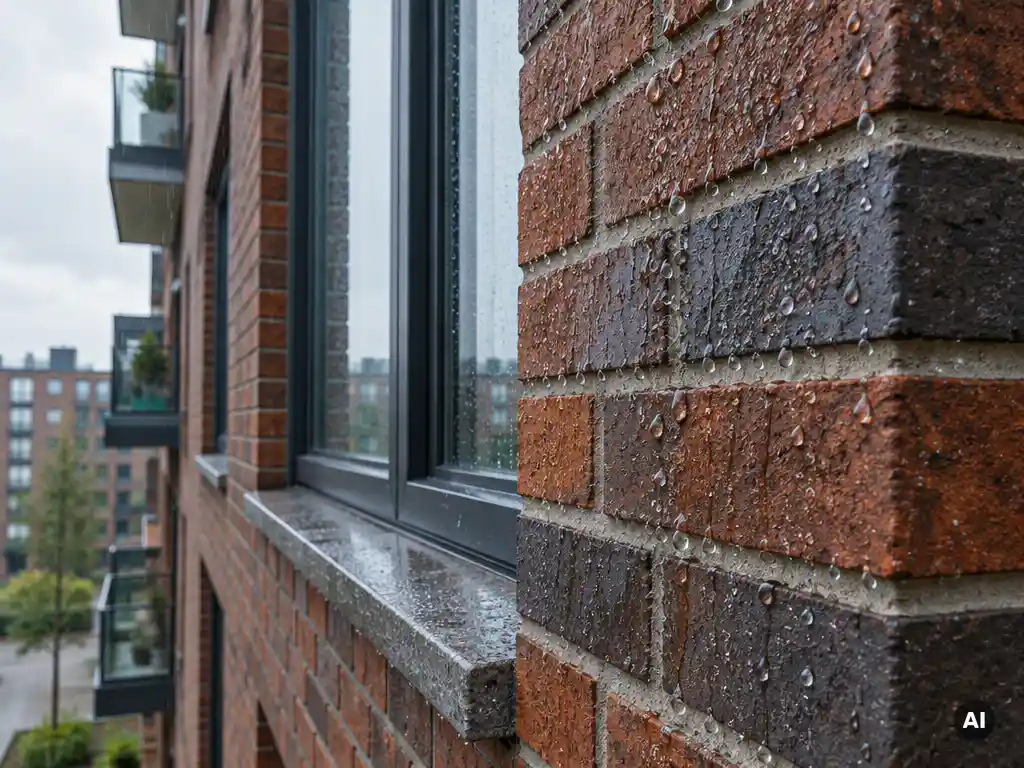
Impregnating a facade protects a building from the inside out by making the porous facade material water-repellent, without changing the appearance of the facade. This prevents moisture penetration, which is the root cause of virtually all forms of long-term facade damage. In the sections below, we answer the most frequently asked questions about facade impregnation: from how it works technically to the right time to apply it.
How does facade impregnation work technically?
Facade impregnation works by allowing a combination of alkylsilanes and (poly)siloxanes to penetrate deep into the pores of the facade material. These components react chemically with the substrate and form a hydrophobic layer inside the structure of the material. Water can then no longer be absorbed, but the facade remains vapor-permeable: moisture from inside can still escape.
The difference from a surface coating is fundamental. An impregnation is invisible and does not change the texture or color of the facade. The active substances penetrate to the core of the material, so the protection does not depend on a film on the outside. This makes the treatment particularly suitable for facades where the original appearance must be preserved.
For the treatment to work properly, the moisture content of the substrate at the time of application is a decisive factor. If the facade is too damp, the components cannot penetrate properly and the impregnation does not bond sufficiently. Specialists assess the moisture content beforehand and determine whether the substrate is ready for treatment.
What damage does facade impregnation prevent in buildings?
Facade impregnation primarily prevents moisture penetration, and with it a wide range of consequential damage. Water that does not penetrate the facade cannot cause damage through freeze-thaw cycles, salt efflorescence, biological growth, or deterioration of the pointing. This makes impregnation a preventive measure with a broad protective effect.
The most common types of damage that facade impregnation counteracts:
- Frost damage: Water that freezes in the pores expands and breaks the material open from within. An impregnated facade does not absorb this water.
- Salt efflorescence: Soluble salts are transported to the outside by moisture and crystallize on the surface. Without moisture absorption, this transport stops.
- Biological deterioration: Algae, mosses, and fungi need moisture to grow. A dry facade offers less of a breeding ground for biological growth.
- Deterioration of joints and brickwork: Prolonged exposure to moisture attacks lime-rich pointing materials and weakens the structural cohesion of brickwork.
Proper facade cleaning prior to impregnation is a prerequisite for the desired result: dirt, algae, and loose material must be completely removed before the treatment takes place.
What is the difference between impregnating and coating a facade?
The difference between impregnating and coating a facade lies in how the protection is achieved. An impregnation penetrates deep into the material and is invisible; a coating forms a film on the surface that changes the appearance of the facade. Both methods offer protection, but they are suited to different situations and objectives.
With impregnation, the facade remains vapor-permeable and the surface looks identical to how it looked before. This is desirable for historic buildings, natural stone, and brick where the original look of the material must be preserved. The protection is in the material itself, not on the surface.
A coating, such as the products in our range for facade impregnation and water-repellent treatment, applies a visible or semi-visible layer. This may be desirable when color restoration or a specific protective function is required, for example with non-porous facade cladding or window frames. Some coatings also offer protection against graffiti or oils, which an impregnation does not.
The choice between impregnating and coating depends on the facade material, the desired appearance, and the specific protection needs. Specialists determine which method is appropriate based on the substrate and the purpose of the application.
Which facade materials is impregnation suitable for?
Facade impregnation is suitable for porous mineral substrates such as brick, concrete, natural stone, and calcium silicate brick. These materials have an open structure that allows the alkylsilanes and siloxanes to penetrate and react chemically with the substrate. Non-porous materials such as glass, metal, or glazed tiles do not absorb the impregnation and are therefore not suitable.
A few points of attention per material type:
- Brick and brickwork: Porous and well suited to impregnation. Pointing requires extra attention because of its different composition.
- Concrete: Suitable, but porosity and moisture content vary greatly depending on the concrete quality. Specialists assess this beforehand.
- Natural stone: Suitable for many types, but not every type of natural stone reacts the same way. Granite, for example, is less porous than sandstone or limestone. Always test on a non-visible sample area.
- Calcium silicate brick and sandwich panels with a mineral core: Generally well suited, provided the surface structure is open enough.
For non-porous facade cladding and window frames, coatings are a better alternative. Always consult the product data sheet and have the substrate assessed by specialists before carrying out a treatment.
How long does facade impregnation last?
The lifespan of facade impregnation is generally up to ten years, depending on the quality of the application, the type of impregnation, and the environmental conditions. Facades that are heavily exposed to rain, wind, and pollution lose their hydrophobic effect faster than facades in a sheltered environment.
Factors that influence the lifespan:
- The porosity and absorbency of the substrate at the time of application
- The moisture content of the facade during treatment
- Exposure to weather and pollution after application
- The quality of the preparation, including cleaning and repair of damage
Periodic inspection is advisable. If water no longer beads on the facade surface but is absorbed again, retreatment is due. A specialist can assess this and determine whether cleaning or a full retreatment is needed.
When is the best time to impregnate a facade?
The best time to impregnate a facade is when the substrate is dry, the moisture content is low enough, and the temperature is consistently above freezing. In practice, this means that dry periods in the shoulder seasons, spring or autumn, are generally the most suitable. Frost, rain, and extreme heat are unfavorable for the application.
Besides the weather conditions, the condition of the facade is decisive. Impregnation only makes sense if the facade is clean, free of biological growth, and structurally intact. Damaged joints or cracks must be repaired first, otherwise moisture will still get in through those weak spots.
Impregnating preventively, before damage becomes visible, is more effective than waiting until moisture problems have already occurred. New or renovated facades lend themselves well to immediate treatment after completion, as soon as the material has cured sufficiently and the moisture content is at the right level.
How Mavro helps with facade impregnation and facade renovation
We develop and produce professional solutions for the protection and renovation of facades, tailored to the requirements of specialists in construction, property management, and infrastructure. Our product range includes, among others:
- Semi-permanent coatings such as Nitowax and Nitoshield for protecting non-porous facade cladding and window frames
- Nitocryl® for facades where durable surface protection is required
- Nitocolour, a permanent coating with color-restoring properties and a lifespan of up to ten years
- Professional graffiti removers for facades that need additional protection
In addition to products, we offer technical advice and training for correct application. This way you can be sure that the result meets the requirements of the project and the properties of the substrate. Get in touch via our contact form or call +31 (0) 418 680 680 directly for tailored advice.