
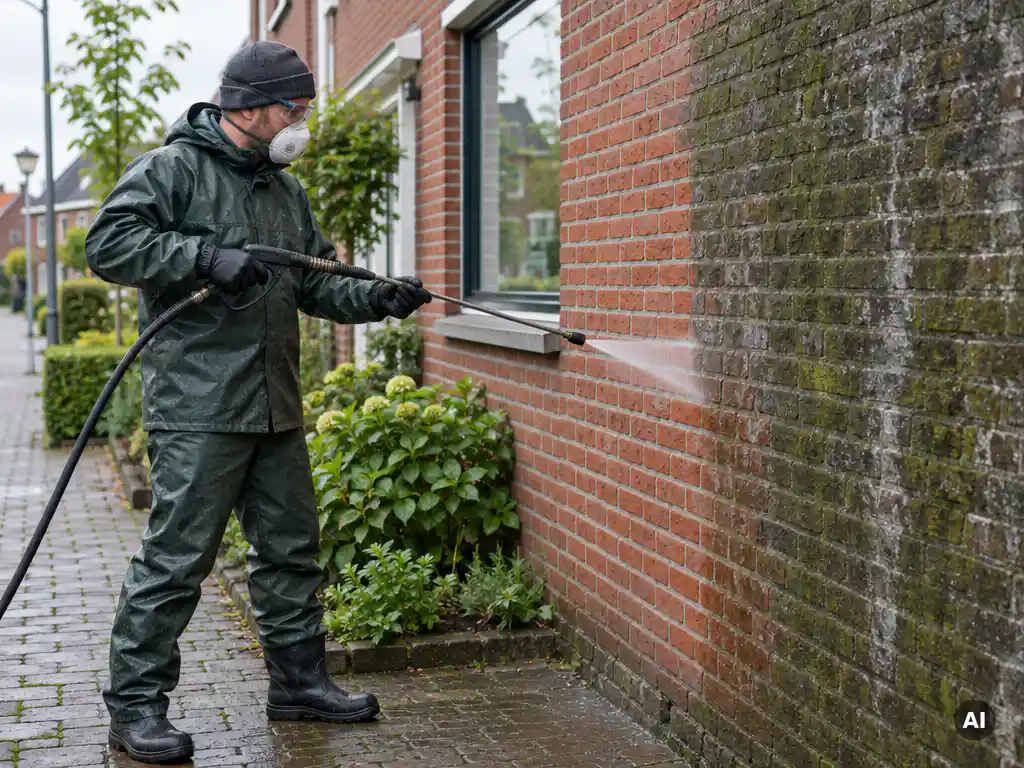
Facade cleaning is the professional removal of dirt, biological growth, deposits, and other contamination from the exterior of a building. It becomes necessary as soon as contamination affects the appearance, water resistance, or lifespan of the facade material. For building owners, contractors, and facility managers, timely cleaning is a practical way to prevent costly damage and repair expenses. Below, we answer the most frequently asked questions about facade cleaning, from the causes of contamination to the difference from facade impregnation.
Which types of contamination make facade cleaning necessary?
Facade cleaning is necessary when dirt, biological growth, or chemical attack damages the facade material or reduces its water repellency. The most common forms of contamination are algae, moss, fungi, soot deposits, efflorescence, graffiti, and industrial dust. Each type of contamination calls for a specific approach and the right cleaning agent.
- Biological growth such as algae and moss attaches itself to porous materials and retains moisture, which leads to frost damage and accelerated weathering.
- Soot and exhaust deposits are typical in urban environments and visibly discolor facades without directly causing structural damage.
- Efflorescence occurs when soluble salts migrate to the surface through moisture and crystallize there, causing white stains.
- Graffiti quickly penetrates unprotected facade material and is difficult to remove without the right graffiti removers.
- Industrial dust and oil deposits occur on buildings near production sites or busy roads and require specific degreasing agents.
Not every type of contamination is equally urgent, but biological growth and graffiti that has penetrated the surface call for quick action. The longer dirt acts on the facade material, the deeper it penetrates and the harder it becomes to remove.
How exactly does professional facade cleaning work?
Professional facade cleaning takes place in steps: first, specialists determine the type of facade material and the nature of the contamination, then they choose the appropriate cleaning agent and the right technique, and finally they carry out the cleaning and rinse the surface thoroughly. The approach differs per substrate and per type of dirt.
The most commonly used techniques are:
- Chemical cleaning with acidic or alkaline agents, matched to the facade material. Acidic agents work well on efflorescence and mineral deposits; alkaline agents are suitable for grease and soot deposits.
- High-pressure cleaning in combination with a chemical agent, where water pressure removes loose contamination without damaging the surface.
- Soft cleaning (softwash), which combines low pressure with an active solution, particularly for sensitive materials such as natural stone or wood fiber boards.
Important: not every facade material reacts the same way to cleaning agents. Granite and other types of natural stone can be sensitive to acids or alkalis. Specialists always assess the material first and, if necessary, carry out a test treatment on an inconspicuous spot. For correct application, always consult the product data sheet and label of the agent used.
How often does a facade need to be cleaned?
There is no universal cleaning frequency for facades. How often a facade needs to be cleaned depends on the location, the facade material, the environmental conditions, and the presence of a protective coating or impregnation. In urban or industrial environments, cleaning may be needed more often than in rural areas.
Factors that determine the cleaning frequency:
- Environmental load: buildings along busy roads or near industry become contaminated faster than buildings in quiet residential neighborhoods.
- Facade material: porous materials such as brick and concrete absorb dirt faster than non-porous materials.
- Presence of protection: a facade with a hydrophobic impregnation or coating is more resistant to dirt and moisture, which means cleaning is needed less frequently.
- Biological load: north-facing or shaded facades are more susceptible to algae and moss growth and require periodic inspection.
Specialists generally advise inspecting facades periodically and cleaning them as soon as contamination becomes visible or water repellency decreases. Preventive protection after cleaning can extend the intervals between cleanings.
What is the difference between facade cleaning and facade impregnation?
Facade cleaning removes existing contamination from the surface. Facade impregnation is a protective treatment applied after cleaning to make the facade material hydrophobic and slow down future contamination. The two applications complement each other but are not interchangeable.
Facade impregnation works on the basis of a combination of alkylsilanes and (poly)siloxanes that penetrate the pores of the material and make the surface water-repellent. This reduces moisture absorption, which counteracts frost damage and biological growth. An impregnation generally has a lifespan of up to ten years, depending on the product and the environmental conditions.
The difference in summary:
- Facade cleaning: reactive, removes existing dirt and growth, restores the original condition of the surface.
- Facade impregnation: preventive, protects the cleaned surface against moisture and reduces future contamination.
Cleaning is always the first step. Impregnating a dirty or damp facade does not deliver an optimal result, because the active components cannot penetrate the material properly.
When is professional facade cleaning mandatory or recommended?
Professional facade cleaning is recommended when contamination visibly affects the facade, water repellency has decreased, or when a building is being renovated, sold, or handed over. In some situations, such as municipal enforcement against graffiti or maintenance obligations in lease agreements, cleaning may also be mandatory.
Concrete situations in which professional execution is strongly recommended:
- Visible biological growth that affects the facade material or causes moisture problems.
- Graffiti on unprotected facade material, where the wrong agents or techniques can cause permanent damage.
- Preparation for facade renovation, impregnation, or the application of a protective coating.
- Handover of a building or transfer upon the purchase and sale of real estate.
- Municipal or contractual maintenance obligations for housing associations and managers of public real estate.
Professional specialists have the knowledge to choose the right agent and the right technique without damaging the facade material. Especially with sensitive substrates or valuable facade cladding, doing the work yourself without expertise is a risk.
How we help with facade cleaning and facade protection
We develop and produce professional products for both facade cleaning and facade protection, tailored to the requirements of contractors, property managers, and specialized maintenance companies. Our product line for facade renovation and protection includes:
- Semi-permanent coatings such as Nitowax and Nitoshield that protect weathered facades and make them water-repellent.
- Nitocryl® for durable protection of non-porous facade cladding and window frames.
- Nitocolour, a permanent color-restoring coating with a lifespan of up to ten years, which protects the facade material and visually renews it at the same time.
Would you like to know which product suits your facade type and maintenance challenge? Get in touch via our contact form or call us directly on +31 (0) 418 680 680. Our specialists will be happy to help you find the right approach.