
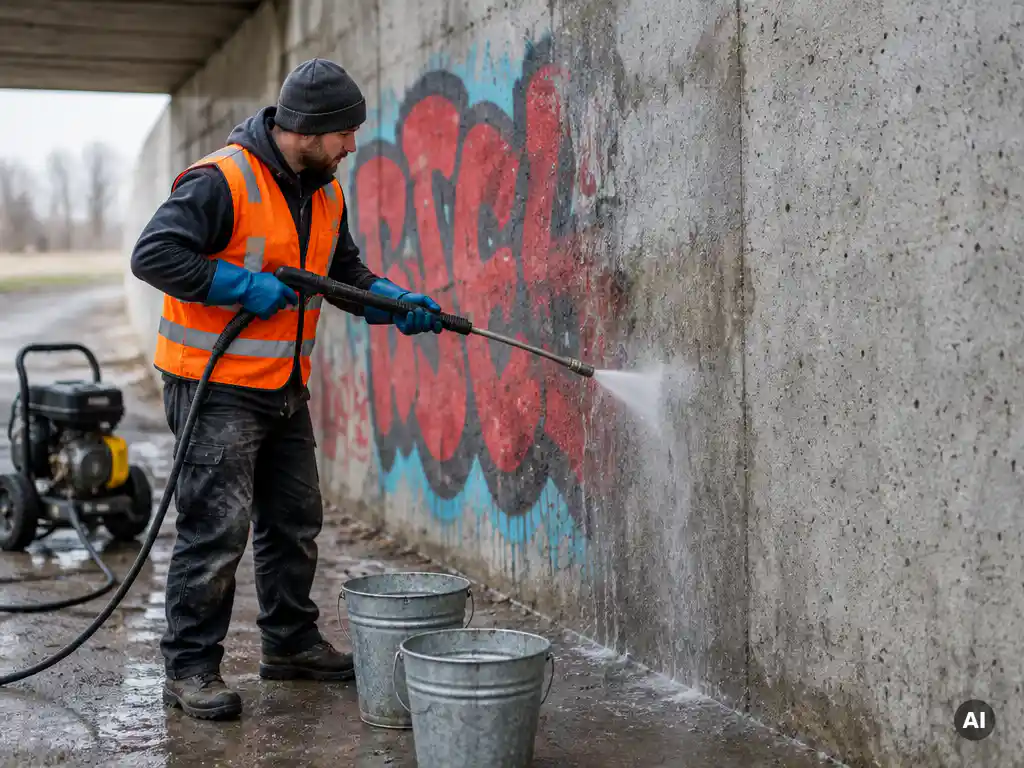
The difference between a gel-type graffiti remover and a liquid formulation lies mainly in its consistency and how it is applied. A gel stays in place on the treated spot, which makes it suitable for vertical surfaces, while a liquid can be spread across the surface more quickly and is better suited to horizontal or easily accessible areas. Which formulation you choose depends on the surface, the type of graffiti and the location. Below, we answer the most frequently asked questions on this topic.
When should you choose a gel instead of a liquid?
You choose a gel-type graffiti remover when working on vertical or hard-to-reach surfaces, or when the product needs a longer dwell time without running off. The thicker consistency of a gel keeps the product in place and ensures sufficient contact with the graffiti layer.
A liquid remover is quicker to apply and may be better suited to porous materials on horizontal surfaces, but on vertical surfaces it runs downward before it can do its job. In those situations you lose both product and working power. A gel prevents that problem. If you are dealing with large, flat horizontal surfaces such as a pavement or a floor, a liquid may actually be the better choice because of its faster application.
How does a gel-type graffiti remover work on vertical surfaces?
A gel-type graffiti remover works on vertical surfaces thanks to its thick consistency, which prevents the product from sliding off. Specialists apply the gel to the sprayed area, let it dwell and then remove it with water or a cloth. The active components in the gel break down the paint or ink. Consult the product data sheet and label for correct application and safety instructions.
During the dwell time, the active components penetrate the graffiti layer. On porous materials such as concrete or stone, this can be an advantage, because the gel also stays in the pores of the material. This distinguishes the gel from a liquid that has already run off before it has fully taken effect. For professional applications on buildings and infrastructure, the gel is therefore a practical choice.
We’ll figure it out for you!
Want to talk through your challenge?
Our advisors will gladly help you find a practical solution.
What are the advantages of a liquid graffiti remover?
A liquid graffiti remover offers advantages in terms of speed and coverage. Liquids are easy to spread over large surfaces and are suitable for horizontal surfaces, easily accessible walls and smooth, non-porous surfaces such as glass or glazed ceramic.
In addition, liquid products combine well with professional spraying equipment, which makes the work more efficient on larger projects. On non-porous substrates such as metal or glass, graffiti adheres less deeply into the material, which can make removal easier. Consult the product data sheet for correct application. Take a look at our range of graffiti removers for both formulations.
Does the type of graffiti matter when choosing a remover?
Yes, the type of graffiti affects the choice of remover. Spray paint, markers, permanent markers and etched glass each react differently to cleaning products. Spray paint and thick layers of paint call for a stronger formulation with a longer dwell time, while marker ink reacts differently on smooth surfaces than on porous substrates.
Older or dried-on graffiti is generally harder to remove than fresh graffiti. In that case, a gel with a longer dwell time can be an advantage, because its components break down the hardened paint layer step by step. Etched glass or chemical damage falls outside the scope of standard graffiti removers and requires specialist treatment. For most common graffiti on buildings and public transport, a suitable graffiti remover in gel or liquid form can be sufficient, provided the right formulation is chosen for the surface and the type of graffiti.
Which substrates require extra care when removing graffiti?
Substrates such as natural stone, wood, polished marble, historic facades and painted metal require extra care when removing graffiti. These materials can be sensitive to certain chemicals and may discolour or suffer structural damage if the wrong remover is used.
- Natural stone: different types of stone react differently to cleaning products; consult the product data sheet and leave the choice to specialists.
- Wood: absorbs liquids quickly, allowing components to penetrate deeply; leave application to specialists and consult the product data sheet.
- Polished marble: can react sensitively to certain solvents; even short dwell times can damage the surface.
- Historic facades: old brickwork and limestone surfaces are fragile; leave product selection and execution to specialists.
- Painted metal: the paint layer on the metal can be damaged if too strong a product is used; always test on an inconspicuous spot first.
When in doubt, it is wise to always do a small test patch on an inconspicuous spot first. This helps you avoid irreparable damage to the surface. For removing graffiti from buildings with sensitive substrates, professional advice is strongly recommended.
Can an anti-graffiti coating make future removal easier?
Yes, an anti-graffiti coating can make future graffiti removal considerably easier. The coating forms a protective layer on the surface, so graffiti adheres less deeply and can therefore be removed with less effort.
There are two main types of anti-graffiti coatings: permanent and semi-permanent. A permanent coating withstands multiple cleaning cycles; the exact number varies per system. A semi-permanent coating is removed together with the graffiti and must then be reapplied. Which type you choose depends on how often a location is defaced and what the substrate can handle. Graffitiguard Permanent is an impregnating agent with anti-graffiti properties. Consult the product data sheet for correct application and technical specifications.
Applying a coating is useful at locations that are regularly targeted, such as public transport, tunnels, bridges and facades in busy urban areas. A coating can also reduce the chance of a lasting graffiti ghosting after cleaning, which improves the end result.
How we help you choose the right graffiti remover
The choice between gel and liquid is not always straightforward, especially when you are dealing with sensitive substrates, stubborn inks or large surfaces. We are happy to think along with you. Our range of professional graffiti removers has been developed for a wide variety of applications and materials, with attention to ease of use and correct application by specialists.
- Gel and liquid formulations for both porous and non-porous substrates
- Products that dissolve graffiti and ink without damaging the underlying material, provided they are applied correctly according to the product data sheet
- Solutions for contractors, municipalities, housing associations and facility service providers
- Additional anti-graffiti coatings for preventive protection of facades and infrastructure
- Product advice and guidance for correct application in practice by specialists
Would you like to know which graffiti remover best suits your situation? Get in touch with us and we will help you further with concrete advice.