
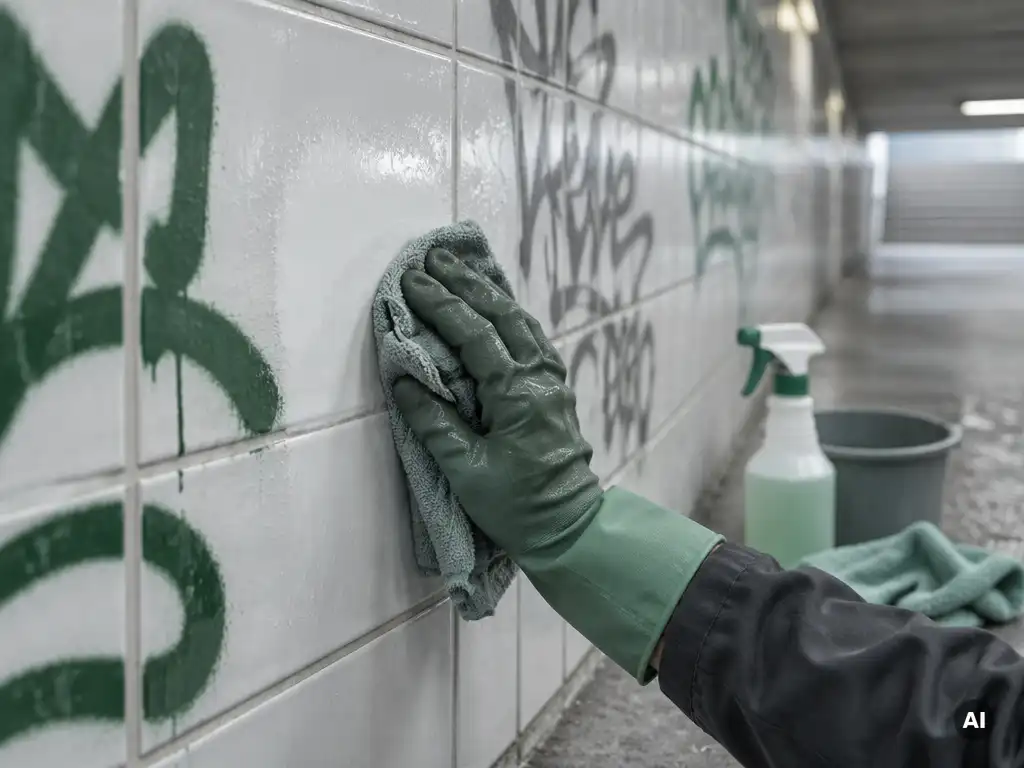
Yes, a graffiti remover works on ceramic tiles, but the result depends heavily on the type of tile. Glazed ceramic tiles are relatively easy to clean because the glaze layer absorbs very little. Unglazed or porous tiles require more caution and a specific product. In this article, we answer the most frequently asked questions about removing graffiti from ceramic tiles, from material risks to the right approach.
Which materials can a graffiti remover damage?
A graffiti remover can damage materials that are sensitive to solvents, acids, or alkaline substances. This applies especially to uncoated natural stone, soft plastics, painted wood, and certain types of metal. Porous surfaces such as unglazed tiles, brick, and concrete can also be affected if the wrong product is used or if the dwell time is too long.
The extent of the damage depends on three factors: the chemical composition of the cleaning agent, the sensitivity of the surface, and the duration of exposure. Aggressive solvents that are effective on epoxy graffiti can at the same time damage a soft substrate. Always consult the product data sheet and the label before using a graffiti remover, and test the product first on an inconspicuous spot. This also applies to ceramic tiles, especially if it cannot be established with certainty whether they are glazed.
How does a graffiti remover work on glazed ceramic tiles?
On glazed ceramic tiles, a graffiti remover generally works well. The glaze forms a dense, non-porous top layer that hardly absorbs paint, marker, or lacquer. As a result, graffiti stays on the surface and a cleaning agent can loosen it effectively without damaging the tile itself.
It works as follows: the cleaning agent dissolves the binders in the graffiti, after which the paint or ink detaches from the surface. With glazed tiles, the product does not penetrate the material, which greatly reduces the risk of discoloration or surface damage. After the dwell time, the graffiti can be wiped away or rinsed off with water. Use a professional graffiti remover that is suitable for non-porous surfaces and consult the product data sheet for the correct application.
We’ll figure it out for you!
Want to talk through your challenge?
Our advisors will gladly help you find a practical solution.
What are the risks with unglazed or porous tiles?
With unglazed or porous ceramic tiles, the risks are considerably greater. Graffiti penetrates deeper into the material, and the same goes for the cleaning agents that are used. This can lead to discoloration, surface damage, or a permanent shadow on the tile, even after the graffiti itself has been removed.
The main risks are:
- Paint penetration: Graffiti soaks deep into the pores, making complete removal more difficult.
- Chemical damage: Strong solvents can damage the structure of the tile or discolor it.
- Graffiti ghosting: Even after cleaning, a visible stain sometimes remains, also known as a graffiti shadow.
- Uneven cleaning: Porous tiles absorb the cleaning agent unevenly, which can cause stains or dull patches.
With porous tiles, it is especially important to choose a product that is specifically suitable for this type of substrate. Consult the product data sheet for the correct dwell time and method, and leave the work to specialists.
Which type of graffiti remover is suitable for ceramic tiles?
For ceramic tiles, a gel-type graffiti remover is a suitable choice. Gels stay on the surface better than liquid products, which makes the dwell time easier to control and prevents the product from running onto adjacent materials. Mavro’s graffiti removers are applied undiluted. Consult the product data sheet for the specific application instructions.
When choosing a product, look out for the following characteristics:
- Suitable for ceramics: Always check whether the product explicitly lists ceramic tiles among its areas of application.
- Gel form: Offers better control over the dwell time than liquid products and prevents run-off onto adjacent surfaces.
- Versatile: A product that is also suitable for other substrates such as concrete and metal offers more flexibility for professional applications.
Avoid products based on strong acids or high concentrations of acetone on unglazed tiles. These can damage the surface structure and lead to irreversible damage. When in doubt, consult the product data sheet or call in specialists.
How do you remove graffiti from ceramic tiles without damage?
Removing graffiti from ceramic tiles without damage calls for a step-by-step approach with the right product and the right technique. Always start with a test on a small, inconspicuous spot to check whether the product is suitable for the specific tile. Preferably leave the work to specialists.
Follow these steps for a responsible result:
- Identify the type of tile: Determine whether the tile is glazed or unglazed. This determines which product and which method are used.
- Choose the right product: Use a gel-type graffiti remover that is suitable for ceramic surfaces and consult the product data sheet.
- Test first: Apply the product to a small, inconspicuous area and wait for the dwell time stated on the product data sheet.
- Apply the product: Cover the graffiti completely with the gel and let it work for the prescribed time.
- Remove the graffiti: Wipe away the gel together with the loosened graffiti using a soft cloth or spatula. Do not use abrasives on glazed tiles.
- Rinse thoroughly: Remove all residues of the cleaning agent with clean water.
- Assess the result: Check that the tile is completely clean and that no damage or shadow is visible.
With stubborn graffiti on porous tiles, a second treatment may be needed. Never force it by scrubbing harder, but consult the product data sheet for guidance on repeated application.
Does anti-graffiti coating protect tiles better than cleaning afterwards?
Yes, an anti-graffiti coating protects ceramic tiles structurally better than cleaning each time after the fact. A coating seals the pores of the tile and ensures that graffiti does not penetrate the material. As a result, future graffiti is easier and faster to remove, with less risk of damage or residual stains.
Anti-graffiti coatings come in two variants: semi-permanent coatings that are removed together with the graffiti and then have to be reapplied, and permanent coatings that withstand multiple cleaning cycles. The number of cleaning cycles a permanent coating withstands differs per system. Consult the product data sheet for the specifications of the product in question. Mavro also offers Graffitiguard Permanent, an impregnating agent with anti-graffiti properties.
Cleaning afterwards is always possible, but with repeated graffiti attacks, cleaning costs and the risk of surface damage add up. A coating is a preventive measure that extends the lifespan of the tiles and shortens cleaning time. This is particularly relevant for graffiti on facades and buildings that are regularly defaced.
How we help with removing graffiti from ceramic tiles
Mavro develops and produces professional graffiti removers that are suitable for a wide range of substrates, including ceramic tiles. Our products are designed for professional application by specialists. What we offer:
- Gel-type graffiti removers that are suitable for both glazed and porous ceramic tiles.
- Professional formulas that are applied undiluted and are designed to dissolve graffiti and ink without unnecessarily damaging the underlying material.
- Anti-graffiti coatings for preventive protection of tiles, facades, and other surfaces, including Graffitiguard Permanent.
- Advice and guidance on correct application by specialists, so that the product is used optimally and damage is prevented.
Whether you work as a contractor, facility manager, or municipality, we are happy to think along with you about the best approach for your situation. Contact us for personal advice on the right graffiti remover for ceramic tiles.