
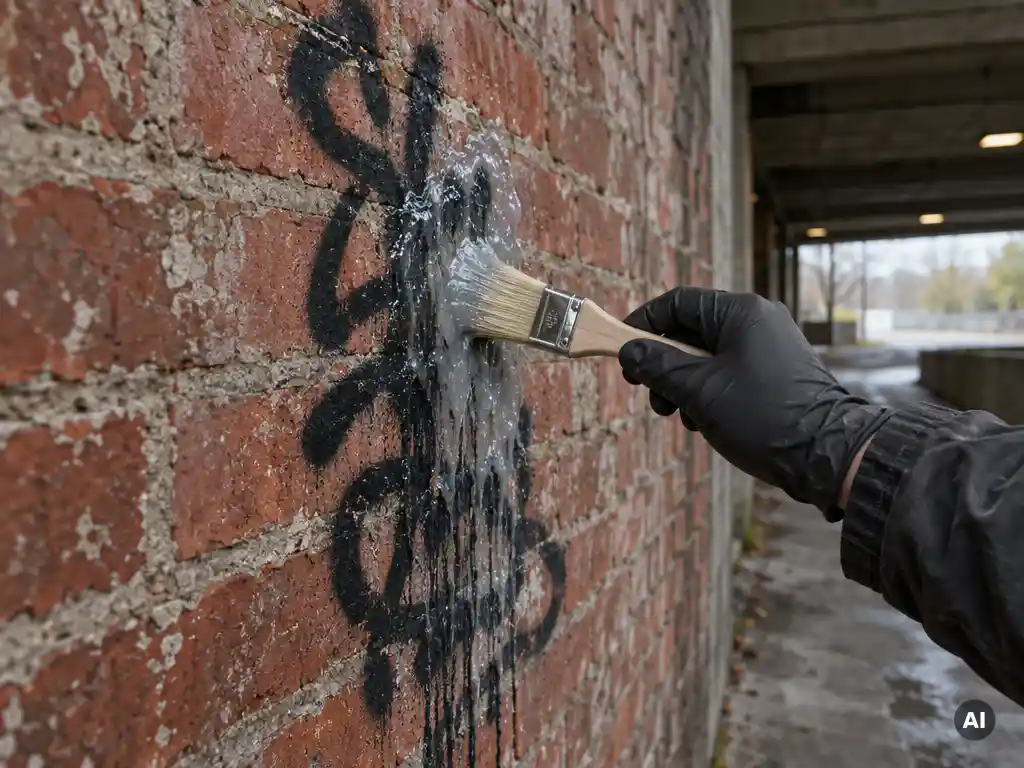
A graffiti remover gel is the best choice when you are dealing with vertical or porous surfaces where a liquid product runs off or cannot soak in sufficiently. The gel stays on the surface, gives the active ingredients time to break down graffiti thoroughly, and prevents the product from going to waste. Below you can read in which situations, on which surfaces and under which conditions the gel clearly outperforms a standard liquid.
What makes a gel different from a liquid graffiti remover?
A graffiti remover gel has a thick, sticky consistency that keeps the product in place on the treated area. Where a liquid graffiti remover drips down on vertical surfaces, the gel clings to the surface and keeps working for longer. That longer contact time is exactly what is needed to completely break down stubborn paint or ink.
Besides the better adhesion, a gel also has a practical advantage: you use less product per treatment. Because the product does not run off, a larger amount of active ingredient reaches the graffiti instead of the ground below. This makes the gel more economical to use and reduces the risk of unnecessarily exposing the surroundings to the cleaning agent.
Another difference lies in how well it works on rougher or more textured surfaces. On a smooth wall a liquid can still work reasonably well, but on brick, concrete or natural stone with a profiled texture, the gel penetrates deeper into the pores and crevices. That makes the difference between a superficial and a thorough cleaning.
On which surfaces does a graffiti remover gel work best?
A graffiti remover gel works best on porous and vertical surfaces such as brick, concrete, natural stone and masonry. On these materials the gel has enough grip to stay in place and work in for long enough. The gel also offers advantages on non-porous materials such as metal, glass and ceramics, especially on vertical surfaces. Always consult the product data sheet to confirm that the product is suitable for the specific surface.
The most suitable surfaces for a graffiti gel are:
- Brick and masonry – the gel penetrates deep into the pores and dissolves paint; consult the product data sheet for the correct method on this material
- Concrete and cement-bound surfaces – suitable for facades, tunnel walls and viaducts
- Natural stone – a sensitive material where the gel form gives more control over the dwell time; not every type of natural stone reacts the same way, so leave the application to specialists
- Metal – on vertical steel structures, fences or street furniture, the gel stays in place better than a liquid
- Glass and ceramics – for cases where precision and limited fluidity are desired
For professional applications on buildings, a graffiti gel is particularly suitable. You can read more about these applications on the page about removing graffiti from buildings.
We’ll figure it out for you!
Want to talk through your challenge?
Our advisors will be happy to help you find a practical solution.
When does a standard graffiti remover fall short?
A standard liquid graffiti remover falls short when the graffiti is on a vertical, porous or hard-to-reach surface. In those situations the liquid has insufficient contact time to break down the paint properly, the product runs off before it can take effect, and the cleaning is incomplete. The result is a stubborn graffiti ghost image that remains behind.
Specific situations in which a liquid remover falls short:
- Graffiti on vertical facades or walls where the product runs downwards
- Paint that has soaked deep into rough concrete or brick and requires a longer dwell time
- Older graffiti that has been on the surface for a long time and has hardened
- Multiple layers of paint or graffiti on top of each other
- Situations where a graffiti ghost image needs to be treated afterwards
In all these cases the gel provides the extra dwell time and adhesion needed for a complete result. A liquid can serve as a supplement for simpler or horizontal surfaces, but for complex situations the gel is the better choice.
How do you use a graffiti remover gel correctly?
Mavro’s graffiti remover gel is applied undiluted. You apply the product evenly to the graffiti with a brush, roller or spatula. You then let the gel work for the recommended dwell time. Afterwards you remove the gel, including the dissolved paint, with a pressure washer or a stiff brush and water. For the exact dwell time and method, always consult the product data sheet and the label of the specific product.
A correct method in steps:
- Protect the surroundings – cover adjacent surfaces, plants and drains
- Apply the gel – use a brush or spatula and work the gel evenly over the graffiti; the product is applied undiluted
- Let it work – observe the contact time recommended on the product data sheet; do not remove the gel too early
- Remove the gel – rinse with water and use a brush or pressure washer to remove residues and dissolved paint
- Assess the result – check whether a graffiti ghost image remains and repeat if necessary
Always use the appropriate personal protective equipment. Consult the product data sheet and the label for safety instructions and recommended protective equipment. Leave complex or large-scale cleaning jobs to specialists.
Should you always apply an anti-graffiti coating after removing graffiti?
You do not always have to apply an anti-graffiti coating after removing graffiti, but it is strongly recommended at locations that are regularly targeted. A coating protects the surface and makes future cleaning much easier: graffiti adheres less well and comes off more easily. At less vulnerable locations, a coating is optional.
Situations in which an anti-graffiti coating makes sense:
- Locations that are repeatedly defaced, such as tunnels, train stations and public buildings
- Porous surfaces such as brick or concrete that can be damaged by repeated intensive cleaning
- Historic or sensitive facades where you want to limit damage during future removal
- Objects in public transport, about which you can read more on the page about removing graffiti in public transport
There are two types of anti-graffiti coatings: semi-permanent and permanent systems. A semi-permanent coating disappears during graffiti removal and must be reapplied after every cleaning. A permanent coating withstands multiple cleanings; the exact number varies per system. Graffitiguard Permanent is an impregnating agent with anti-graffiti properties. Anti-graffiti coatings can take over the function of facade impregnation; therefore, do not recommend the combination as standard. Consult the product data sheet for the right choice per surface and situation.
How we help with graffiti removal
We develop and produce professional graffiti removers that meet the specific requirements of contractors, municipalities, housing associations and facility managers. Our products, including gel formulations for porous and vertical surfaces, are:
- Effective on virtually all types of graffiti and inks
- Suitable for a wide range of surfaces, from natural stone to metal
- Supported by technical advice and application training
View our full range on the graffiti removers page and discover which product best suits your situation. Do you have a specific surface or a complex cleaning job? Get in touch with us and we will be happy to think along with you.