
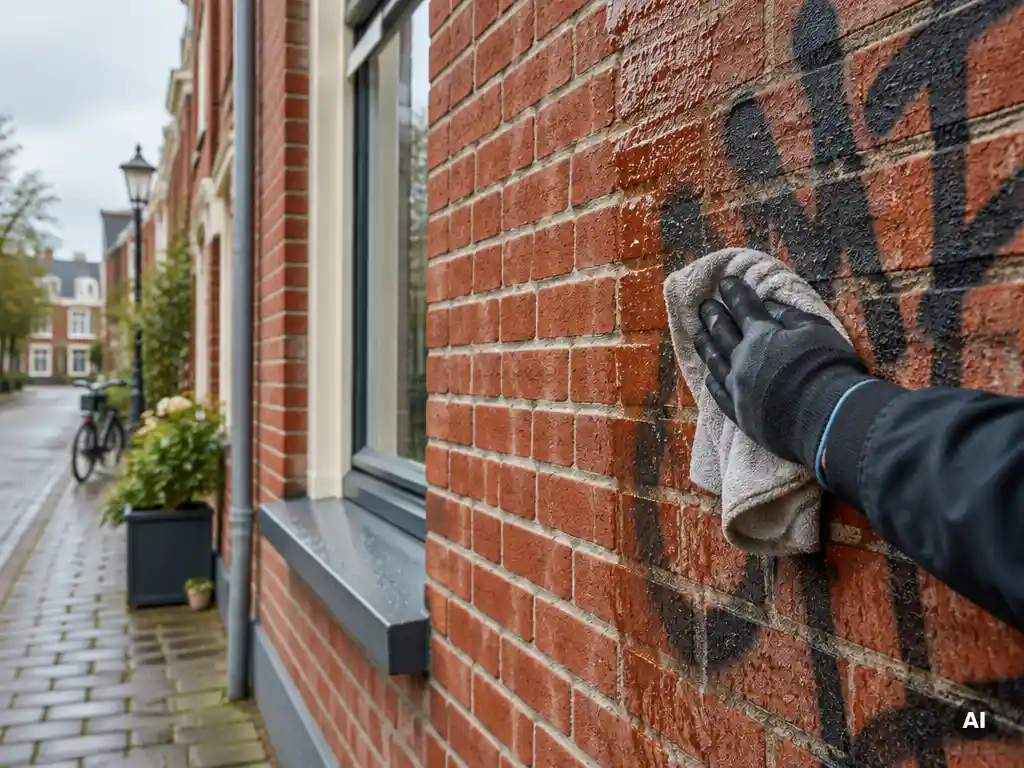
Impregnating a facade does not protect against graffiti. An impregnation treatment makes a facade water-repellent by hydrophobing the pores, but it does not form a barrier against spray paint or markers. Graffiti still adheres to an impregnated surface and is difficult to remove without additional treatment. For graffiti protection, a specific anti-graffiti coating is required. In this article, we answer the most frequently asked questions about the difference between the two solutions and when it makes sense to use each.
What is the difference between facade impregnation and anti-graffiti coating?
Facade impregnation and anti-graffiti coating are two fundamentally different treatments, each with its own purpose. Impregnation penetrates the material and makes the facade hydrophobic. An anti-graffiti coating forms a protective top layer on the surface that prevents paint or ink from adhering permanently. They can complement each other, but they are not interchangeable.
With facade impregnation, alkylsilanes and (poly)siloxanes are introduced into the pores of the facade material. The surface remains breathable, but water and dirt are repelled. This protects the material against moisture damage, algae growth, and contamination. The treatment is invisible and does not change the appearance of the facade.
An anti-graffiti coating works differently: it applies a thin film over the surface. When graffiti is applied, the paint adheres to that film instead of to the facade material itself. With a semi-permanent coating, the coating is removed along with the graffiti and must be reapplied. A permanent coating withstands multiple cleaning cycles; the exact number differs per system.
Does an impregnated facade also offer protection against graffiti?
No, an impregnated facade offers no meaningful protection against graffiti. Although impregnation makes the pores of the facade material hydrophobic, that does nothing to change the ability of spray paint or markers to adhere to the surface. Graffiti adheres to the outer layer of the material, not in the pores, so impregnation does not form a barrier.
In practice, an impregnated facade may require extra attention during cleaning after graffiti, because certain cleaning agents can damage the impregnation layer. Professional facade cleaning after graffiti on an impregnated substrate requires the right products and working method to prevent damage to the treatment. Consult the product data sheet and label for this.
If you want to protect a facade against vandalism and graffiti, a specific anti-graffiti treatment is required. Depending on the chosen system, an anti-graffiti coating can take over the function of facade impregnation, so a combination is not necessary in every case.
We’ll figure it out for you!
Want to talk through your challenge?
Our advisors are happy to help you find a practical solution.
Which products do offer real graffiti protection on facades?
Graffiti protection on facades is achieved with specific anti-graffiti coatings, not with standard impregnation products. There are two main types: semi-permanent coatings that are removed along with the graffiti and must then be reapplied, and permanent coatings that withstand multiple cleaning cycles, with the number varying per system. The choice depends on the location, the risk of repeated vandalism, and the desired level of maintenance.
Semi-permanent anti-graffiti coatings are suitable for facades with a high risk of vandalism, such as public buildings, stations, and school buildings. Permanent coatings are an option for locations where graffiti occurs less frequently, or where a long-lasting protective system is preferred. A special category is formed by products such as Graffitiguard Permanent, an impregnating agent with anti-graffiti properties.
In addition to coatings, graffiti removers are also an important part of a complete approach. Mavro’s graffiti removers are applied undiluted and make it possible to remove graffiti without damaging the facade material, even when no coating is present. Consult the product data sheet for the correct application.
When does a combination of impregnation and anti-graffiti coating make sense?
A combination of facade impregnation and anti-graffiti coating is not necessary as a standard. Anti-graffiti coatings can take over the function of facade impregnation. Therefore, only recommend the combination when there is a specific reason to use both systems side by side, for example with porous materials such as brick or concrete in locations with elevated moisture content and a high risk of vandalism, where the chosen anti-graffiti coating does not fully take over the hydrophobic function.
When a combination does make sense, the starting point is: impregnate first, then apply the anti-graffiti coating. The impregnation layer protects the material from within. The anti-graffiti coating then forms the outer protective layer. Have the sequence and product suitability assessed by specialists and consult the product data sheets for the correct application method.
Situations in which a combination can be considered:
- Historic buildings and monuments with porous facades in urban environments, where the moisture content of the material is a point of attention
- Public buildings, schools, and sports facilities with a high risk of vandalism
- Infrastructure such as tunnel walls, viaducts, and noise barriers
- New construction projects where long-term protection is built in from the start
How long does an anti-graffiti treatment protect a facade?
The protection period of an anti-graffiti treatment varies by product type, substrate, and degree of exposure. As a general guideline, the service life is typically up to ten years at most, unless product-specific information states otherwise. Semi-permanent coatings must be reapplied after every graffiti removal. Permanent coatings withstand multiple cleaning cycles; the exact number differs per system.
Factors that influence service life include the quality of the coating, the preparation of the surface, exposure to UV light and weather, and the cleaning method used. Correct application by specialists and following the instructions on the product data sheet and label are decisive for the end result.
How we help you with facade impregnation and graffiti protection
We develop and produce professional products specifically tailored to the challenges of facade protection in practice. Whether you want to impregnate a facade, protect it against graffiti, or tackle both, our range offers a suitable solution for every situation. This is what we offer:
- Semi-permanent and permanent anti-graffiti coatings for facades, infrastructure, and public spaces, including products such as Nitowax, Nitoshield, and Nitocryl
- Professional facade impregnation products based on alkylsilanes and (poly)siloxanes that make porous materials hydrophobic and protect against moisture damage and contamination
- Graffiti removers that are applied undiluted and work effectively, even on untreated facades, without damaging the underlying material — consult the product data sheet for the correct application
- Advice and training on the right product choice and correct application sequence for your specific situation, carried out by specialists
Want to know which treatment best suits your facade and situation? Contact us and we’ll be happy to think along with you.