
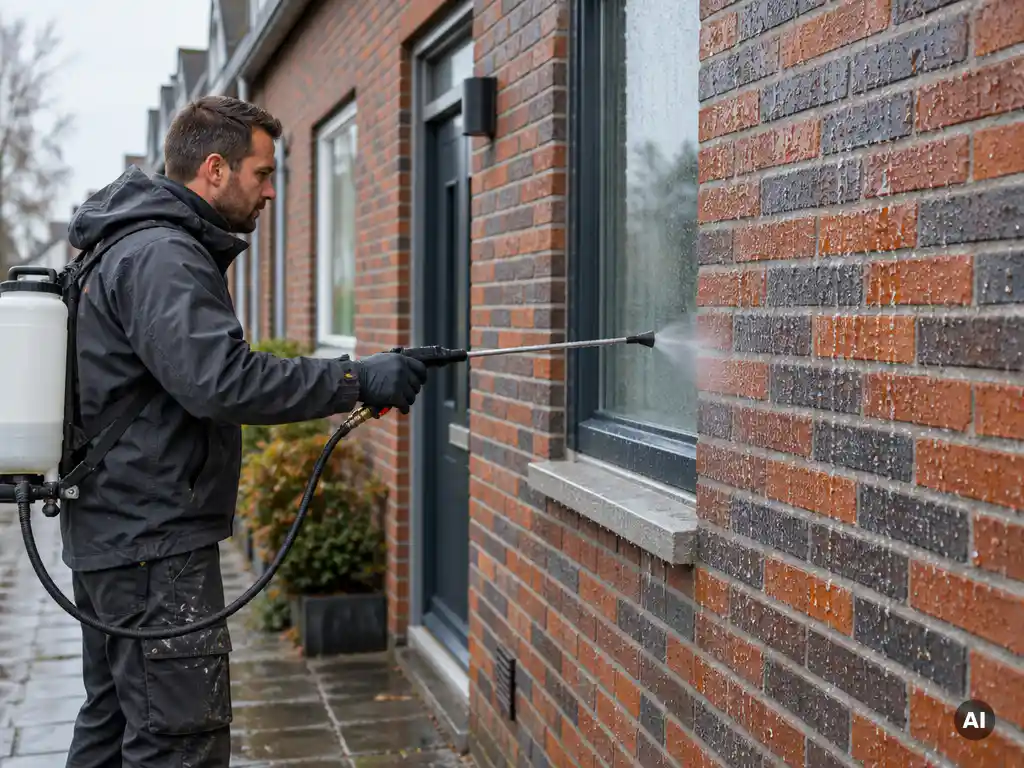
Impregnating a facade saves money in the long term because it prevents moisture infiltration, mold growth, and material damage before those problems arise. A single treatment protects a facade for years and avoids the much higher costs of repair work, facade cleaning, or renovation. This article answers the key questions about the financial logic behind facade impregnation for building owners, contractors, and facility managers.
How much does facade damage cost if you don’t impregnate?
Without impregnation, a facade accumulates significant damage over the years from moisture, frost, and biological attack. Repair costs are generally many times higher than the preventive treatment. Frost damage to brickwork, stubborn algae growth, or ingrained dirt calls for intensive cleaning, repointing, or even partial replacement of facade material.
Specifically, the following costs can arise if you skip facade impregnation:
- Professional facade cleaning that is needed repeatedly due to accelerated soiling and biological growth
- Repointing due to frost damage to porous joints that absorb moisture and expand
- Mold and algae treatment in the case of prolonged moisture absorption in the facade structure
- Facade cladding or plasterwork that comes loose or crumbles due to persistent water damage
- Energy loss because a wet facade insulates less effectively and heating costs rise
The combined costs of all these problems make preventive impregnation financially attractive, especially for larger buildings or properties in an exposed environment.
How does facade impregnation work as a protection mechanism?
When you impregnate a facade, a combination of alkylsilanes and (poly)siloxanes penetrates deep into the facade material and makes the pores water-repellent without sealing them completely. Water beads off the surface instead of soaking into the material, while the facade material remains vapor-permeable.
This mechanism works on several levels at once:
- Water repellency: the active components bond to the pore walls and repel liquid water
- Vapor permeability: water vapor can still escape to the outside, which prevents moisture build-up in the wall
- Resistance to biological growth: a lower moisture content in the facade offers less breeding ground for algae, moss, and mold
- Reduced soiling: dirt and fine particulates adhere less well to a water-repellent surface
The result is a facade that stays clean-looking for longer, requires less maintenance, and is structurally better protected against the weather conditions that cause the most damage in the long term.
We’ll find out for you!
Want to talk through your challenge?
Our advisors will gladly help you find a practical solution.
How long does an impregnation treatment last?
A professionally applied facade impregnation generally lasts up to ten years, depending on the product used, the facade material, and the degree of exposure to wind, rain, and sunlight. Consult the product data sheet for the specific lifespan of the system being applied.
Factors that influence the lifespan include:
- The porosity and type of facade material (brick, concrete, natural stone, plasterwork)
- The orientation of the facade (north-facing or south-facing with plenty of sunlight)
- The quality of the preparation, including prior facade cleaning
- The concentration and penetration depth of the applied components
A treatment that protects the facade throughout its service life and prevents repair and cleaning costs during that period generally pays for itself many times over. Regular inspection by specialists helps determine the right moment for a re-treatment.
What are the indirect savings of facade impregnation?
In addition to the direct savings on repair work, facade impregnation also delivers indirect financial benefits. A well-protected facade needs cleaning less often, retains its appearance longer, and contributes to the property value of a building.
The most important indirect savings are:
- Lower maintenance frequency: an impregnated facade gets dirty more slowly, so professional cleaning is needed less often
- Better insulation performance: a lower moisture content in the facade contributes to better insulating properties, which can translate into lower energy costs
- Longer lifespan of the facade material: less frost damage and less chemical attack mean the material lasts longer
- Preserved appearance: a well-kept look matters for commercial real estate, rental homes, and public buildings
When is facade impregnation most cost-effective?
Facade impregnation is most cost-effective directly after a thorough cleaning of a facade that is still structurally sound. At that point the facade is clean and intact, the active components penetrate optimally, and you prevent damage before it starts. Waiting until damage is visible makes the treatment more expensive and less effective.
Situations in which impregnation is particularly cost-effective:
- New builds or recently renovated facades where you want to protect your investment
- Buildings in an exposed environment with heavy rainfall, wind, or a maritime climate
- Porous materials such as untreated brick, calcium silicate brick, or concrete
- Properties where facade maintenance is logistically complex and therefore expensive, such as high-rise buildings
- Real estate with tenants or users where disruption from repair work must be kept to a minimum
For building owners and property managers the rule is: the sooner you impregnate after a clean starting condition, the greater the long-term savings.
Which factors determine the price of professional facade impregnation?
The price of professional facade impregnation depends on the facade surface area, the type of material, the preparation required, and the quality of the product used. For large or complex properties, accessibility and scaffolding costs also play a role.
Specific factors that determine the price are:
- Surface area: more square meters means more product and more labor
- Material type: highly porous materials require more product per m²
- Preparation: if the facade first has to be cleaned or repaired, additional costs apply
- Product specification: high-quality systems based on alkylsilanes and (poly)siloxanes generally perform longer; consult the product data sheet for the specific properties
- Accessibility: high-rise buildings or hard-to-reach sections of the facade require scaffolding or aerial work platforms
It is wise to always weigh the price per treatment against the expected savings on maintenance and repair over the coming years. In that comparison, a professional treatment by specialists is almost always the cheapest option in the long term.
How we help with facade impregnation and protection
We develop and produce professional products for facade renovation and protection that fit the daily practice of contractors, property managers, and facility service providers. Our range offers concrete solutions for the challenges covered in this article:
- High-quality impregnation products based on alkylsilanes and (poly)siloxanes that penetrate deeply and provide long-lasting water repellency
- Semi-permanent coatings such as Nitowax and Nitoshield for non-porous facade cladding and window frames
- Color-restoring coatings such as Nitocryl® and Nitocolour; consult the product data sheet for the specific lifespan per system
- Professional cleaning products for optimal preparation before impregnation
- Advice and training for correct application by specialists, so the product performs at its best
Would you like to know which product best suits your facade and situation? Get in touch with us and we’ll gladly think along with you.