
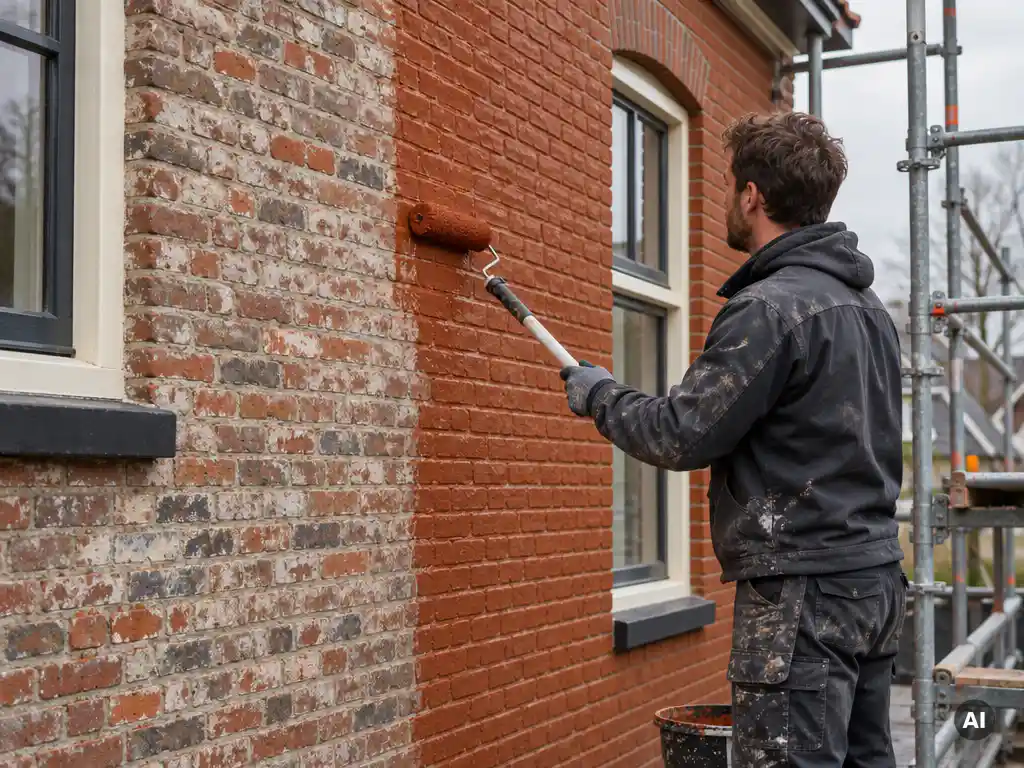
A color-restoring facade coating works by applying a thin, transparent or tinted layer to a weathered facade, which restores the original color and gloss of the material. The coating either penetrates the top layer of the facade material or forms a protective film that masks discoloration while protecting the surface against moisture, dirt, and UV radiation. Below, we answer the most common questions about how this process works and when to use it.
What changes chemically in a facade to make the color fade?
Facade colors fade because UV radiation breaks down the binders and pigments in the surface material. This process is called photodegradation and attacks the molecular structure of the paint, coating, or the facade material itself. At the same time, water, oxygen, and pollution cause oxidation and biological degradation, making the color duller and more uneven.
In practice, several processes occur at once:
- UV degradation: Sunlight breaks down the polymer chains in binders, causing the top layer to chalk and the pigment to lose its intensity.
- Oxidation: Contact with oxygen changes the chemical composition of the surface and leads to yellowing or graying.
- Biological growth: Algae, moss, and fungi attach themselves to porous surfaces and give the facade a green or black discoloration.
- Pollution: Fine particulate matter, soot, and exhaust fumes settle in the pores of the facade material and cannot always be completely removed with ordinary facade cleaning.
The result is a facade that looks aged, even though the material may still be structurally in perfect condition. This is exactly where a color-restoring coating offers a targeted solution.
How does a color-restoring coating restore the original color?
A color-restoring facade coating restores the original color by applying a formulation that either penetrates the aged top layer or covers it with a new, stable color layer. The coating contains pigments and binders that resist UV radiation and weathering, so the color is retained for a long time instead of fading again.
The mechanism differs by product type. Penetrating coatings soak into the facade material and restore the color from within, while film-forming coatings create a protective outer layer. Both types generally contain:
- UV-stable pigments that resist photodegradation
- Binders based on silicones, acrylates, or polyurethane that are flexible and weather-resistant
- Hydrophobic components that repel water and prevent moisture absorption
Good products combine color restoration with active protection. For example, Nitocolour, a permanent color-restoring coating, has a service life of typically up to ten years. The coating not only restores the appearance of weathered facades but also repels moisture, oils, and solvents, structurally protecting the facade for the long term. Consult the Nitocolour product data sheet for the specific application conditions.
We’ll figure it out for you!
Want to talk through your challenge?
Our advisors will gladly help you find a practical solution.
Which facade types and materials is this coating suitable for?
Color-restoring facade coatings are suitable for non-porous and semi-porous facade materials such as facade cladding, hard plastic facade panels, aluminum window frames, and other non-absorbent substrates. They are less suitable for highly porous materials such as untreated brick or rough concrete, where a different preparation or impregnation is needed first. Always assess the substrate case by case and consult the product data sheet for specific suitability.
Suitable applications include:
- Plastic facade panels and sandwich panels
- Aluminum and steel facade cladding
- Plastic window frames and window profiles
- Painted concrete and precast concrete elements
- Fiberglass-reinforced panels
For facades where the substrate needs protection but not color restoration, facade impregnation is worth considering. It strengthens the water-repellent properties without changing the color or appearance of the material. It is always wise to clean and assess the substrate first before applying a coating.
What is the difference between a color-restoring coating and ordinary facade paint?
The main difference lies in the purpose and the formulation. Ordinary facade paint completely covers the surface with a new, opaque color layer and is intended for painting facades. A color-restoring coating is specially formulated to restore and protect the existing color, without completely painting over the material.
In practical terms, there are further relevant differences:
- Layer thickness: Facade paint applies a thicker, opaque layer. A color-restoring coating is thinner and more transparent or lightly tinted.
- Adhesion: Coatings are often specifically formulated for substrates that are difficult to paint, such as aluminum or plastic, where standard facade paint adheres poorly.
- Protection: Color-restoring coatings contain active protective components such as hydrophobic agents and UV filters. Facade paint primarily offers aesthetic coverage.
- Service life: Professional coatings such as semi-permanent and permanent variants generally have a longer service life than standard facade paint. Consult the product data sheet for the specific service life per product.
For weathered facades where the structure is intact but the color has deteriorated, a color-restoring coating is therefore more targeted and often more efficient than repainting.
When is a color-restoring facade coating the right choice?
A color-restoring facade coating is the right choice when a facade looks aged or faded but is still structurally in good condition. If the material is not damaged or deteriorated and only the color and protective top layer have broken down due to weather and UV radiation, a coating offers an effective and cost-saving solution compared to full replacement or renovation.
Specific situations in which you would choose this approach:
- Facade panels or window frames that have become discolored or dull after years of exposure to sunlight
- Facades where the existing coating or paint has broken down but the underlying material is intact
- Buildings where you want to lower maintenance costs by applying a long-lasting protective layer
- Situations where replacing the facade cladding is technically or financially unfeasible
If the facade is dirty or biologically affected, it is wise to carry out professional facade cleaning first before applying a coating. A clean, dry substrate with a suitable moisture content is the basis for good adhesion and an optimal result. Preferably have the application carried out by specialists.
How we help with color-restoring facade coatings
We develop and produce professional coatings specifically designed for the renovation and protection of facades. Our range offers concrete solutions for weathered and discolored facades:
- Nitocolour is a permanent color-restoring coating with a service life of typically up to ten years, suitable for facade cladding, window frames, and other non-porous substrates
- Nitowax and Nitoshield are semi-permanent coatings that repel moisture, oils, solvents, and graffiti
- Nitocryl® offers protection for facades that need extra resistance to mechanical stress and weather conditions
In addition to our products, we also offer advice and training so that specialists apply the right coating in the right way. For application and safety, always consult the product data sheet and label of the product concerned. Want to know which solution best suits your facade or project? Get in touch with us and we’ll gladly think along with you.