
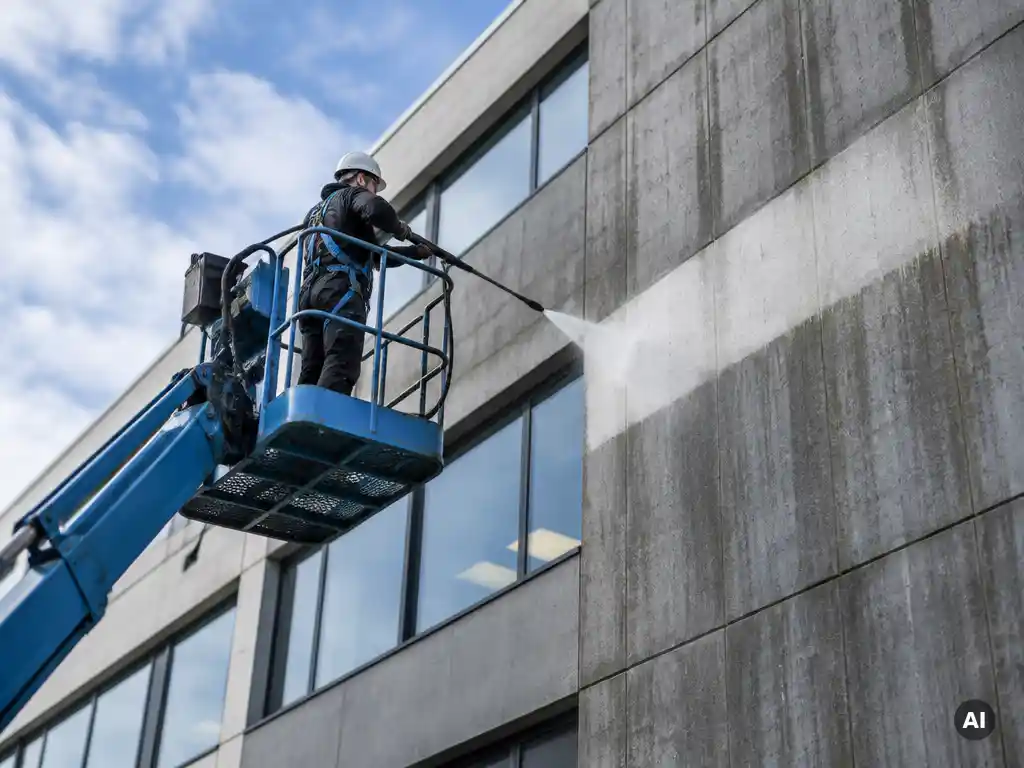
The cost of professional façade cleaning for a commercial building averages between € 3 and € 15 per m², depending on the type of façade, the degree of soiling and the cleaning method chosen. For a medium-sized commercial building, you can quickly end up with an investment of several hundred to several thousand euros. The exact price depends heavily on factors such as surface area, accessibility and whether you opt for a one-off cleaning or a maintenance contract. In this article, we answer the most frequently asked questions about costs, methods and how to request a reliable quote.
Which factors determine the price of façade cleaning?
The price of façade cleaning is determined by a combination of factors: the type of façade cladding, the size and accessibility of the surface, the degree of soiling and the cleaning method chosen. Each of these elements can significantly affect the final cost.
The most decisive factors at a glance:
- Façade material: Brick, concrete, natural stone, aluminium and façade panelling each require a different approach. Porous materials are more labour-intensive and therefore more expensive to clean.
- Surface area: The larger the surface to be cleaned, the lower the price per m² generally turns out to be thanks to economies of scale.
- Degree of soiling: Deposits of algae, moss, soot or graffiti require more time and specialised products than regular dust and dirt.
- Accessibility: A façade at great height requires scaffolding, an aerial work platform or rope access techniques. This significantly increases labour costs.
- Cleaning method: High-pressure cleaning is generally cheaper than chemical cleaning. The choice depends on the material and the nature of the soiling.
- Region and labour market: Rates can vary by region based on local labour costs and market conditions.
Always take these factors into account when requesting quotes. A low price per m² says little if accessibility costs are charged separately.
What is the average cost per m² for façade cleaning?
On average, you pay between € 3 and € 15 per m² for professional façade cleaning of commercial buildings. Simple high-pressure cleaning of an accessible façade sits at the lower end of this range. Complex chemical cleaning of heavily soiled or hard-to-reach façades sits at the upper end.
An indicative overview per type of cleaning:
- High-pressure cleaning: € 3 to € 6 per m². Suitable for harder materials such as concrete and clinker brick with regular soiling.
- Chemical cleaning: € 6 to € 12 per m². Necessary for stubborn deposits, algae or biological growth on porous façades.
- Sandblasting or abrasive blasting: € 8 to € 15 per m². Used for heavy soiling or when other methods give insufficient results.
- Steam cleaning: € 5 to € 10 per m². Applicable to certain sensitive materials; always consult a specialist about suitability for each substrate.
Additional work for scaffolding, aerial work platforms or special protective measures is generally charged separately. Always ask about this explicitly when requesting a quote.
We’ll figure it out for you!
Want to talk through your challenge?
Our advisers will gladly help you find a practical solution.
What is the difference between one-off cleaning and a maintenance contract?
A one-off façade cleaning is a standalone job in which the façade is cleaned once. A maintenance contract includes periodic cleaning at fixed intervals, often combined with inspection and any follow-up treatment. For commercial buildings, a maintenance contract is almost always more cost-effective and effective in the long term.
With a one-off cleaning, you pay the full mobilisation costs and preparation time in one go. This can make sense after a renovation or in the case of incidental severe soiling. The drawback is that without regular maintenance, soiling returns more quickly, making the next one-off cleaning more intensive and more expensive.
A maintenance contract offers several advantages:
- Lower costs per visit thanks to fixed agreements and less intensive cleanings
- Better protection of the façade material through timely treatment of growth
- Predictable budget for facility managers and property managers
- Options to combine with other maintenance work
For commercial buildings with a prestigious appearance, an annual or biennial maintenance contract is the wisest choice.
Which cleaning method is most suitable for my façade?
The most suitable cleaning method depends on the façade material and the nature of the soiling. High-pressure cleaning works well for hard, non-porous surfaces. Chemical cleaning is better suited to porous materials with biological growth. If you are in doubt about the right method, have a specialist advise you so that the façade material is not damaged.
Hard and non-porous façades
Concrete, ceramic façade panelling and aluminium profiles generally tolerate high-pressure cleaning well. The method is fast, effective and relatively inexpensive. Do make sure the water pressure is matched to the material, because excessive pressure can damage joints or coatings.
Porous and sensitive façades
Brick and other porous materials respond better to low-pressure chemical cleaning. This uses specialised cleaning products that dissolve soiling without attacking the material. Bear in mind that natural stone, such as sandstone, can react differently to acidic or alkaline cleaning products depending on the type of stone; always have a specialist assess suitability. After cleaning, it can be worthwhile to treat the surface with a façade impregnation based on alkylsilanes and (poly)siloxanes. This treatment penetrates the pores of the substrate and reduces the absorption of moisture and dirt. Consult the product data sheet for application instructions and the required moisture content of the substrate.
How do you request a reliable quote for façade cleaning?
You request a reliable quote for façade cleaning by obtaining at least three quotes from specialised companies, always asking for an itemised price specification. That way you compare not only the total amount, but also exactly what is being delivered.
Follow these steps for a quote that is easy to compare:
- Describe the work as completely as possible: Provide the type of façade material, the total surface area, the height of the façade and the nature of the soiling.
- Ask for an itemised quote: Have mobilisation costs, scaffolding, cleaning products and follow-up treatment listed separately.
- Ask about references and working method: A professional cleaning company can show reference projects and will explain which methods and products will be used.
- Ask about the cleaning products used: Request the product data sheets and check whether the products are suitable for the façade material in question.
- Ask whether follow-up treatment is included: Cleaning without follow-up treatment or impregnation leads to re-soiling more quickly.
Always compare quotes on the basis of scope and specifications, not on price alone. The cheapest provider is rarely the best choice for a professional commercial building.
When does it make sense to add an anti-graffiti coating?
An anti-graffiti coating makes sense when a façade is located in an environment with an increased risk of vandalism, such as city centres, public transport hubs or business parks along busy routes. The coating makes removing graffiti considerably easier and protects the underlying façade material.
There are two types of anti-graffiti coatings you can consider:
- Semi-permanent coating: A protective layer that is removed along with the graffiti during removal and must then be reapplied. Suitable for façades with frequent graffiti problems. Consult the product data sheet for the number of cleaning cycles the system withstands.
- Permanent coating: A more durable protective layer to which graffiti adheres less and which withstands multiple cleaning cycles; the exact number varies per system. Graffiti can be removed with a graffiti remover, which is applied undiluted. Ideal for commercial buildings with a prestigious appearance.
Anti-graffiti coatings can take over the function of façade impregnation. Combining them with a separate impregnation is therefore not necessary in all cases; have a specialist advise you based on the specific system and substrate. A good anti-graffiti coating generally offers protection for up to ten years, unless the product-specific information states otherwise.
How we help you with façade cleaning and façade protection
We develop and produce professional products for both façade cleaning and long-lasting façade protection. Whether you are looking for an effective cleaning product, an impregnation based on alkylsilanes and (poly)siloxanes or an anti-graffiti coating, our range offers a solution for a wide variety of façade types and situations. For application and safety, always consult the product data sheet and label.
What we offer for commercial buildings:
- Façade cleaners for a wide range of materials and types of soiling, from algae and moss to industrial soot
- Façade impregnation and water repellent treatment based on alkylsilanes and (poly)siloxanes, which treat the pores of the substrate and limit the absorption of moisture and dirt
- Semi-permanent and permanent coatings such as Nitowax, Nitoshield and Nitocolour, which restore weathered façades and generally offer up to ten years of protection
- Anti-graffiti coatings, including Graffitiguard Permanent as an impregnating agent with anti-graffiti properties, which protect the façade and make future removal considerably easier
- Advice and training for professional application by specialists, so you get the maximum result from our products
Would you like to know which products best suit your façade or project? Contact us and we will gladly think along with you.