
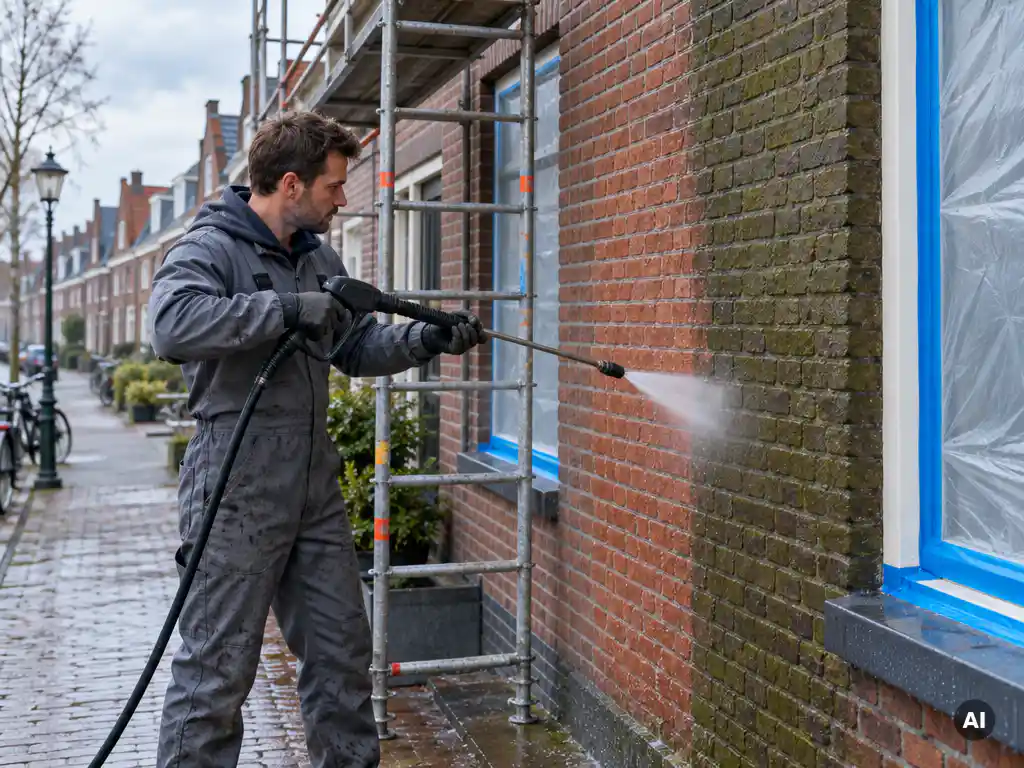
Preparing a façade properly for impregnation takes three steps: thoroughly inspecting it for defects, cleaning it correctly, and allowing it to dry sufficiently. If you skip any of these steps, the impregnation will not bond properly and you will quickly lose the protective effect. This article answers the most frequently asked questions about preparation, so that specialists can get the job right from the start.
Why is a clean façade important before impregnation?
A façade must be clean before impregnation because dirt, algae, moss and salt efflorescence block the bonding of the impregnating agent. The agent then fails to penetrate the material, so the protection remains superficial and breaks down quickly. Only a clean, open substrate absorbs the product properly and guarantees a durable result.
Impregnation works through penetration: the agent soaks into the porous material and forms a water-repellent layer from the inside out. If there is a layer of dirt, biological growth or loose material on the façade, it acts as a barrier. The impregnating agent then bonds to the dirt instead of to the underlying material, and disappears along with the dirt once it comes loose.
In addition, biological growth such as algae and moss can actively damage the surface. If you impregnate over it, you are protecting the problem instead of solving it. Proper façade cleaning is therefore not an optional step, but a prerequisite for effective impregnation.
Which defects should you inspect before you start?
Before you start cleaning or impregnating, check the façade for cracks, pointing, loose parts, salt efflorescence and biological growth. These defects must be repaired or treated before you continue, otherwise you will undermine the end result of the impregnation.
Walk the façade systematically and look out for the following:
- Cracks and hairline cracks: even small cracks let water in and must be sealed before impregnation.
- Damaged or missing pointing: open joints are a direct entry point for water and negate the rest of the protection.
- Loose or flaking parts: these must be removed and repaired, otherwise the impregnation will not bond in those areas.
- Salt efflorescence: white stains on the surface point to moisture problems from within. Treat the cause first.
- Moss, algae and fungi: biological growth eats into the material and must be completely killed and removed before you continue.
Note down all defects and repair them before you begin cleaning. Impregnation is a protective treatment, not a repair product.
We’ll find out for you!
Want to talk through your challenge?
Our advisors will gladly help you with a practical solution.
How do you clean a façade correctly before impregnation?
You clean a façade correctly before impregnation by first treating biological growth with a suitable cleaner, then rinsing the surface, and finally checking that the surface is completely free of dirt, cleaning residue and loose particles. For the correct method, pressure settings and dwell times, always consult the product data sheet and label of the product used.
Step 1: treat biological growth
Start by applying an algicide or biocide to areas with moss, algae or fungi. Let the product work in accordance with the instructions on the label, so that the biological growth is completely killed. Then remove the residue mechanically or rinse it away.
Step 2: clean with a pressure washer or chemical cleaner
For stubborn dirt, deposits or lime scale, use a suitable chemical façade cleaner that is matched to the substrate in question. Adjust the pressure of the pressure washer to the material and the condition of the substrate; consult the recommendations in the product data sheet for this. Excessive pressure damages soft stone or joints and increases the risk of moisture penetration.
Always rinse from top to bottom, so that dirt and cleaning agent run downwards and you do not re-contaminate sections that have already been cleaned. Make sure no cleaning agent residue is left behind, as this disrupts the bonding of the impregnation.
How long should a façade dry before impregnation?
A façade must be completely dry before you apply impregnation. The drying time required depends on the material, the thickness of the wall and the weather conditions. Some materials, such as thick natural stone or solid brick, need several days to dry through completely.
Do not check dryness only at the surface, but also deeper in the material. A façade can look dry while there is still moisture inside. If in doubt, use a moisture meter to measure the moisture content of the material. Consult the data sheet of the impregnating agent you intend to use for the maximum permitted moisture content before application.
Also take the season into account when estimating drying time. In summer a façade dries faster than in autumn or winter, when humidity is higher and temperatures are lower.
What conditions are ideal for applying impregnation?
The ideal conditions for applying façade impregnation are dry weather, no direct sunlight on the surface being treated, and a suitable temperature and humidity. The exact application conditions are stated in the data sheet of the impregnating agent used.
Take the following factors into account:
- Temperature: too cold and the product does not dry properly; too warm and it evaporates too quickly before it can penetrate. Consult the data sheet for the permitted temperature range.
- Direct sunlight: sun heats the surface and speeds up drying, so the agent does not soak in deeply enough. Preferably work in the shade or on an overcast day.
- Rain: never apply impregnation if rain is expected before the product has fully cured. Rain washes away the agent before it has cured.
- Wind: strong wind accelerates evaporation and can make application more difficult, especially with spray application.
Always check the product specifications of the impregnating agent you use, as the exact requirements differ per product.
What are the most common mistakes when preparing façades?
The most common mistakes when preparing façades are: impregnating too early while the moisture content of the façade is still too high, not repairing defects before cleaning, not rinsing off cleaning agent residue completely, and removing biological growth only superficially without addressing the cause.
Other common mistakes include:
- Skipping the inspection: anyone who starts cleaning straight away without first assessing the façade will miss defects that cause problems later.
- Using too high a water pressure: this damages the pointing or the surface, which in fact leads to more moisture penetration.
- Applying impregnation in unsuitable weather conditions: too hot, too cold, or precipitation on the way, and the product will not perform as intended.
- Applying too few coats on a highly absorbent surface: porous materials sometimes require multiple coats to provide sufficient protection. Consult the data sheet for the recommended application method.
- Not allowing for drying time: haste is the greatest enemy of good impregnation.
Careful preparation takes time, but saves on repair costs and retreatment in the long run.
How Mavro helps with façade cleaning and impregnation
At Mavro International we develop and manufacture professional products for the complete preparation and protection of façades. Whether it involves removing stubborn deposits, biological cleaning or applying a durable impregnation, our range offers the right solution for every step:
- Professional façade cleaners for a wide range of substrates and contaminants
- Biocides and algae removers for effective treatment of biological growth
- Impregnating agents based on alkylsilanes and (poly)siloxanes that repel water, oil and dirt
- Protective coatings such as Nitowax and Nitoshield for façades that need extra protection
- Technical advice and training for correct on-site application
All products are developed for professional use by specialists. For application and safety, always consult the product data sheet and label. Want to know which products best suit your specific situation? Get in touch with us and we will gladly think along with you.